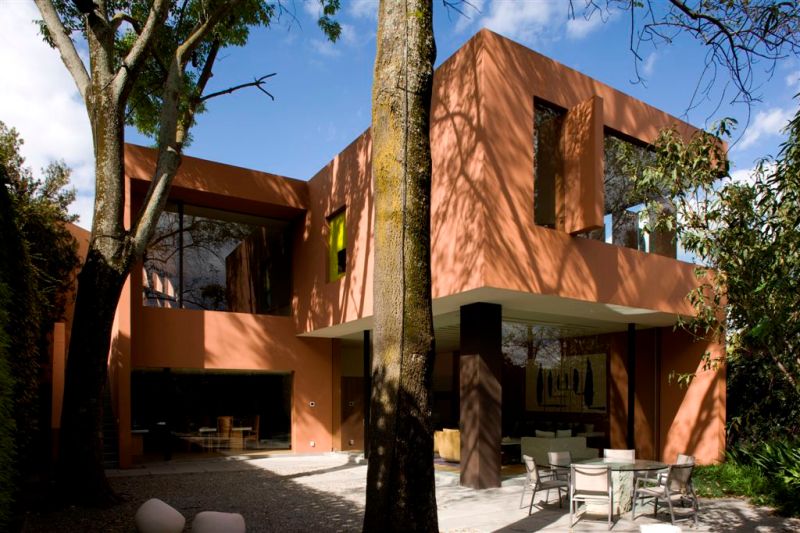
The Camino Real in Mexico City has always been a different kind of hotel. Turn off the thoroughfare in the Polanco neighborhood, past the anonymous wall, and you confront a bowl of water, at times sloshing around in its marble confines, then swirling and boiling, before coming to a temporary rest. The hubbub of the metropolis is gone.
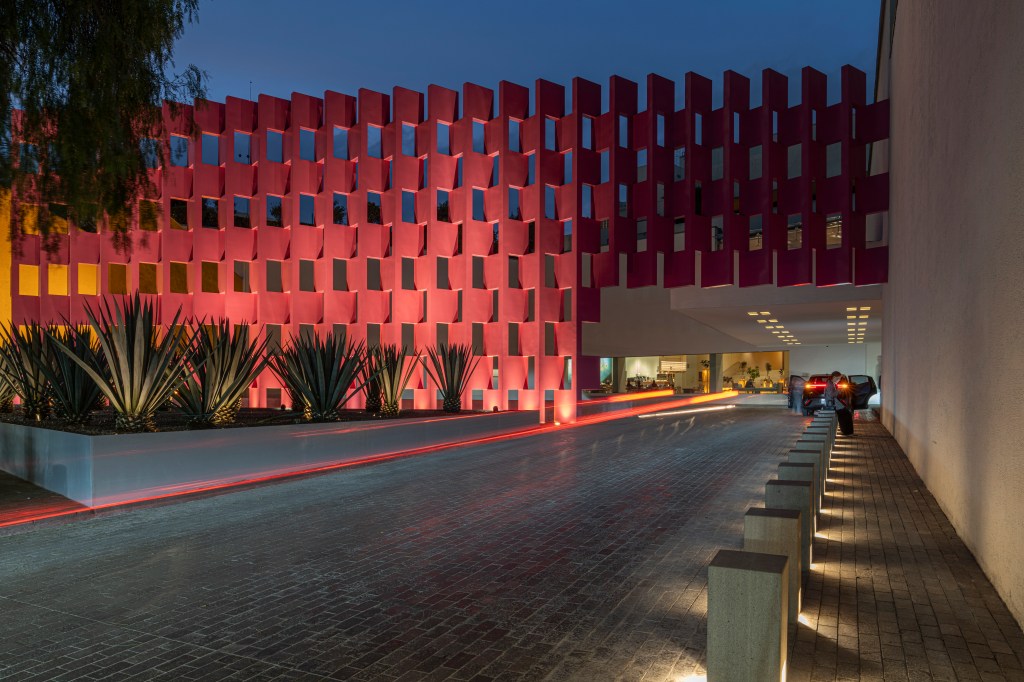
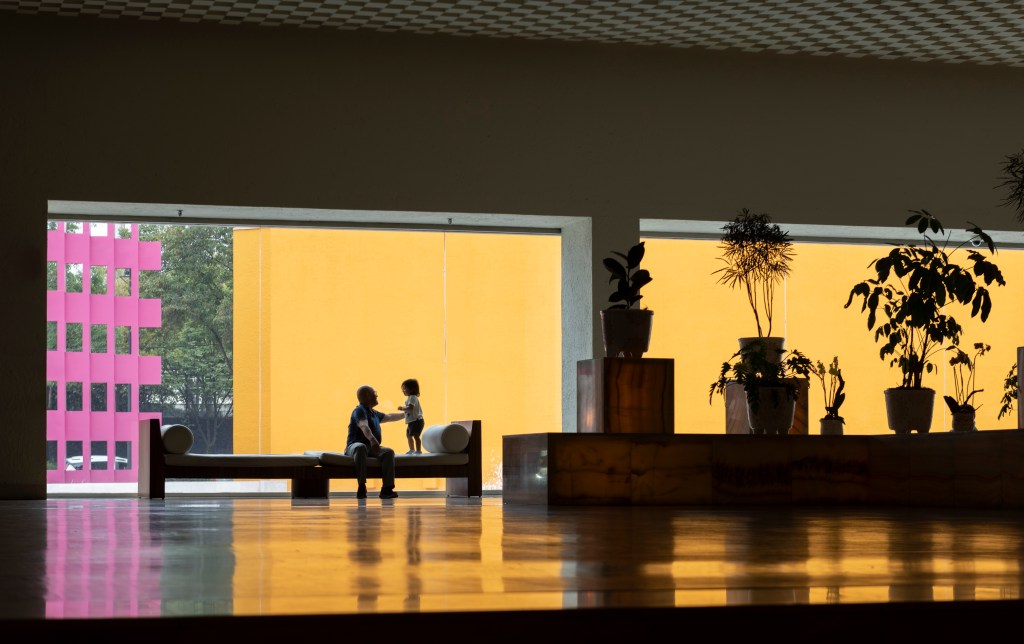
Walk through the low port cochere –more of an open porch—and into the first lobby, and you find yourself in an airy environment that then plunges down broad steps into the lower reception. Originally the floor was wood, adding a sensuality to the experience.
From there it is on through low, broad corridors and past gardens lush with plantings to your room, It is an ample, but simple affair where again the horizontal prevails and decoration is held to a minimum. I know of few large-scale, business-oriented establishments (the Camino has over seven hundred rooms) that are this elegant and restful.
The building was designed by Ricardo Legorreta, working with his master and mentor, Luis Barragan, who took charge of the garden layouts, and the artist Mattias Goeritz.
Over the decades since the building opened in time for the 1968 Olympics, it has held up reasonably well through various less-than-inspired renovations (like the one that replaced the wood with standard-issue hotel marble) and now is being refreshed and opened under the guidance of Victor Legoretta, the original architect’s son.
I was in Mexico City at this younger architect’s invitation to see how he and his small team, tucked into a multi-level office in the mostly residential neighborhood of Lomas Santa Fe, has carried on and developed the legacy of a designer who must of us see as the person who popularized, but also simplified and made more corporate, Barragan’s legacy.
What Victor Legorreta has done is to continue to work in that idiom of abstract, strong masses and colors, expansive spaces arranged in drawn-sequences, and compositions that emphasize the surprise that comes from hidden places and off-kilter elements, but to streamline it for a different time and place.
That place is still mainly Mexico, although the firm has and continues to work extensively in the United States and now has projects as far afield as Tanzania. The character is also what Barragan defined, in opposition to most of his peers, as a kind of essential and elemental interpretation of the colors, landscape, and cultural traditions of Mexico, even if what resulted might have been a bit of a fantasy.
What obviously keeps the Legorreta firm going is large-scale work such as office buildings and apartment blocks, but where they, like most architects, are able to continue to refine the particular architecture developed by Barragan and a very few others of his generation (Andres Casillas and Jose Iturbe come to mind), is in the design of single family homes.
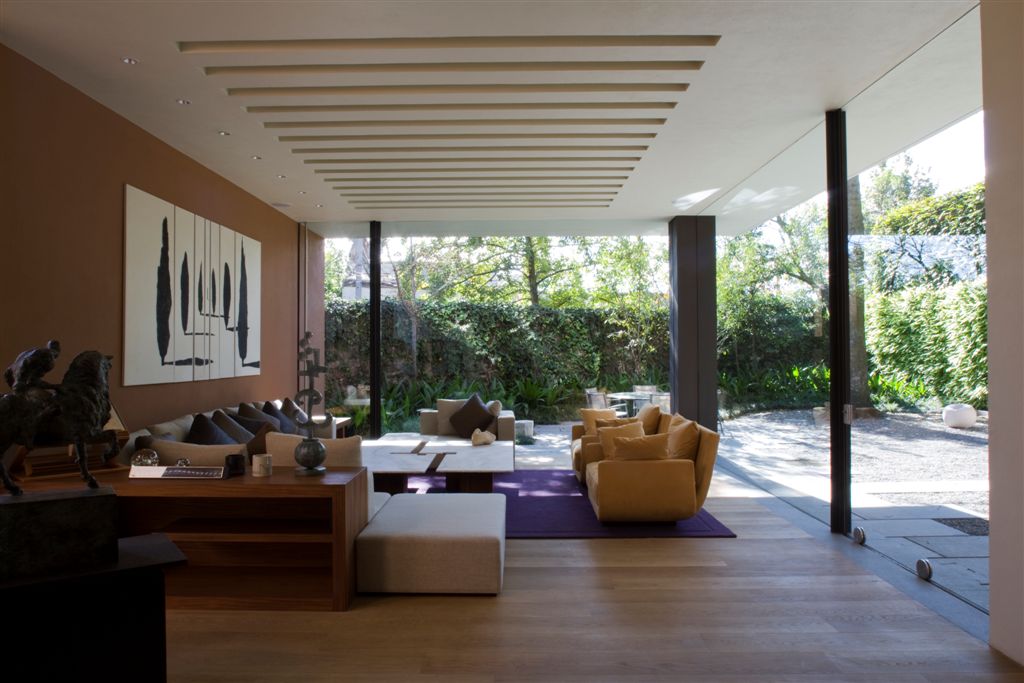
Victor Legorreta’s own house in Mexico City is a case in point. The elements you expect from a Legorreta project are all there: the cross-mullioned, but floor-to-ceiling window outlined in the particular kind of pink of which the firm is so fond; the few steps that take you up, then turn and split to follow the quicky section of what at first seems like a simple set of rooms that develops into a split-level rotation; the window placed high in the airy bedroom, covered with a wood shutter you open with a long pulley; the staircases bounded by a slotted screen, the inside of which is colored, tinging the whole center of the house; the pumping up of the scale of every room, both by stretching the dimensions longer and higher than you would expect, and by making walls heavy, and offset, so that they become masses with a sculptural presence.
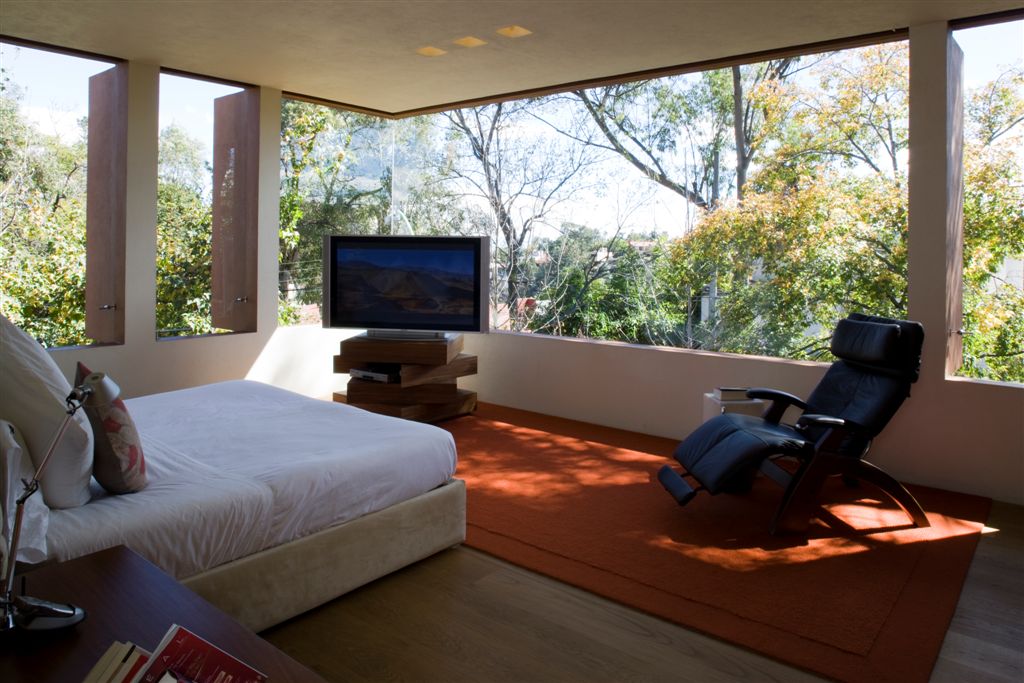
In this case, though, there is less weight and more expanse than in Ricardo’s Legorreta’s work. The intersections of planes are more pronounced and the cut-outs crisper, making the house seem less like a retreat carved out of a solid and more like an assembly of interconnected places to live. Perhaps the fact that Victor Legorreta worked for architects such as Fumihiko Maki influences that development.

At the weekend house Victor Legorreta designed for himself in Valle de Bravo, the community around a humanmade lake about two hours from Mexico City that functions like the city’s Hamptons, the drawing out continues to a sequence of spaces, from the entry porch, through a shift towards one axis from which one sees the barrel-vaulted living room, past a courtyard and bedroom wing, to another slight shift of axis, a few turns, and a continual opening up of diagonal vistas.
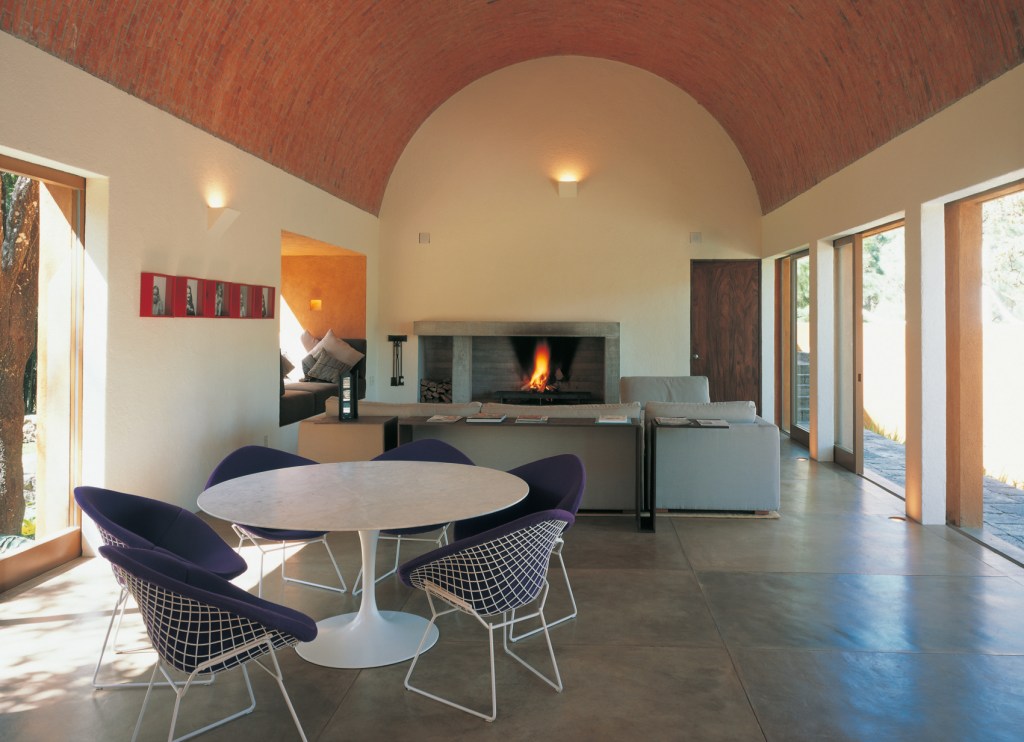
The end result is that you peel away planes and views as you move through the brightly colored, partially indoor and partially nature, spaces before entering into the solidity of the living area.
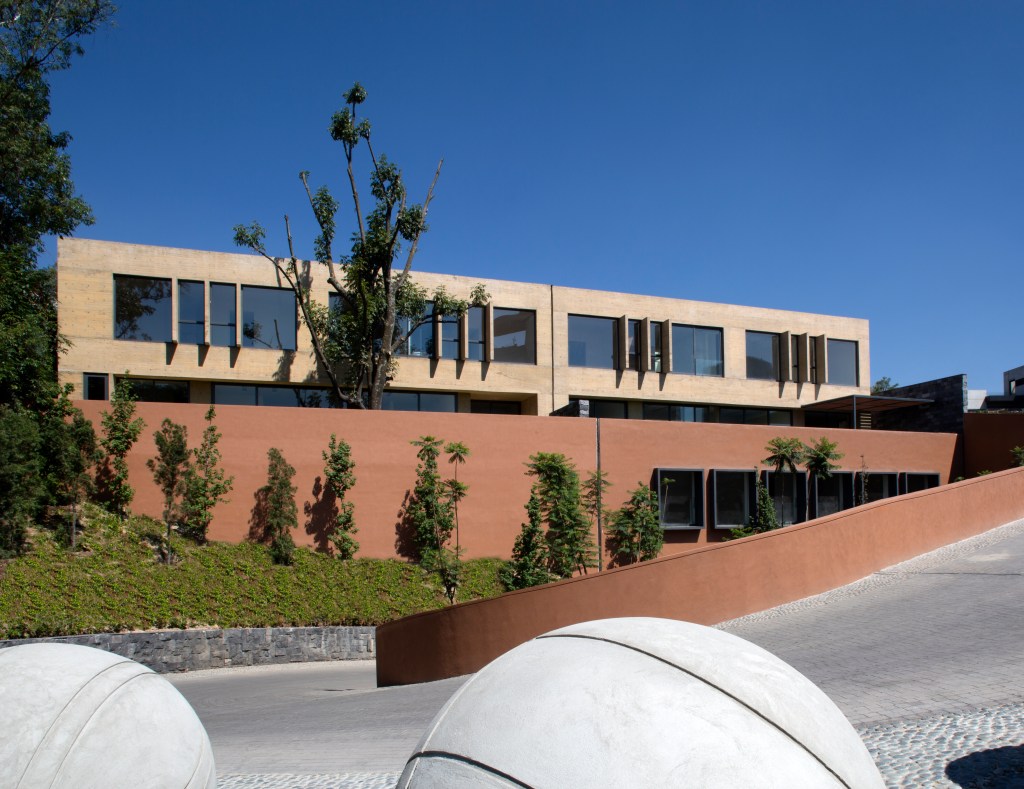
In some of the younger Legorreta’s houses, especially a complex of ten homes called La Petanca (the developer is a fan of that Basque form of boulle), the architecture becomes even more a game of abstract planes hovering, cantilevering, intersecting, and piling up to create a much more vertical spiraling of space than the father ever made. The compositions continue even onto the outdoor furniture and other garden elements, which become abstractions of the building’s overall mass.
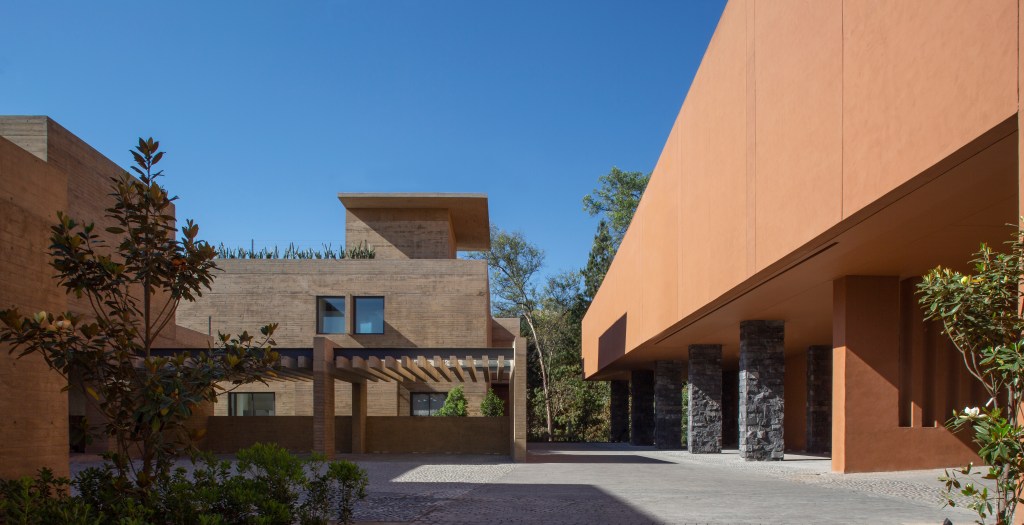
What the firm — which now also includes a niece among its junior partners and may soon welcome Victor Legorreta’s own son, Iván, who has graduated from architecture, into the fold, — has given up is some of the weight that is a hallmark of the particular traditions in which Legorreta worked.
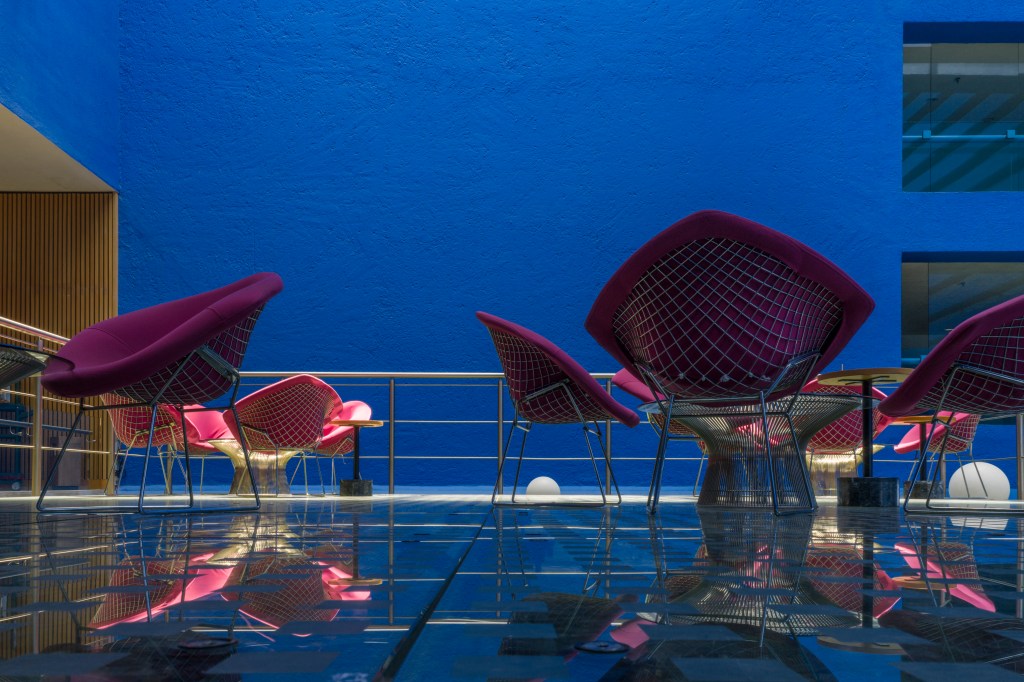
That is especially true in the larger-scale work, where technology and cost tend to shed the emphasis on underlining the place with what I imagine in drawings as being the equivalent of a fat piece of charcoal, preferably a pink, chartreuse, yellow, of purple one, in favor or more efficient housing. But even with the luxury of obviously well-heeled clients, the firm now prefers a cleanness and crispness. That much is certainly evident in the renovation of the Camino Real, where muted colors and textures and much spindlier furniture respond to our current tastes.
The danger, of course, is that the Legorreta firm will give up what made the work that came out of Barragan, Goeritz, and their compatriots so strange, grand, and even surreal. What they gain is architecture hewn out of the compositional techniques, color palette (however edited) and strong command of sequence that defines a Legoretta project against the standard wood, glass, and steel hives that have become the default homes of the rich and famous.
The Legoretta’s still have something to offer of great beauty and seductive eeriness, and their attempts to not only ascertain its fullest reach in those monumental homes, but to draw it out into the more everyday places of work and play makes for an architecture worth following.
The views and conclusions from this author are not necessarily those of ARCHITECT magazine.
Read more: The latest from columnist Aaron Betsky includes reviews of: Mexico City Underwater | On Vitruvius | On Olive Development | Calder Gardens | White House and Classical Architecture | Louis Kahn’s Esherick House | Ma Yansong’s Fenix Museum | The Cult of Emptiness | An Icon in Waiting | Osaka Expo | Teamlab | the Venice Biennale of Architecture | On Michael Graves | On Censorship or Caution? | Uniformity in Architecture | Book on Frank Israel | Legacy of Ric Scofidio| Fredrik Jonsson and Liam Young | DSR’s New Book | the Stupinigi Palace | Living in a Diagram | Bruce Goff | Biopartners 5 |Handshake Urbanism | the MONA | Elon Musk’s Space X | AMAA | DIGSAU | Art Biennales | B+ | William Morris’s Red House | Dhaka | Marlon Blackwell’s new mixed-use development | Eric Höweler’s social media posts,| Peter Braithwaite’s architecture in Nova Scotia,| Powerhouse Arts, | the Mercer Museum, | and MoMA’s Ed Ruscha exhibition.
Keep the conversation going—sign up to our newsletter for exclusive content and updates. Sign up for free.