Why has the United States not developed any alternatives to the suburban development? The notion of the single-family home, built in a completely standardized manner (who says we don’t apply mass production techniques to architecture) sited on a curving street, preferably a cul-de-sac, with a driveway out front, a garage next door, and a yard behind, is a model vouchsafed by both culture and the economic structures that have grown up around it, not to mention memory and tradition.
In recent years, it has been joined by cheaper alternatives, including suburban rowhouses, Type 3 honkers, and “manufactured” housing (trailer parks), but the model still stands as the ideal American home.
On Olive: An Aspirational Urban Suburb?
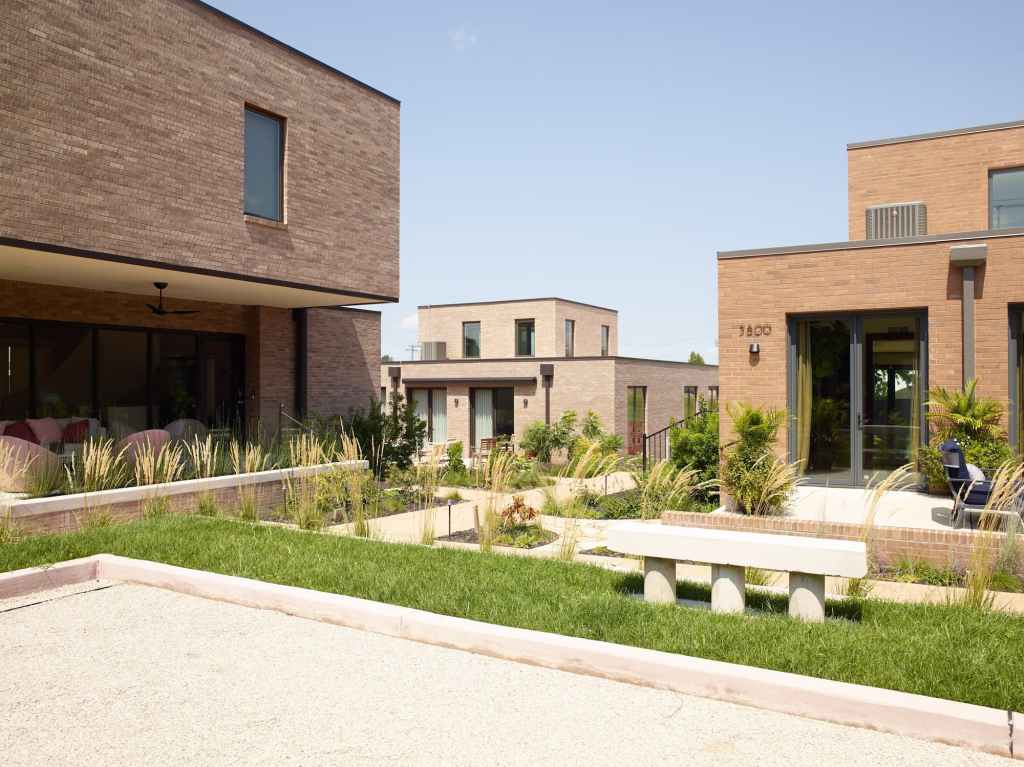
In St. Louis, art Maecenas Emily Rauh Pulitzer is trying to offer an alternative. On a long lot in a bombed-out part of the city now dubbed the Grand Center Arts District, where she has also built her contemporary art center, she has developed seventeen million dollar-plus homes arranged in a hopscotch pattern on a shared lot.
Almost finished, On Olive is almost completely sold out, and Pulitzer is now planning an expansion across the street. Could this mode of making a suburban city, albeit within city limits, offer an upscale, and thus aspirational, alternative to the safe suburban home?
Architectural Ambition Meets User Reality
A few weeks ago, Washington University architecture Chair Aki Ishida took me to find out. What we encountered was a work in progress. That is not only because not all the houses were finished, but also because in almost all of them the buyers had asked for extensive remodeling of the interiors.
This points to what I think is the largest problem with the designs: laid out by the Mexican architect Tatiana Bilbao (though One Olive also made considerable changes to her original sketches), the houses were designed by her and the also Mexican firms Productura and Estudio Macias Peredo, as well as by the New York-based MOS.
Breaking the Suburban Mold—Or Not?
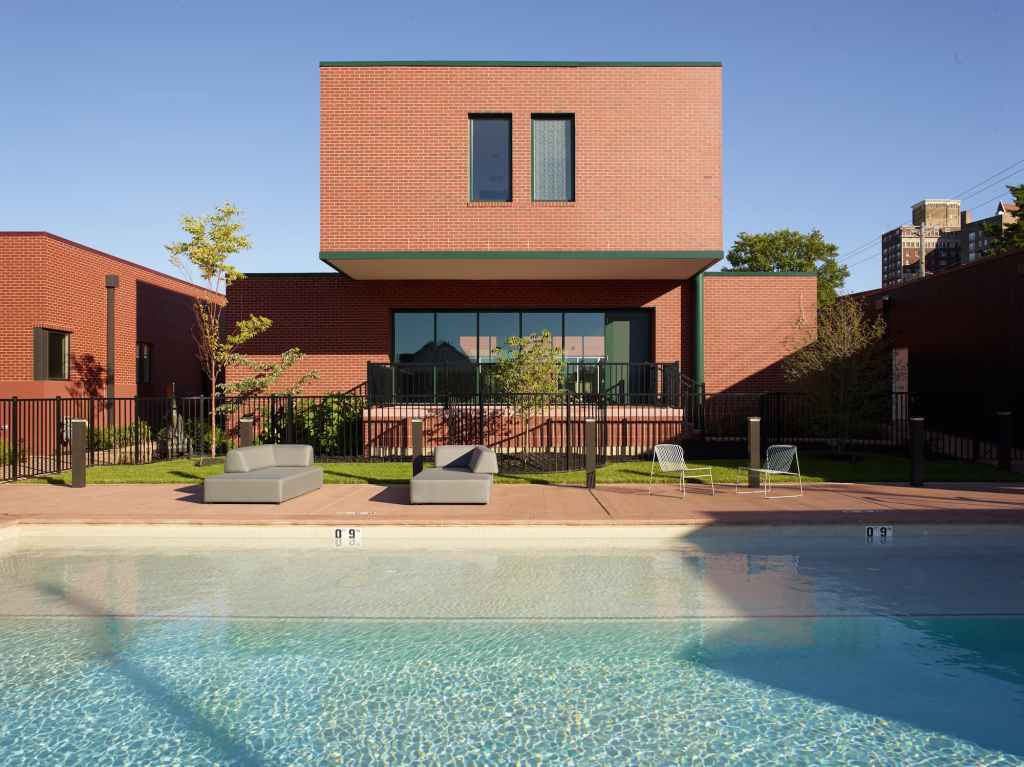
All four of the designers tried to open the suburban home, creating flowing spaces and breaking the box with cantilevers and pop-ups. The thin slot bisecting the houses Productura designed, and the spiral staircase Bilbao installed in her designs stand out especially for their drama and beauty.
Unfortunately, the layouts almost all ignore the realities of suburban living. Each of the ones we visited felt cramped, despite their oversized windows and double-height spaces.
Moreover, in every structure the buyers were hiving off open space or already had done so for more bedrooms, bigger bathrooms, and other enclosures that befit the way they envision leading their lives in these structures.
Site Constraints and Design Limitations
Part of the problem is also the restrictions of the site. None of the houses rises above two stories above the ground, and most of them are only one story. To compensate for this restriction, which was part of One Olive’s attempt to create an intimately scaled community, the living spaces extend down into the basement.
This means that many of the bedrooms and living areas are dimly lit caverns with narrow clerestories pleading the sky for views and illumination. At between two- and four-thousand square feet, the houses are not small by any definition, but I am afraid all feel that way – or you could say they are intimate.
A Uniform Village with Individual Tweaks
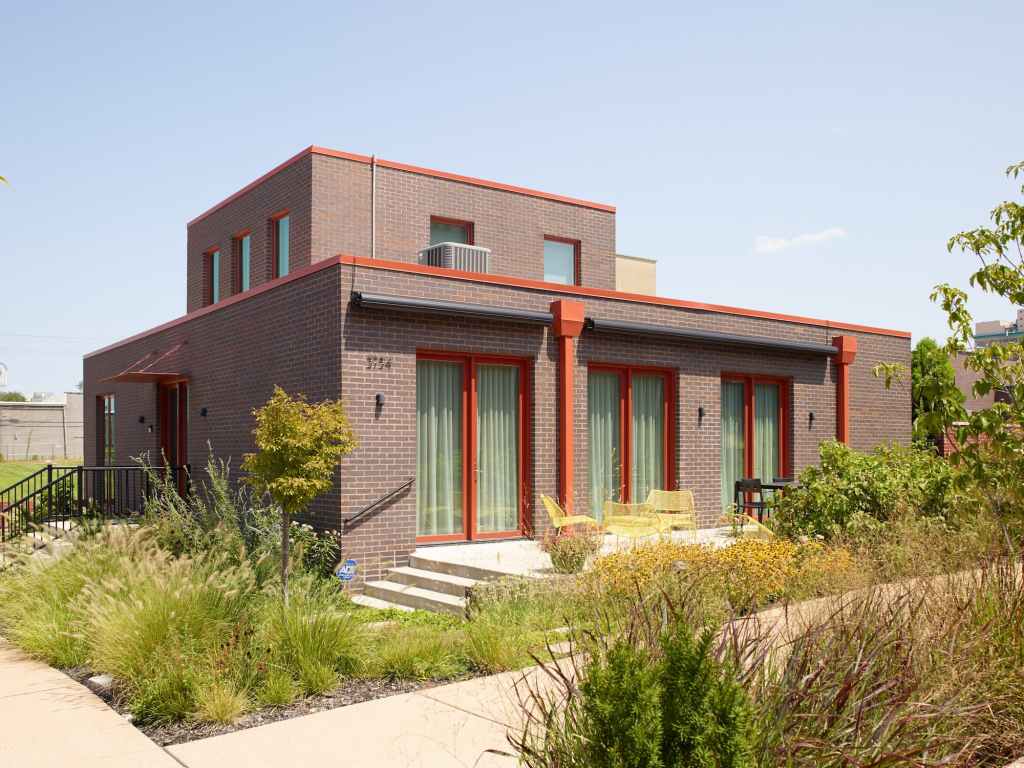
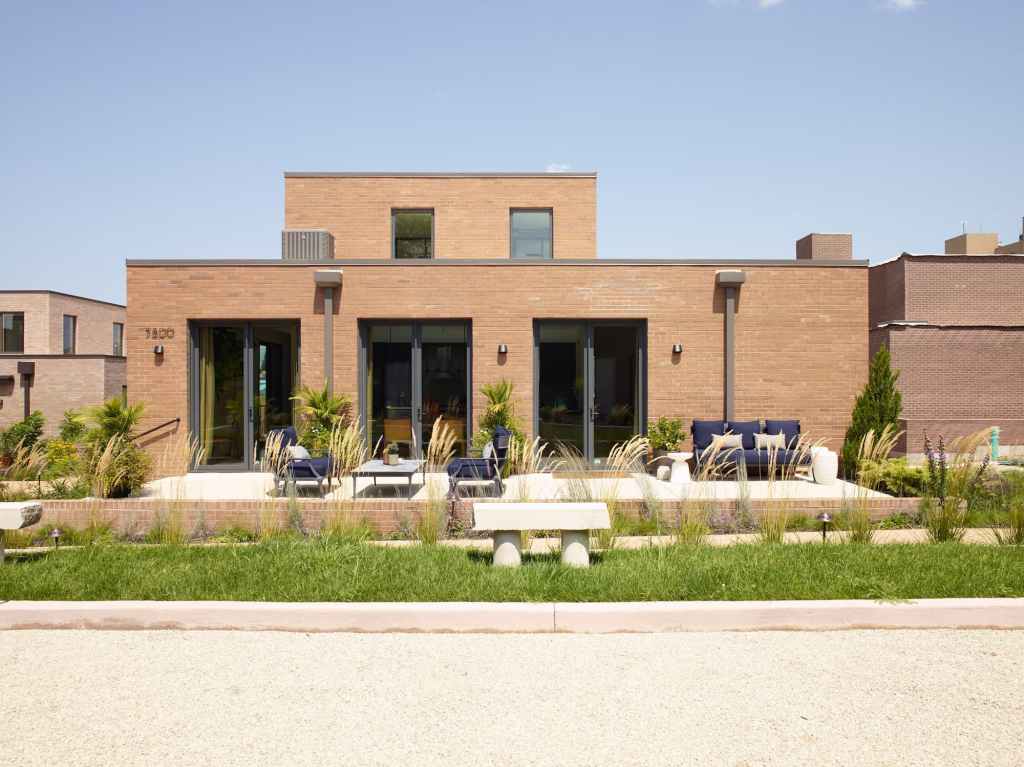
The desire to create a unified community also means that all the houses are variations on brick-clad boxes. Bilbao had originally sketched sloping roofs, but here these flat-roofed volumes with their paper-thin ceramic facades spend a lot of time trying to distinguish themselves with the limited means the restrictions allow them.
MOS’s expressed chimneys, originally designed to have both interior and exterior (fake) fireplaces, are the most expressive of these. Peredo, on the other hand, tried to vary the box on the façade itself by creating a stucco base that pushes up and down against the brick covering of the house’s main volume. On all the houses, applied downspouts either punctuate the planes or give them a cheap aura, depending on your perspective.
Outdoor Spaces: The Project’s Quiet Triumph
The outdoor spaces are much more successful. Designed in an ad hoc manner by the On Olive team (I could not obtain the name of a landscape designer), they ramble past the houses, spouting native planting and moments for contemplation, dog walking, or gathering for a barbeque.
They are outfitted with all kinds of amenities, which extend into the provision of a swimming pool, gym, and other clubhouse facilities in a historic building On Olive renovated to also house two condominiums. The push and pull of the volumes and their staggered setting on the long lot offsets any sense of repetition or axis, making the whole appear more like the organic village it is meant to be.
The skill with which these spaces are designed makes the closeness of the houses much less of a problem than you would think it would be.
Cultural Blind Spots in Suburban Reinvention
However much I respect the architects and the developer who made On Olive happen, I think their lack of familiarity with the basic type they were trying to fix shows.
I doubt any of them grew up in standard suburban homes (though I know Pulitzer was raised in midcentury modern versions of that type), and it shows in the awkwardness of the houses’ interior arrangement.
Moreover, the site’s ambivalent status as not-quite-suburban, as it is rather a colonization of a void left by St. Louis’ urban decline, makes this also not quite a test case.
The Market Speaks—Loudly
On the other hand, I might be speaking with my own elitist bias. The fact that the houses not only sold but did so at prices higher than On Olive originally envisioned, indicates that there is a market, and thus a desire, for this kind of alternative no matter how awkward its spaces might seem. Perhaps the developers will learn from the changes the buyers demanded in the second phase.
Lessons from Hotel Design?
While I was in St. Louis, I stayed at the local branch of the 21c Hotel chain. A self-proclaimed “museum hotel,” it was started by another couple of wealthy art collectors, Laura Lee Brown and Steve Wilson, in Louisville.
I have always admired how these hotels combine a finely honed aesthetic with the logic that makes for a comfortable hotel room. That is because when Brown and Wilson started, they hired their team away from W Hotels.
It made me wonder: what if One Olive had brought in people from, say, Toll Brothers, or another producer of that awful wash of wasteful wannabe mansions covering the prairie beyond St. Louis’ border? Would it have made for a better development, or would these stick builders have overwhelmed good intentions with bad practices?
A Vision of Nellyville
And yet again, I could not help but wander through On Olive humming the great paean to a utopian suburbia, written by local hero Nelly to myself; perhaps he could consult?
Welcome to Nellyville, where all newborns get a half-a-mill’
Sons, get sedan DeVilles, soon as they can reach the wheel
And daughters, get diamonds the size of their age – I’m talkin’
One year get one carat, two years get two carats
Three years get three carats, and so on into marriage
Nobody livin average, everybody jang-a-lang
Nobody livin savage, e’rybody got change
Even the paperboy deliver out the back of a Range
It’s not a game, it’s a beautiful thang
Imagine blocks and blocks of no cocaine, blocks with no gunplay
Ain’t nobody shot, so ain’t no news that day
Ain’t nobody snitchin, they refuse to say
Every month – we take a vote on what the weather should be
And if we vote it rains – know how wet we want it to be
And if we vote it snow – know how deep we want it to get
But the sun gon’ shine 99 percent, in Nellyville…
Think that’s cool? 40 acres and a mule
Fuck that! Nellyville – 40 acres and a pool
Six bedrooms, full bath with a jacuzz’
Six-car garage, pavement smooth
Both front and back deck ‘nough room to land a jet
And you ain’t reached the city, that’s just the projects
There’s no. way. I. I could explaiiiiin.
The way I feel right now
There’s no. way. I. I could explaiiiiin.
The way I feel about livin in Nellyville
The views and conclusions from this author are not necessarily those of ARCHITECT magazine.
Read more: The latest from columnist Aaron Betsky includes reviews of: Calder Gardens | White House and Classical Architecture | Louis Kahn’s Esherick House | Ma Yansong’s Fenix Museum | The Cult of Emptiness | An Icon in Waiting | Osaka Expo | Teamlab | the Venice Biennale of Architecture | On Michael Graves | On Censorship or Caution? | Uniformity in Architecture | Book on Frank Israel | Legacy of Ric Scofidio| Fredrik Jonsson and Liam Young | DSR’s New Book | the Stupinigi Palace | Living in a Diagram | Bruce Goff | Biopartners 5 |Handshake Urbanism | the MONA | Elon Musk’s Space X | AMAA | DIGSAU | Art Biennales | B+ | William Morris’s Red House | Dhaka | Marlon Blackwell’s new mixed-use development | Eric Höweler’s social media posts,| Peter Braithwaite’s architecture in Nova Scotia,| Powerhouse Arts, | the Mercer Museum, | and MoMA’s Ed Ruscha exhibition.
Keep the conversation going—sign up to our newsletter for exclusive content and updates. Sign up for free.