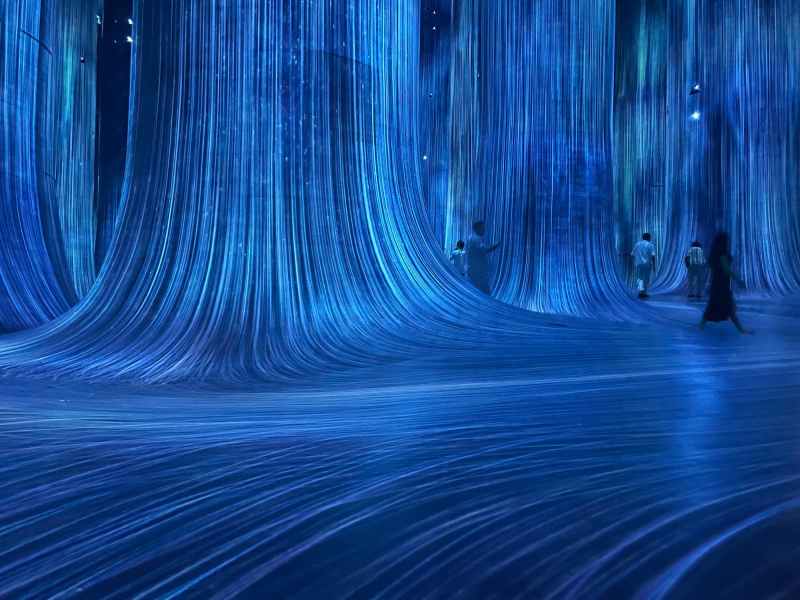
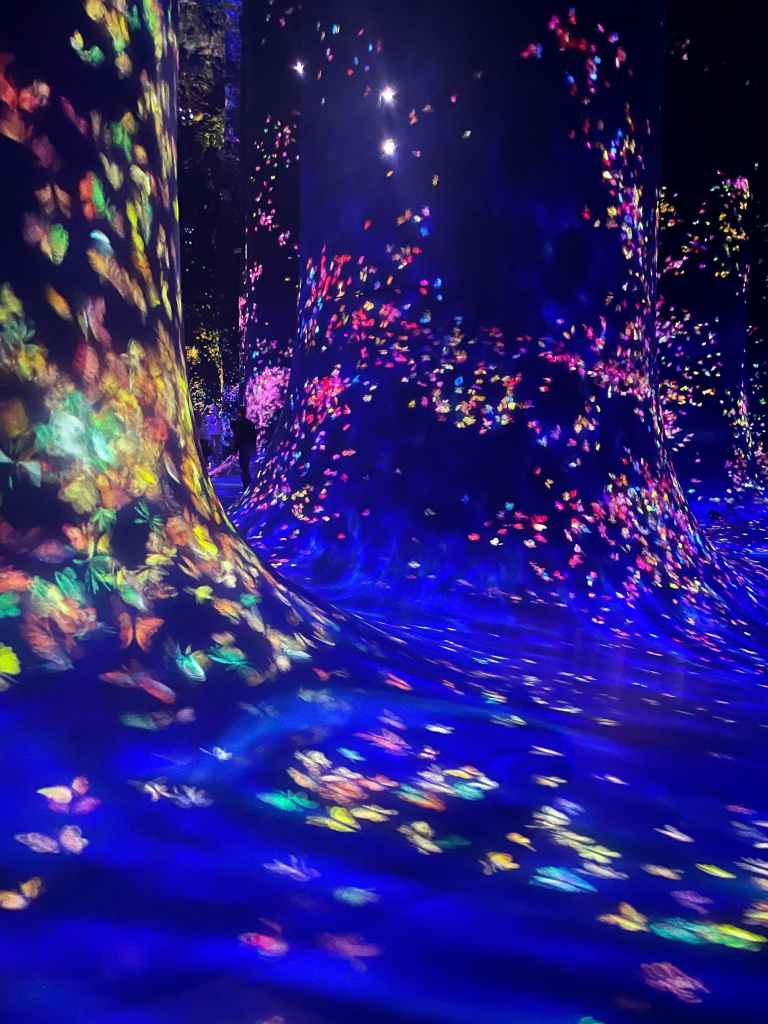
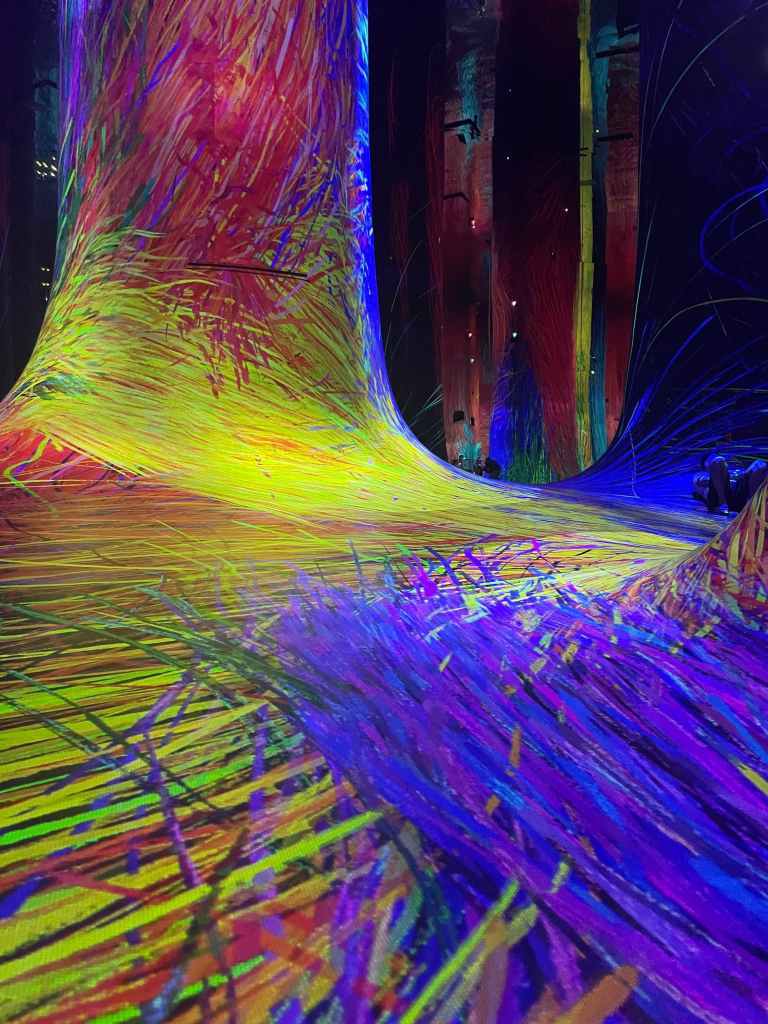
A forest of lights flows all around you. Lines of every color pulse and race up curved forms you discern only by walking along their surfaces. Storms of butterflies appear, then fade away, leaving a flickering of lights punctuating the trunks of trees without roots or flowers. Then the rainbow of color starts coursing around you again, leaving you lost in this forest with no trees.
This is indeed a rebuttal of the old saw that you cannot see the forest through the trees, but not just because the individual elements are missing: there is nothing growing in the space the electronic wizards of Teamlab have carved out of their purpose-built display setting in Abu Dhabi. It is one of several permanent, Disney-like immersive exhibitions the group maintains, along with having pieces on display in museums all around the world and in such public venues as the Singapore airport. At the heart of their art –if you can still call it that—is the projection of images all around you in a way that hides the sources and edges of what you are seeing as completely as they can.
Immersion Versus Spectacle
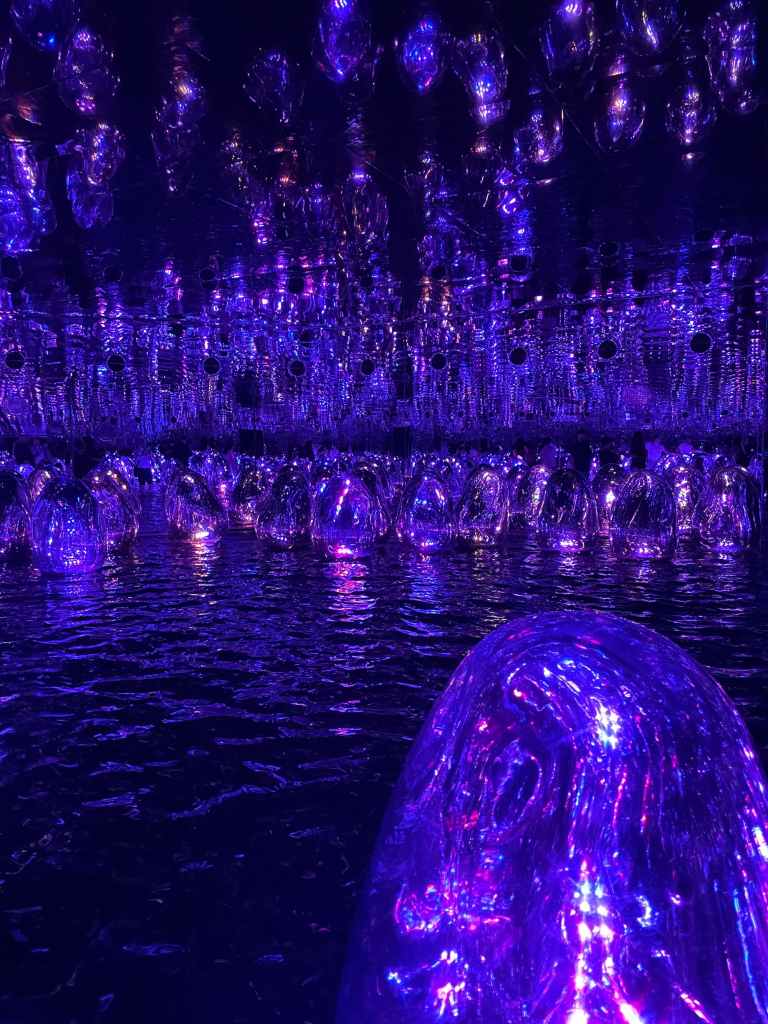
Most of the imagery is an abstract pulsing and streaming of colored stripes, blobs, and oozes, but Teamlab also (and, in my mind, unfortunately) resorts to such crowd-pleasing elements as those butterflies and an array of both imagined and real flowers. In some cases (including in one of the rooms in Abu Dhabi) they make you take your shoes off to wade through shallow water you share with physical blobs bobbing around you. They also use foam and mist, which further blurs the distinction between real and unreal, but also at times makes you aware of that distinction a bit too much. And, as unfortunate as the animated cartoons imagery and the not-quite successful clouds are the New Age meanderings of the music soundtracks. But the effect at its best is overwhelming and beautiful.
From Code to Canvas — The Evolution of Teamlab
Teamlab started with the experiments in electronic art by Toshiyuki Inoko and Shunsuke Aoki when they were still students at the University of Tokyo in 1998. They were among a cohort of young artists who picked up on the new possibilities opened by digital technologies, and, when I was a curator at the San Francisco Museum of Modern Art, we showed their work among other such forays into post-meat space art as among the most avant garde and successful. Over the years Teamlab have expanded the scale and scope of their work and it has proven immensely popular. This has led to a feed-back loop in which all that interest had provided them the means to push the immersive and evocative aspects of their art further, which in turn has attracted bigger audiences paying higher fees (to get into the Abu Dhabi space will cost you almost $40) that then ooh and aah at spaces that feed their interest with softer and more realistic forms than the artists originally used.
The effects have become slicker not just because of the advances in technology and Teamlab’s ability to afford such wizbang soft- and hardware, but also because they can now create purpose-built spaces such as the ones in Abu Dhabi, contained in a stand-alone buildings, in this case of forgettable and badly resolved architecture credited to a local architecture firm called MZ. Like Disney, they have learned how to seduce you away from reality into a realm they control completely, making them able to create a complete alternative to the sunbaked desert urbanism around the air conditioned and scented rooms.
The effect is, for all my criticism of its crowd-pleasing tendencies, magical and often awe-inspiring. To walk through that virtual forest, with its shapes and colors changing your perception of its size, depth, and very nature, immediately releases you from the reality you left behind when you bought your ticket. As you move from there to some of the other displays you experience seemingly endless new vistas or kaleidoscopes that twirl and twist all around you. One of the spaces is a planetarium of universes expanding and contracting, before turning into fields of organic matter blooming into continuous carpets. The space with the pool of water recalls the festivals of floating lanterns in China. The illusions blossom everywhere. Only when you hit a corner or notice the twinkling of a projector does the magic come to a halt.
The Disneyfication of Digital Art
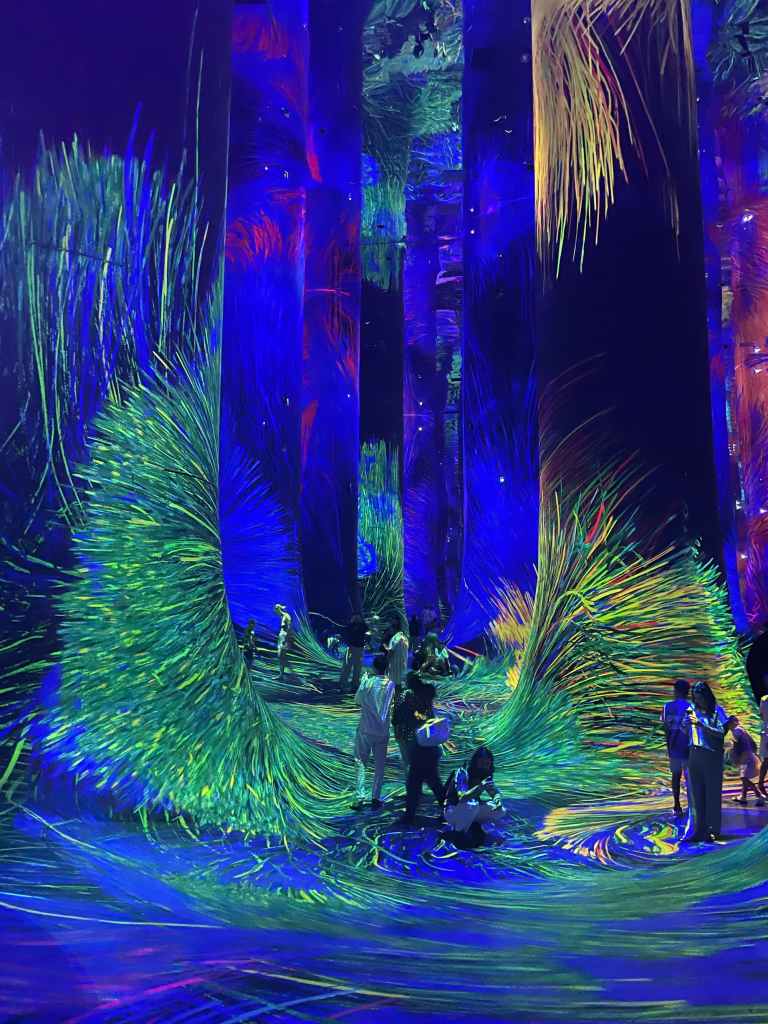
What Teamlab have been able to do is to create a fantasy in space after space that, aside from those few moments, is seamless. They have, in other words, applied the lessons of Disney’s imagineers, who always make sure that nothing intrudes on your sense of being in the fairy tale place to which they have transported you, to the world of ephemeral or digitally-based art.
In pursuing this kind of perfection, they have used shortcuts, ranging from the curves built into the buildings to the ways in which their references to things we know to be large –the universe—or continually changing and blooming –flora and fauna—help us make the leap into something that might leave us otherwise a bit uneasy. And that is the problem. Instead of even a bit of the terror that might come from a leap into the electronic unknown, they give us the beauty of familiar and comforting forms that just happen to be digital hallucinations. You can wonder, but you are soothed at the same time.
Abu Dhabi’s Purpose-Built Wonderland
On the other hand, the awe Teamlab has been able to produce goes far beyond what famous architects such as Jean Nouvel, whose Louvre Abu Dhabi is this building’s neighbor, have been able to achieve with hundreds of millions of dollars of investment and a lot more concrete and steel. That their spaces are real (or, in the case of Frank Gehry’s Guggenheim and Norman Foster’s National Museum, both still under construction in the same neighborhood, will be real) and perhaps more subtle might make them more meaningful, but an hour or two of luxuriating in the worlds Teamlab has created made me question the equation. Only the art the Louvre contains and makes accessible for about the same price as the Teamlab ticket, takes us not only out of our current state, but into more complex and meaningful worlds.
The views and conclusions from this author are not necessarily those of ARCHITECT magazine.
Read more: The latest from columnist Aaron Betsky includes reviews of: the Venice Biennale of Architecture | On Michael Graves | On Censorship or Caution? | Uniformity in Architecture | Book on Frank Israel | Legacy of Ric Scofidio| Fredrik Jonsson and Liam Young | DSR’s New Book | the Stupinigi Palace | Living in a Diagram | Bruce Goff | Biopartners 5 |Handshake Urbanism | the MONA | Elon Musk’s Space X | AMAA | DIGSAU | Art Biennales | B+ | William Morris’s Red House | Dhaka | Marlon Blackwell’s new mixed-use development | Eric Höweler’s social media posts,| Peter Braithwaite’s architecture in Nova Scotia,| Powerhouse Arts, | the Mercer Museum, | and MoMA’s Ed Ruscha exhibition.
Keep the conversation going—sign up to our newsletter for exclusive content and updates. Sign up for free.