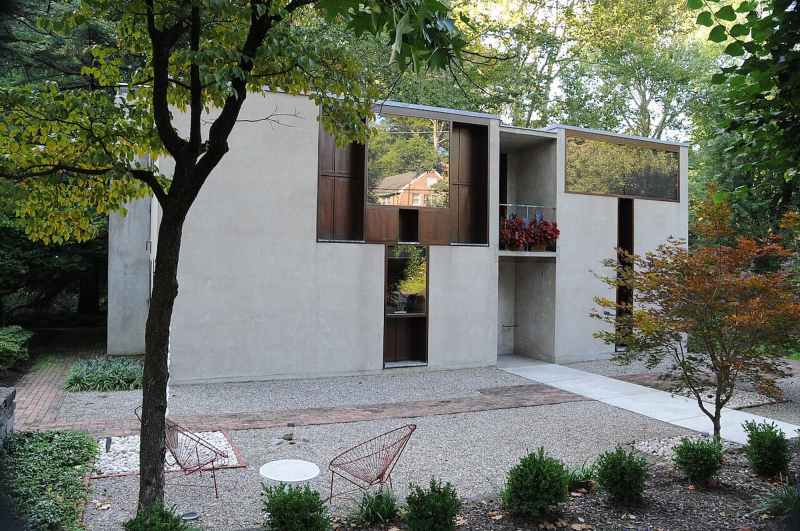
Art can abstract and condense a part of the world into an artifact that heightens our awareness of the elements that make up the reality within that frame. That achievement is also evident in those buildings that are architecture. I had the pleasure recently of experiencing an instance of amazing architecture in a small house: Louis Kahn’s 1961 Esherick House in Chestnut Hill, Pennsylvania. It is an emblem of something at the core of American culture: the suburban home.
We live about half a mile from the house, and I had taken visitors to see it (along with Robert Venturi’s Vanna House, 1964, just down the street) several times. I had not been inside, however, since my undergraduate friend and Philadelphia native, Jonathan Sawyer, and I had talked our ways into the home during my first trip to the city in the 1970s.
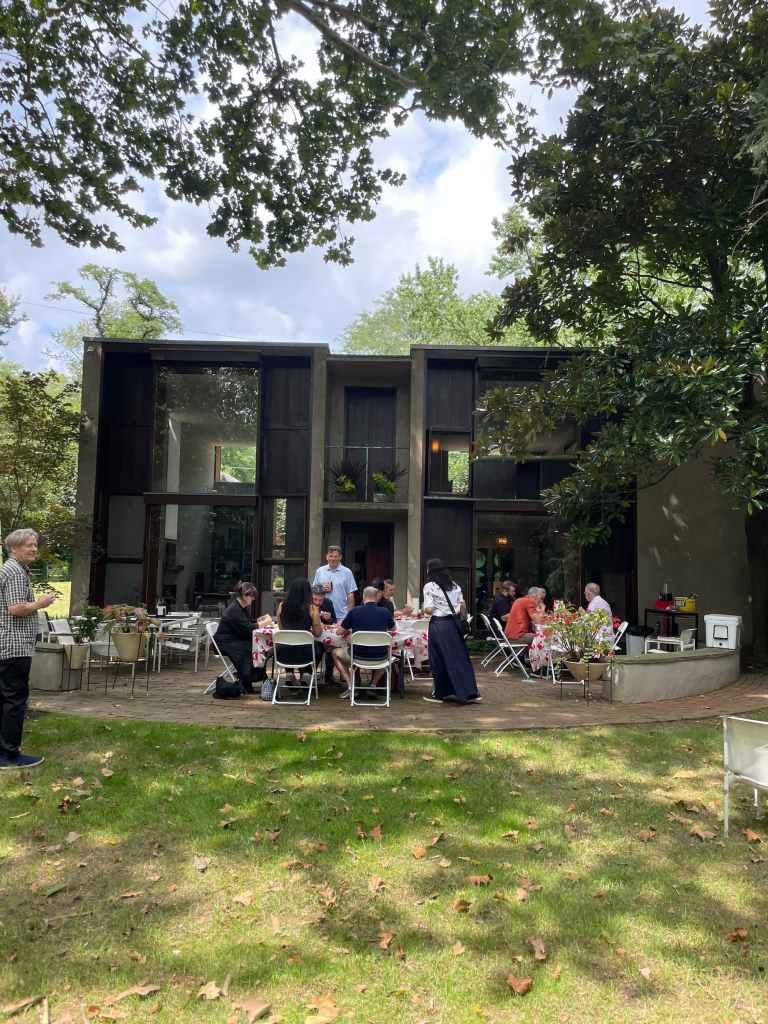
This summer its current owners, Dan Macey and Paul Savidge, hosted a “Kahn and Crabs” feast for our local chapter of Docomomo, the international organization that concerns itself with the preservation of modern monuments, and I was able to wander around and through its fully restored forms.

The house is a box Kahn divided not quite equally into two more boxes. The one to the right of the entrance as you view the building from the street is a two-story living area, while to the left you find a dining area on the ground floor with the sole bedroom above.
In-between the two parts is a central corridor and staircase. To the left of the dining area Kahn tucked in a service section containing the kitchen, bathrooms and utilities and, on the second story, the bedroom’s bath and closet, as well as a study area.
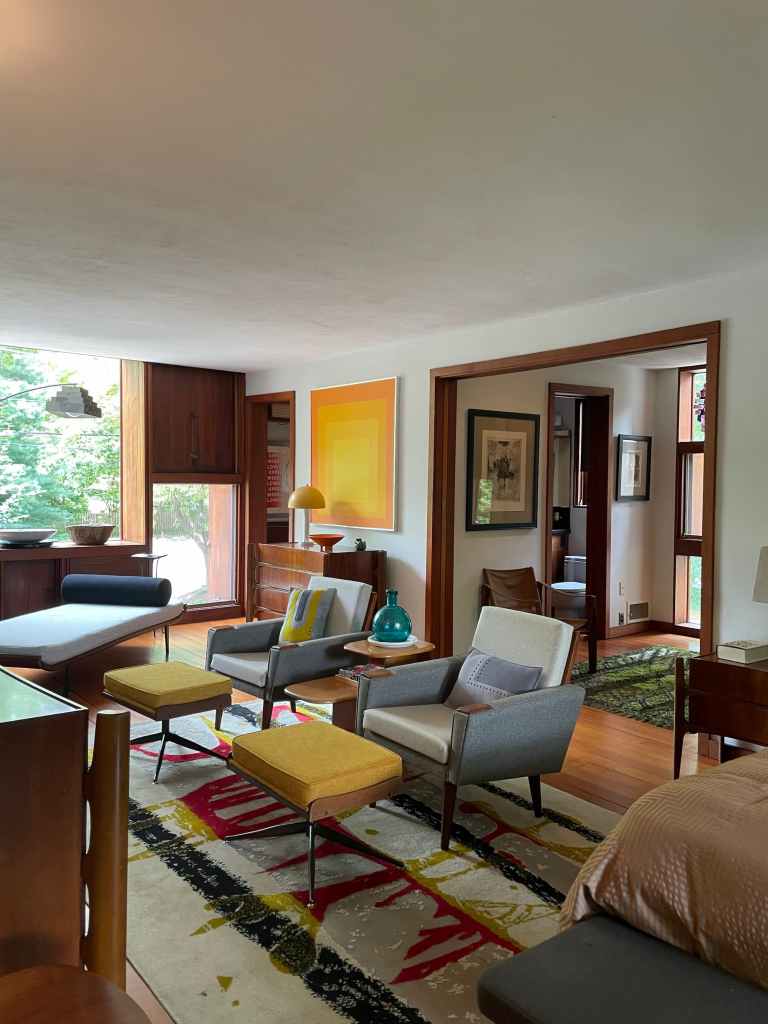
Protruding from the two-story volume is a fireplace and chimney. The whole adds up to about two thousand square feet.
Kahn presents this composition in what appears to be a simple manner. He clad the concrete block structure with stucco painted an off-white and framed all the windows in dark-stained wood.
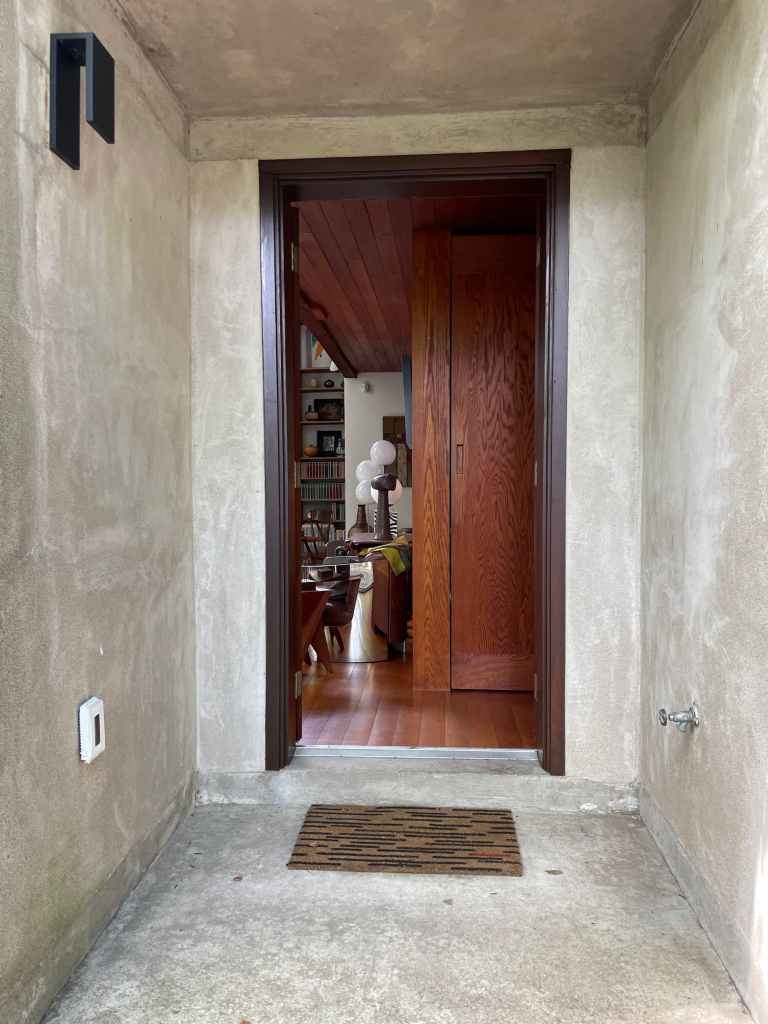
Then you might notice what there is not. There are no other gestures or additions other than the fireplace element and an adjacent carport. There is no base, no visible roof, no protruding eaves. You are protected from the elements in front of both the front and back door not with any porch, but because the entrances are recessed. There are no other materials, no gestures, no references to domesticity. You get just the fact of the building placed on a meadow next to a dead-end street.
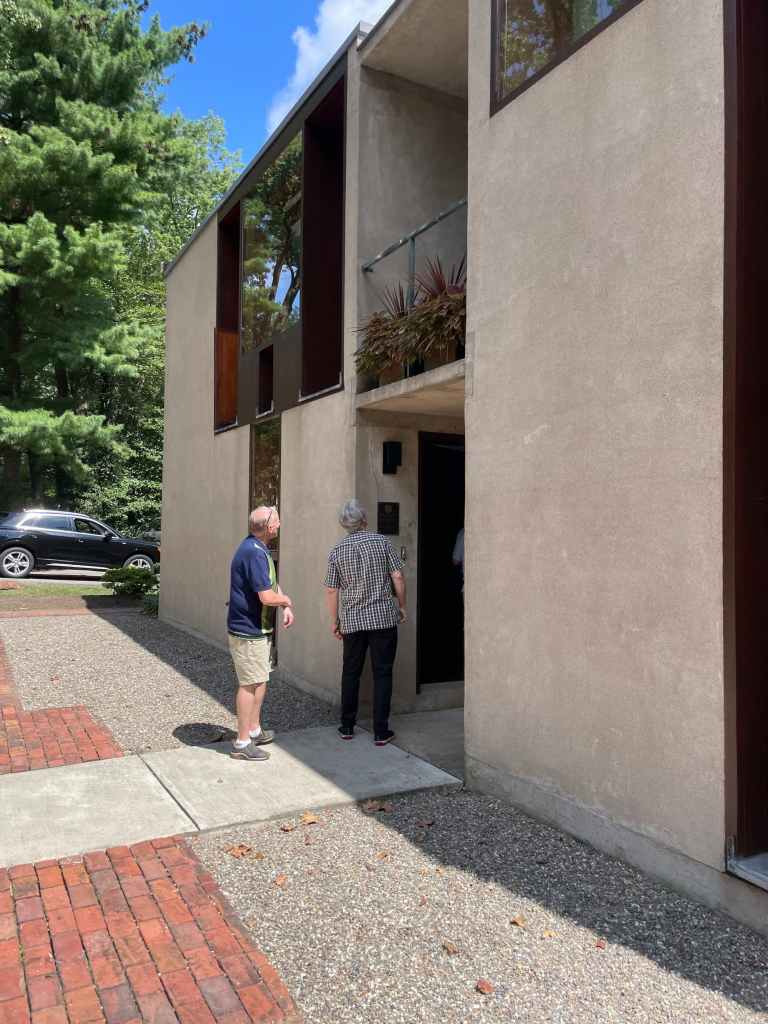
It is from there that the complexity and contradiction, as the architect of the Vanna House would have it, begin. The front is, as befits a (semi)rural villa, more closed and formal.
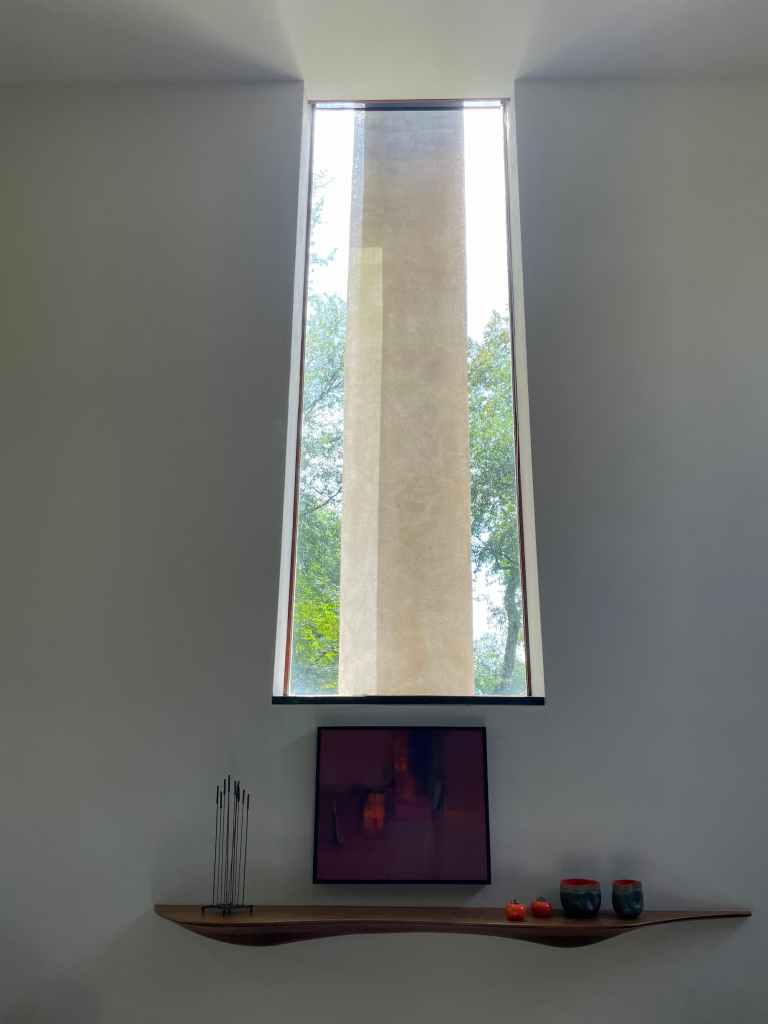
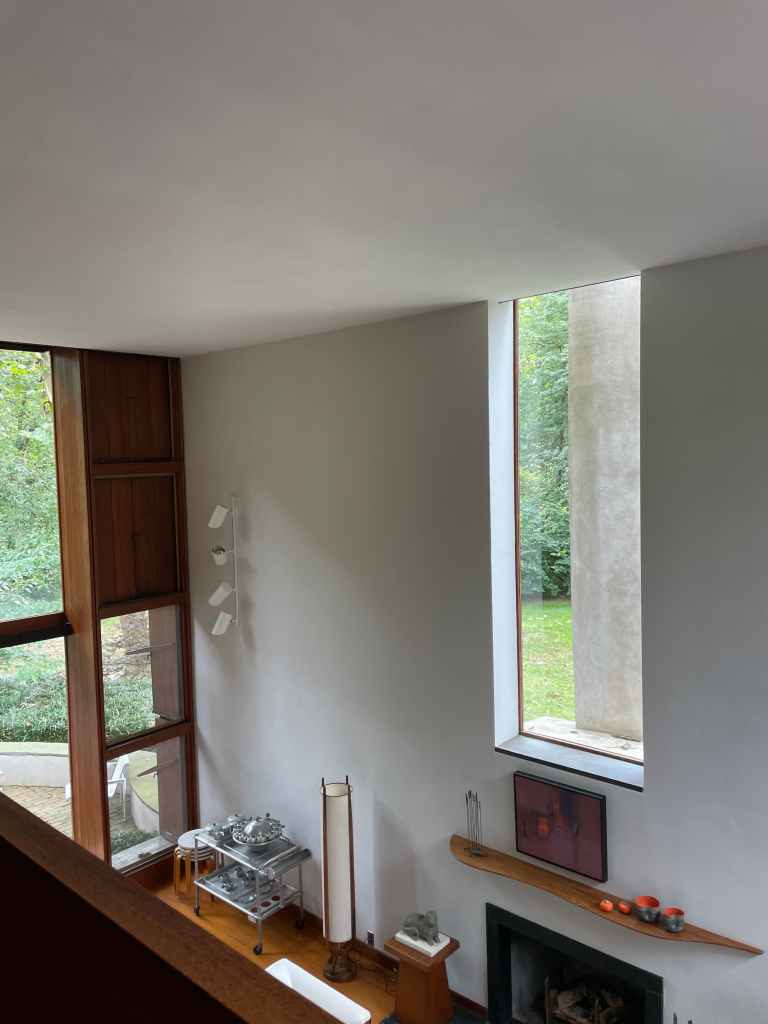
A clerestory light consisting of a single pane runs along the top of the living room wall, supported, at least visually, by a column of wood-framed glass. The fireplace signs the domestic warmth inside. The study area next to the only bedroom has a square window flanked by two sidelights, themselves split in the middle. That pane also has it columnar window support. Because about a third of this volume is taken up by the service elements, however, this collection of glass-in-wood is off-center. The entrance between these unequal halves is a shadow-catching slit containing the entrance portico and a balcony above.
The rear consists almost completely of windows. In both halves, large glass panes dominate symmetrical sidelights, again split down the middle into two panes. The one difference in the two halves’ compositions, other than that the bedroom side is one-third smaller, is that a wood-paneled section at eye height on the second floor gives some privacy to the bedroom; Kahn broke that mask with small window that provides a framed view. The back door has its own window above, breaking up the array of glass, wood, and stucco into the kind of loose composition that in good villa tradition contrasts to the formality of the front. The sides, which you can barely see, have few windows. They are planes supporting the main facades.
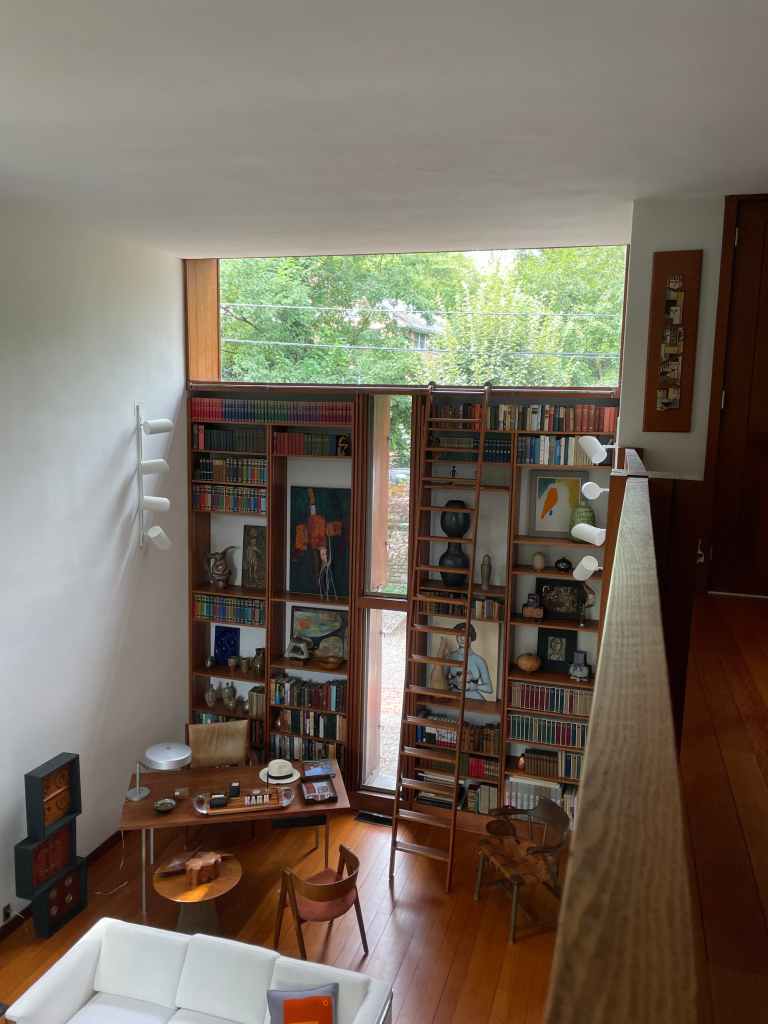
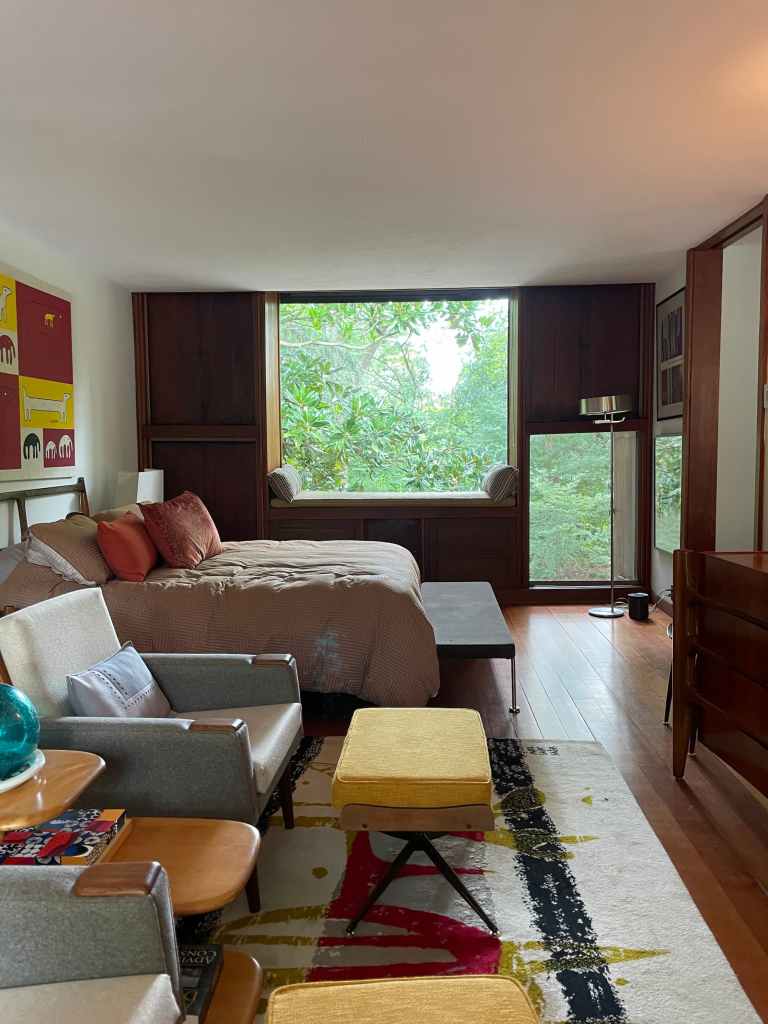
On the inside, Kahn did little to modulate the rooms beyond contrasting wood, stucco, glass, and built-in floor-to-ceiling bookcases (the client, Margaret Esherick, was a bookseller) and providing one lower area in the living room below a small balcony –supported, in a flash of expression, by a single beam roughly hewn by the client’s uncle, the woodworker Wharton Esherick. Everywhere, the details stand out, from pulleys that operate the lower windows to the articulated connections of the wood frames and railings.
Each space is clear and defined, and yet open to what is next to it. The living room is so grand you wonder how it fits into the mall volume. The different spaces are tailored to their uses without there being a sense that they are defined by being a place to sleep, eat, read, or socialize. The outside is everywhere present, but in its place, beyond the wood frames. Here the composition of the windows makes sense: some are for looking out, others for letting light sweep over you. The one tour-de-force beyond Wharton Esherick’s handiwork, which also includes a copper backsplash in the kitchen, is the window in front of the chimney that turns that piece into a still life when you view it from inside.
Walk around and through the house and everything seems so simple and clear. Rooms whose contours are clear, and proportions that make them seem larger than they are, nest next to each other in a volume of which you are always aware. Between these frames, space flows, expanding, contracting, and moving in and out of the surroundings. The symmetries, all local and contingent on what part you consider, center the parts of the building, while the sweep of the composition, especially on the rear, brings the whole together.
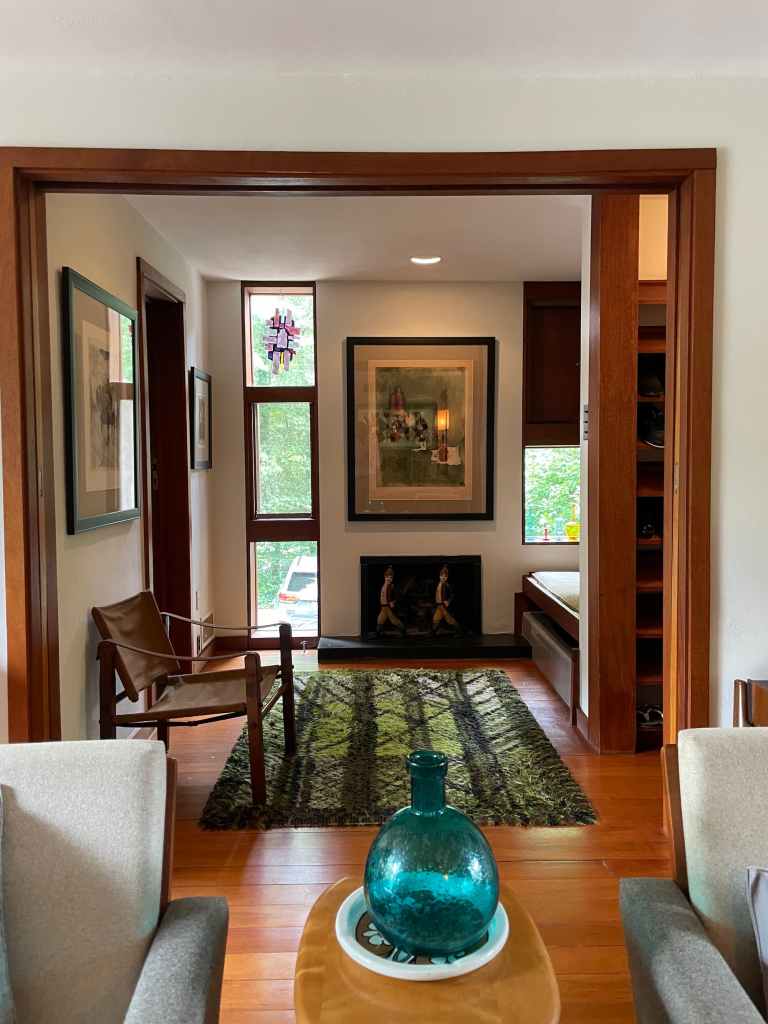
What Kahn has done here is to turn a domestic moment into architecture. He has boiled down the relationships of functions for living and the traditions of what a (American suburban) house is and how it should appear to a degree of clarity I have rarely seen elsewhere. He has made us see that social and historic type without recourse to direct citation or representation. Of course, it helps that this is a small and free-standing house commissioned by a client attuned enough to architecture to accept these abstractions (her brother was the California-based architect Joseph Esherick). It also helped that there was a sufficient, although not extravagant, budget.
What the visit reminded me of is how simple and complex architecture is. It is not much more than structure framing spaces carried out in materials in a manner that provides prospect and refuge. To do it well, even when the program and size are as seemingly simple as they were in this case, turns out be the province of very few designers. To develop and tune those few elements to the point where they embody the essence of what they house is given to even fewer people.
I do not mean to once again glorify a dead white male architect as a mystical genius, however much the highly sexist and self-aggrandizing Louis Kahn might have positioned himself to generate that praise. What I do want to point out is that making architecture is very, very hard, and that its rewards are elusive, but, at least to me, deeply satisfying. Houses such as the one Margaret Esherick commissioned are proofs of what is possible, laboratories for the development of design at other scales and in more complex situations and, if they survive, monuments to a certain set of social (and thus economic) conditions. The Esherick House is such a place, and I can only celebrate its beauty.
The views and conclusions from this author are not necessarily those of ARCHITECT magazine.
Read more: The latest from columnist Aaron Betsky includes reviews of: Ma Yansong’s Fenix Museum | The Cult of Emptiness | An Icon in Waiting | Osaka Expo | Teamlab | the Venice Biennale of Architecture | On Michael Graves | On Censorship or Caution? | Uniformity in Architecture | Book on Frank Israel | Legacy of Ric Scofidio| Fredrik Jonsson and Liam Young | DSR’s New Book | the Stupinigi Palace | Living in a Diagram | Bruce Goff | Biopartners 5 |Handshake Urbanism | the MONA | Elon Musk’s Space X | AMAA | DIGSAU | Art Biennales | B+ | William Morris’s Red House | Dhaka | Marlon Blackwell’s new mixed-use development | Eric Höweler’s social media posts,| Peter Braithwaite’s architecture in Nova Scotia,| Powerhouse Arts, | the Mercer Museum, | and MoMA’s Ed Ruscha exhibition.
Keep the conversation going—sign up to our newsletter for exclusive content and updates. Sign up for free.