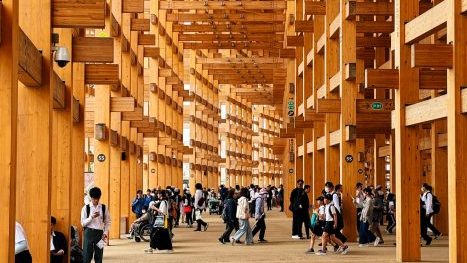
It’s Grand, that Grand Ring. Sou Fujimoto’s big gesture for the Osaka World Expo 2025 –the biggest wood structure in the world, according to Guinness—is two kilometers (well over a mile) long and encompasses most of the 160 pavilions in the show. It is also impressive in its appearance.
Over sixty feet high, it is visible from afar and more than holds its own with the array of cranes and other harbor structures around its artificial island site in the port area.

Up close, it is so much bigger than both the zoo of exhibition objects and support spaces it frames and the human beings lined up to see all those supposed wonders of the world that all you can do is gape in wonder. It is worth going to Osaka just to see this wooden behemoth.

That is a good thing, because the rest of the “architecture” at this Expo is, almost without exception, not only forgettable but downright ridiculous. Though my husband Peter Haberkorn and I did not join all the crowds lining up for hours to see the insides, the pavilions we were able to enter bombarded us with videos that would not have been out of place in this Expo’s famed cousin of 1970. That one was a showcase for new technologies and art, as well as for up-and-coming nations. This year’s version is a collection of nationalistic and corporate bombast that breaks no boundaries and shows nothing new that we could find.

A few of the pavilions had decent outsides: the Uzbekistan one, designed (along with that for the United Arab Emirates) by German “narrative architecture” firm Brückner, stood out with its recycled Japanese brick and adobe walls and its forest crown of Japanese cedar that will be shipped to the building’s subject country when the fair is over, stood out. So did current flavor-of-the-year Lina Ghotmeh’s upside-down A-frame (it is apparently meant to resemble a dhow) housing Bahrain’s display and the petrified forest Czechia shipped over after digging it up from its bogs. The bathrooms, designed by a collection of young Japanese architects, were notably quirky and fun. And that was about it. The rest of the pavilions were stacks, spirals, scaffolding for big signs, or other failed experiments in form and display. It is hard to imagine how much design talent, money, material, and national pride was wasted within these two kilometers.
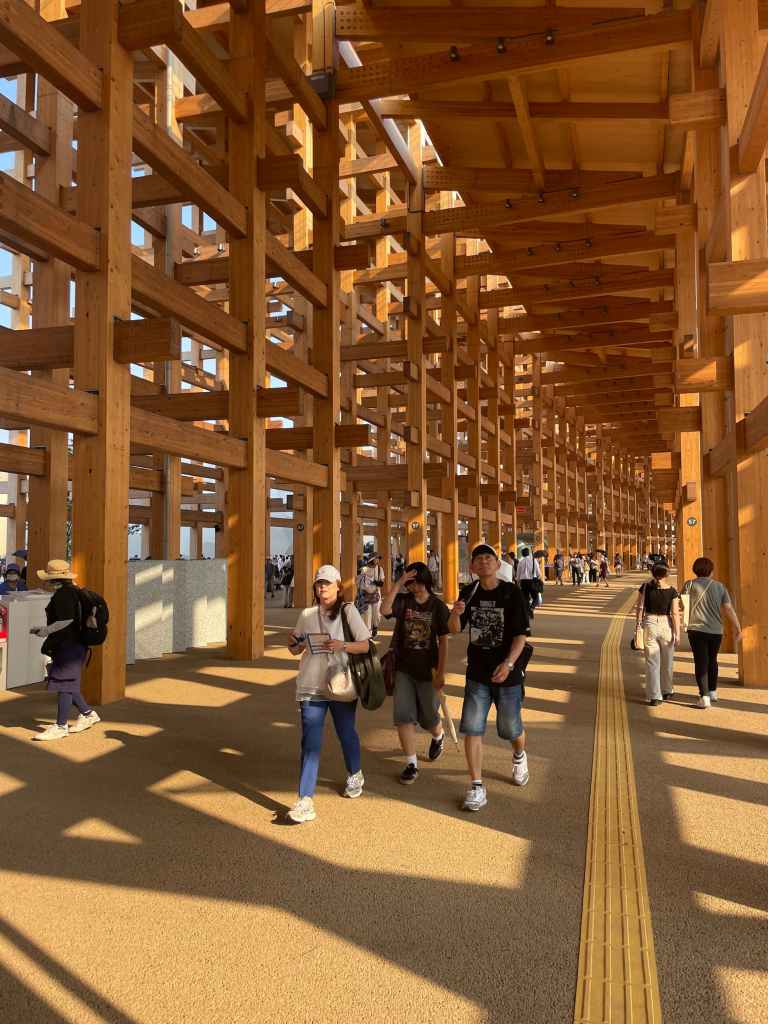
But at least there is the ring. Fujimoto used, or at least referenced, traditional Japanese joinery techniques to erect the network of columns and beams, which are actually assemblies (Glulam) put together for two-thirds of their base material out of native wood and for one third out of Canadian spruce. The reference to traditional temple and residential architecture, all the way back to the Ur-site of Japanese architecture, the 7th century Ise Shrine, is clear, though abstracted and blown up in scale. The metal pieces that make it all work are, unlike is the case in most of Kengo Kuma’s architecture, barely visible.

Fujimoto opened up the lower level to create a tall and airy arcade that runs for about two-third of the ring’s ambit. It provides shade and shelter, as well as a sense of marvel, and, on the hot and muggy day we visited, was notably cooler than the expanses of pavement within the ring. The play of geometry and light draws you eye upward into the grids that rise up far above you and arc away into the distance. It is, in other words, not just big, but designed to both show off its scale and give you a sense of historic and scalar reference.
Periodically, you can rise up through the Ring, either with foot power on stairs or in elevators or on escalators. As you move up, the perspective changes and new vistas open up, until you arrive at the top and the structure’s full sweep becomes evident. The top walkway provides views over the harbor and back towards Osaka (though that city is, like most large metropoles in Japan, not particularly interesting from afar), and then lets you peel off onto lower paths that arc past planting beds and draw you up again to the main circulation route. Here both the monumentality of the Ring and the puniness of the pavilions is clear.
There is apparently some discussion now whether the Ring should be dismantled and its pieces reused, or whether it should be left in place. The latter option makes sense to me; I can easily imagine a large park within the circle, while the Ring itself would remain as the grand monument it is. Commemorating not so much the forgettable Expo as both the essence of one kind of Japanese architecture and what we are able to achieve with manufactured timber, it would also continue to awe through its scale and design.
That does not excuse the billions of dollars spent on this event and the trees felled to create the Ring, any more than the pollution and waste created by myself and the millions of fellow visitors traveling to see the object. Perhaps it is best then to see the Ring as a future monument, which is to say as the combination of tomb and potlatch such objects are in their essence: a reminder of dead ambition and needless waste rising into an (almost) sublime object. At least this one –unlike the closed objects of the pyramids or other grand funerary markers that are at the core of that traditions—is and I hope will remain usable and enjoyable.
The views and conclusions from this author are not necessarily those of ARCHITECT magazine.
Read more: The latest from columnist Aaron Betsky includes reviews of: Teamlab | the Venice Biennale of Architecture | On Michael Graves | On Censorship or Caution? | Uniformity in Architecture | Book on Frank Israel | Legacy of Ric Scofidio| Fredrik Jonsson and Liam Young | DSR’s New Book | the Stupinigi Palace | Living in a Diagram | Bruce Goff | Biopartners 5 |Handshake Urbanism | the MONA | Elon Musk’s Space X | AMAA | DIGSAU | Art Biennales | B+ | William Morris’s Red House | Dhaka | Marlon Blackwell’s new mixed-use development | Eric Höweler’s social media posts,| Peter Braithwaite’s architecture in Nova Scotia,| Powerhouse Arts, | the Mercer Museum, | and MoMA’s Ed Ruscha exhibition.
Keep the conversation going—sign up to our newsletter for exclusive content and updates. Sign up for free.