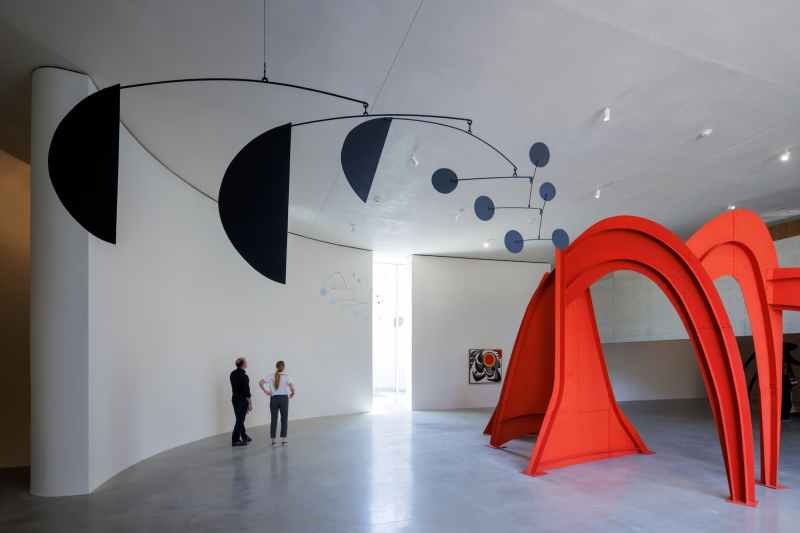
If it looks like a museum, smells like a (new) museum, and works like a museum, is it not a museum? The new Calder Gardens, which is taking its place along with the Philadelphia Museum of Art, the Barnes Foundation, and the Rodin Museum this weekend along the grand avenue of Benjamin Franklin Parkway in Philadelphia, claims it is not a museum, but a “cultural destination dedicated to the art of Alexander Calder.” More poetically, its website claims it is “an oasis for personal introspection, quiet curiosity, and open-ended encounters.”
First Impressions: Monumental Yet Puzzling
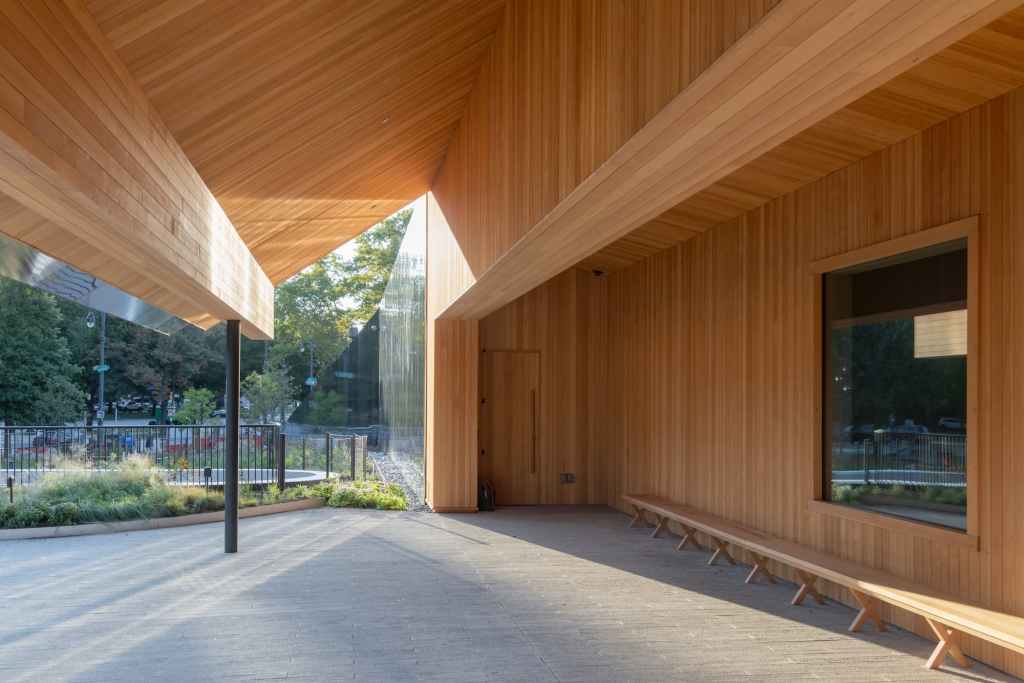
Walking up to its abstract, and therefore monumental, façade with a “porch” that functions like the pedimented front any self-respecting museum has, and then through spaces that proceed around the kind of grand, theater-like steps that are also de rigeur for such institutions, you might scratch your head, as I did on my visit during a press preview, and wonder: what’s the diff?
What You’ll (Not) Find Inside
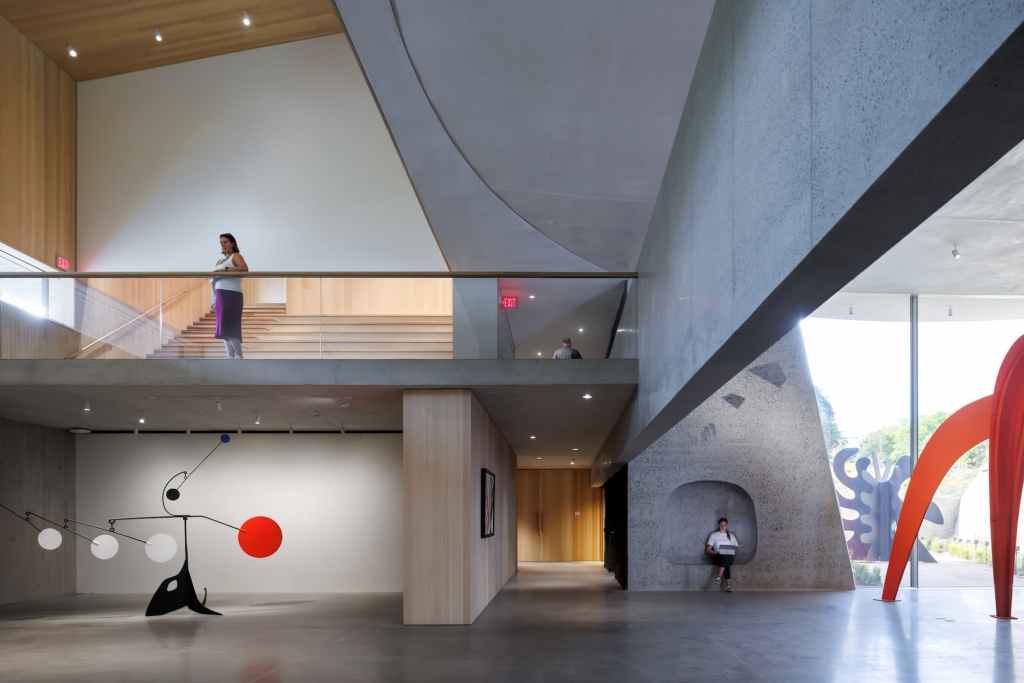
Well, there are no wall labels, for one thing. Also, there is no permanent collection alongside special exhibitions inside the 18,000-foot building. There is, however, an entry lobby, gift shop, as you might expect, but no café. You will find a space that works for education work and meetings that are being actively programmed.
A Garden Without Calder Sculptures?
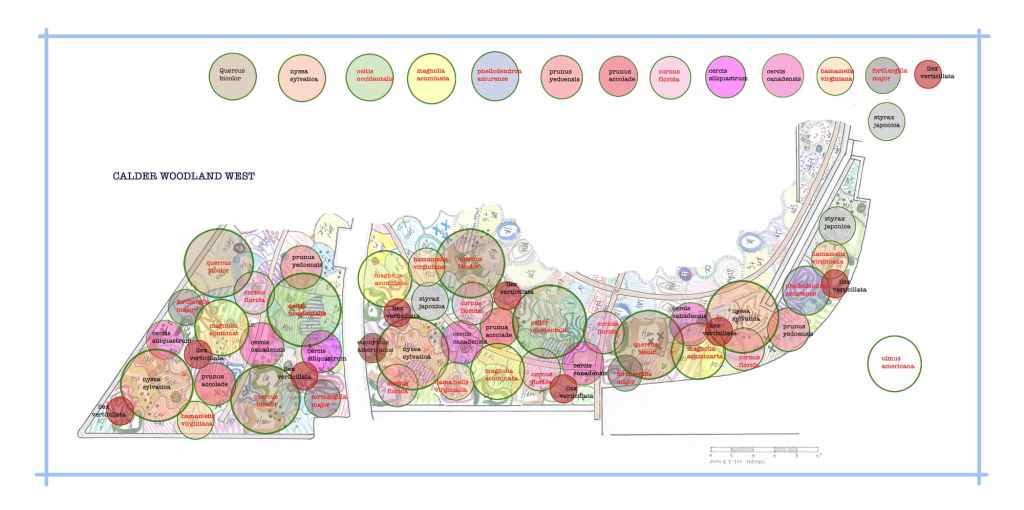
There are, on the other hand, no offices or back-of-the-house conservation and registration areas, as these are handled by the Barnes Collection across the street. The modest not-a-museum sits in a 1.8-acre garden designed by plant maven Piet Oudolf that will, once it has grown in, no doubt be beautiful. Strangely, though, this sculpture garden has no Calder sculptures to anchor its curving paths.
Experiencing the Calder Gardens
Does it matter what the Calder Gardens are? Perhaps not. The experience is, I think, quite breathtaking.
Wander through that nascent green (and brown and every other natural color) space and up a slight rise to the semi-reflective metal slash that is the building’s façade. Its horizontal reach shields you from the highway behind the complex while stretching as a counter to the skyward thrust of downtown’s skyscrapers a mile or so away.
Designing a Space for Sculptures to Breathe
Past the wooden porch and its inviting bench, you can pause to view the gardens and the movement of the boulevard. Then continue into the concrete frames that organize a sequence of spaces sparsely inhabited by the sculptures.
Along the way, shotcrete walls open up to reveal a particular mobile, and walls curve to cocoon another under a skylight. In these moments, you will experience one of the most carefully considered and beautifully arranged collections of sculptures since Isamu Noguchi’s studio opened to the public in Queens in 1985.
The Architects Behind the Vision
The architect of the whole endeavor is Herzog & de Meuron, who certainly know how to bring both drama and precise detailing to art spaces, and then open them up with gestures that bridge between the work they contain and the public coming into the institutions.
Minimal Materials, Maximum Impact
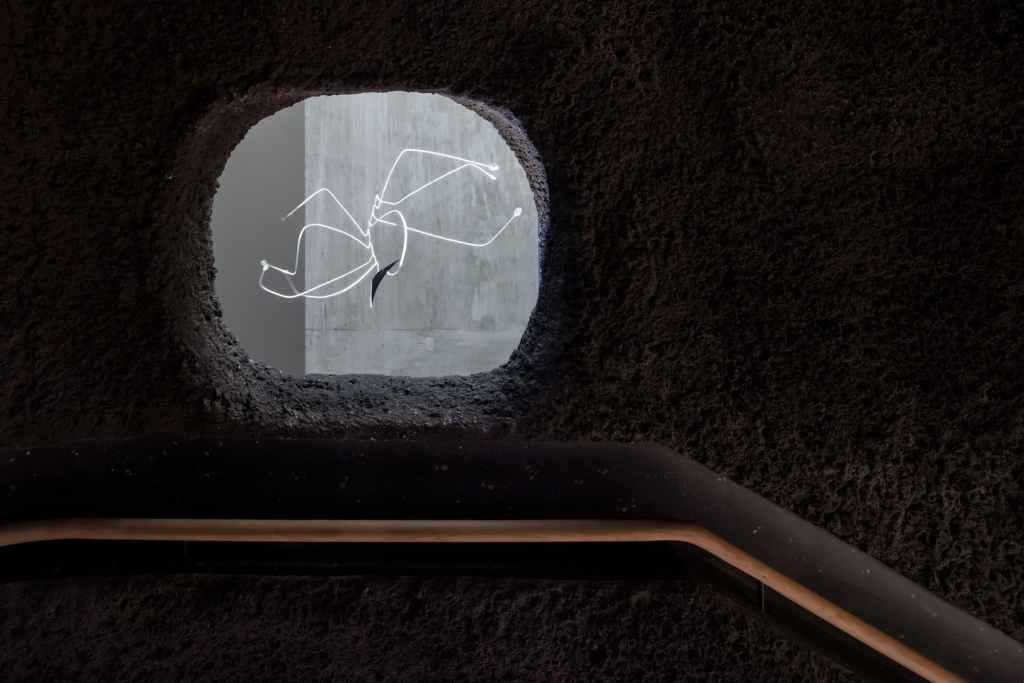
Here, they have concentrated on making a modest building with beautiful spaces. With a restrained palette of concrete and wood, with a few metal details and voids filled with large panes of glass, they have created galleries (or are they something else?) in which the sculptures look fantastic.
These are not white boxes, but lofty expanses that contrast with curved exceptions and controlled views, but few distractions.
A Rare Freedom in Museum Design
The fact that the architects had the freedom to do so because of a $90 million budget (from local donors, the State, and the City) and a client who just wanted a space where Calders would look good, with few of the logistical complications that make museums such complicated commissions, helped.
But Herzog & de Meuron (with Jacques Herzog as the lead) were modest enough to put most of the building underground and to eschew too many big moves. That modesty also led them to make the metal wall not quite reflective, which I think is the most problematic decision evident in the Gardens.
Reflective Façade or Missed Opportunity?
Meant to reflect the gardens, the metal does not quite, and its presence as an object slicing through space is, from certain angles, rather harsh. Perhaps the growth of planting will help.
A New Model of Art Presentation
So, the Calder Gardens are a quasi-museum without a collection. Instead, the Calder Foundation, run by grandson Sandy Rower, has pledged to work with the Barnes to make sure that a continuing stream of pieces, both from their own holdings and as loans from institutions around the world, both of which make up the inaugural installation, will continue.
The lack of wall labels, which to me are a blessing, might frustrate some visitors, but the point is to come face to face with the work as it is without worrying too much about where it came from or what some curator thinks it means.
Bridging Tradition and Innovation
The decision also bridges between Albert Barnes’ idiosyncratic approach to art definition and labeling evident across the street and the staider (in fact, very stale) presentation of art at the Philadelphia Museum of Art.
I wish “real” museums would follow suit instead of inundating us with their opinions. Without any pretentions, on the other hand, to neutrality, the architecture and landscape architecture form a counterpoint to the art, letting the pieces dance in response to the built forms.
A Boost to Philadelphia’s Cultural Identity
There is no doubt that the Calder Gardens will become, as Governor Shapiro noted at the opening, a major tourist attraction that will expand Philadelphia’s art-oriented character (hence the government investment).
The Gardens also keep native son Calder’s legacy alive and open it to public view. The building continues and strengthens the city’s tradition of great architecture, from the works of Frank Furness and Louis Kahn to the many other structures of high quality that dot the urban landscape
A Beautiful Paradox
Whatever it is, the Calder Gardens is thus a welcome addition to the local and international (art) scene. I only wish that a little less concrete had been used to create the drama. Reusing some part of that great urban storeroom of Philadelphia’s built landscape would have been a better solution.
I also wish that the institution had been a little less eager to open before the festivities marking our nation’s 250th year, so that the gardens could have grown in more. But these are essentially nits. The Calder Gardens is one of the most beautiful and successful new art institutions, whatever it might be called, constructed in recent years.
The views and conclusions from this author are not necessarily those of ARCHITECT magazine.
Read more: The latest from columnist Aaron Betsky includes reviews of: White House and Classical Architecture | Louis Kahn’s Esherick House | Ma Yansong’s Fenix Museum | The Cult of Emptiness | An Icon in Waiting | Osaka Expo | Teamlab | the Venice Biennale of Architecture | On Michael Graves | On Censorship or Caution? | Uniformity in Architecture | Book on Frank Israel | Legacy of Ric Scofidio| Fredrik Jonsson and Liam Young | DSR’s New Book | the Stupinigi Palace | Living in a Diagram | Bruce Goff | Biopartners 5 |Handshake Urbanism | the MONA | Elon Musk’s Space X | AMAA | DIGSAU | Art Biennales | B+ | William Morris’s Red House | Dhaka | Marlon Blackwell’s new mixed-use development | Eric Höweler’s social media posts,| Peter Braithwaite’s architecture in Nova Scotia,| Powerhouse Arts, | the Mercer Museum, | and MoMA’s Ed Ruscha exhibition.
Keep the conversation going—sign up to our newsletter for exclusive content and updates. Sign up for free.