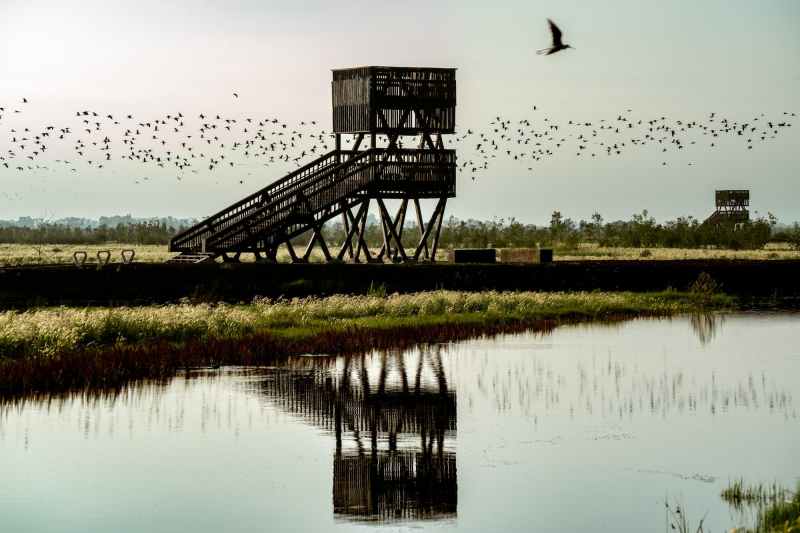
The first thing you notice are the birds. White egrets, russet hawks, all kinds of ducks, and small birds in flocks, by themselves, or in pairs. Then of course there are the insects they feed on, less visible but just as abundant. They all flit and float in and out of a landscape that is not quite solid ground, not quite water, and not even all natural.
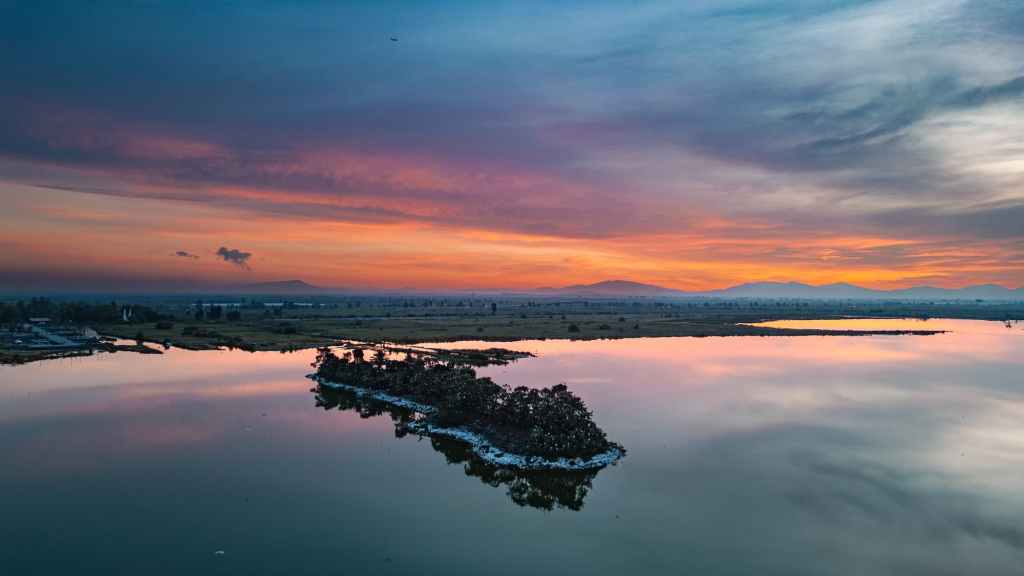
All around you stretches a mixture of the solid and the aqueous, the natural and the humanmade. This is Texcoco Lake Park as it is now: a site of blurred boundaries between time and place floating at the edge of the intensity that is Mexico City.
The Park is the brainchild of the architect Inaki Echeverria who, after ten years of making proposals for what is left of the lake system that once covered most of the plateau where the city now sprawls, got the chance to do something after Mexico’s last President, Andres Manuel Lopez Obrador (AMLO) canceled his predecessor’s plan for a new capitol airport on the site. Already one-fifth built, the Foster-designed behemoth had already traced its runways, access roads, and the foundations for its vast buildings on the fragile landscape. Soil had been compacted and the area drained even more than it had been by centuries of extraction, the drop in the area’s water level, and illegal settlements.
Ironically, this mess created the opportunity for Eccheveria to act at a scale that had not been possible before. The unification of the area under one administration, the fences around the site, and the fact that it was now unused terrain let the architect begin to implement proposals he had made twenty years earlier for wetlands restoration, water storage, ecological preserve, and sustainable farming. To this he added sports and recreational facilities that are include some of few snippets (given the overall scale of the place) of new construction on the site.
It has now been six years since this reconstruction began, and the scope of what will be at almost 30,000 acres or thirty-six times Central Park, one of the world’s largest urban parks. The difficulty in assessing Echeverria’s success as an outsider is that there is not much to see –but that is the point. His aim is not to create a “solution” to the long-troubled ecology or to assert his design talents with buildings, but to open processes that, as he points out, “will take decades to be fully visible.” Add to this the fact that, he adds “architecture stands up, you see buildings, while landscape stretches out,” and you find yourself looking for what he has done.

What you see is the abundance of flora and fauna. What you also notice is the remains of the runways and access roads, some of them already inundated, as well as other preexisting forms, such as the large “caracol,” a round ash mining pit Eccheveria hopes to turn into a spirulina farm. Water is everywhere, slicing through the land in preexisting canals, spreading out in seasonal lakes, and visible behind the dense vegetation of new wetlands. The contrast between the slices of humanmade forms and the fluidity of what nature has created suggest something that is almost picturesque.
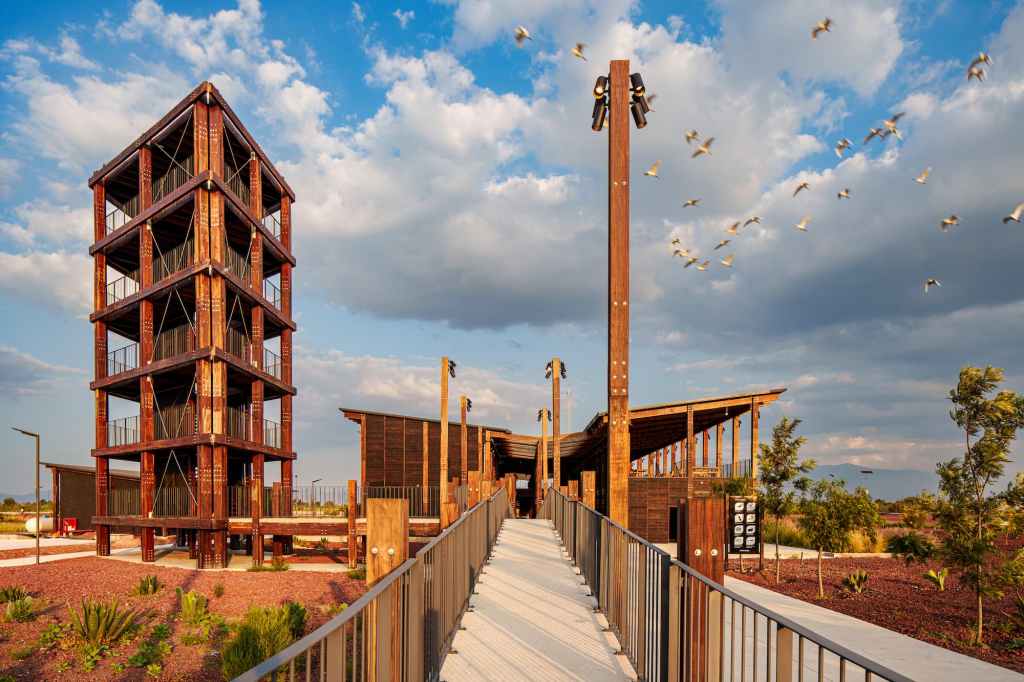
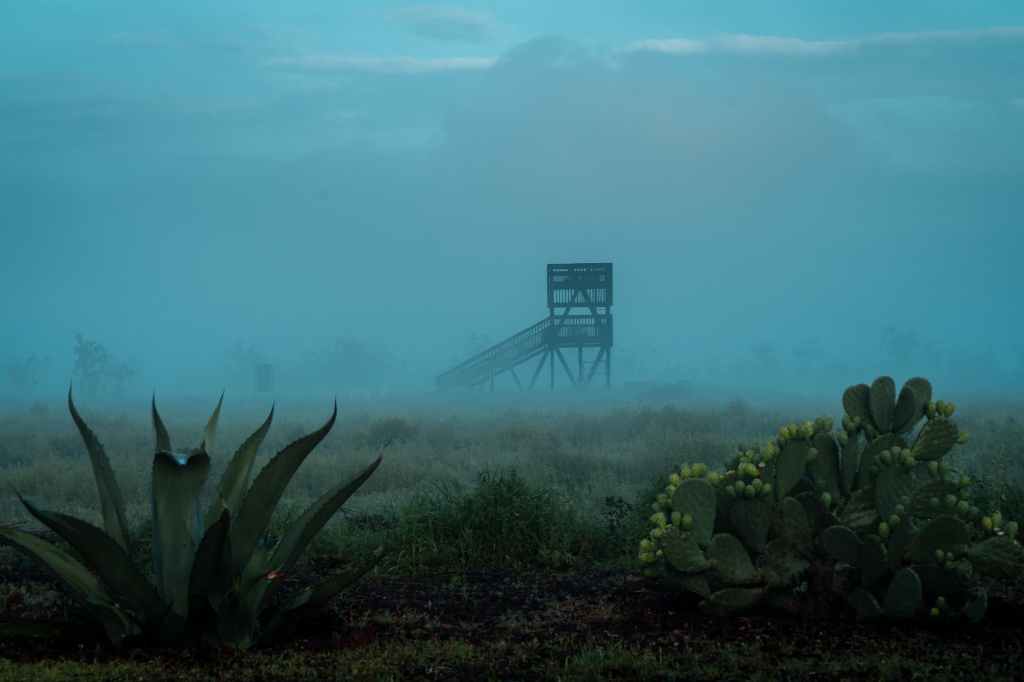
Wooden watchtowers from which you can observe all this now dot the site and after you climb them more of the Park’s contours become visible. What is most remarkable, though, is the lack of definition: the way land and water, weeds and trees, and geometry and blur fade in and out of each other to create a place of vagueness. It is the “terrain vague,” the French term for that shifty, perhaps dangerous territory at the edge of sprawl, turned into a site of vital and aesthetic development.
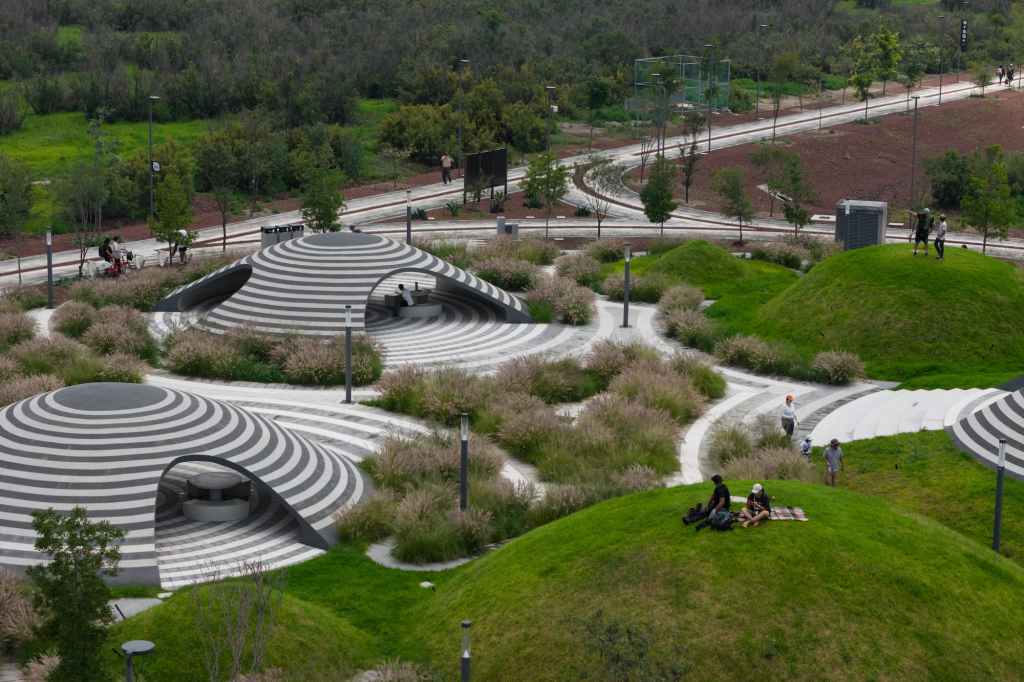
At the other edge of the site from the caracol Echeverria has echoed its shape with half a dozen circular terrains that are mainly the location of the sports fields and support structures. The shape was the most efficient manner to stabilize the soil there but it also, as the architect admits, gives the new Park its most visible shapes, especially seen from aerial photographs or from airplanes flying in and out of the existing airport. Here you will find more fragments, but in this case intentional ones. They include mastabas, hollowed out on one side, that serve as the site for both jai alai and revived pre-Columbian games; a stadium setting for newly popular American football; a concrete strip that will house shops; running and bicycling tracks; and a collection of sewer culverts saved from the airport construction that now serve as sculptural planters.
At the center of this area of new construction stands Eccheveria’s most traditional building, a set of two parallel bars clad in wood and bisected by a long courtyard. This serves as the administration hub for the whole Park. Like the rest of the new buildings, it is handsome and well-put together but lacks the eerie beauty of the Park’s landscape.
For now, most of the Park also feels empty. For a large part that is because the evolving landscape needs protection. For administrative reasons, however, it is also only open on weekends, when it is apparently well-used (I was there on a Wednesday). The site is, again because of the power dynamics in Mexican politics and bureaucracy, not well-served by public transportation, making it, ironically, as dependent as the airport was going to be on car travel.
Still, the Texcoco Park is also important as a giant reminder of what Mexico City once was. Sited in a mile-high basin surrounded by mountains and volcanoes, the plateau has no outlet for the water that comes down from the ranges into the nearly flat terrain. Alkaline soil makes parts of what was once a series of lakes so salty that, after an hour at the Park, you can taste it in your mouth. The Aztec capital Hernan Cortez discovered and conquered floated in and around this water landscape, drawing its sustenance from its ecological riches. The Park is a reminder of that era.
As a recall, Texcoco Park is then a sign of what can be the capital’s future. By accepting and working with this geology and hydrology, and by restoring it where possible, Echeverria and his team have set up the conditions for new ways of experiencing and using the landscape. The site’s scale, which continues across the reserve’s borders to adjacent wetlands and agricultural sites, can make it possible for this restorative work to have an impact almost commensurate that of the Mexico City agglomeration.
Echeverria recently resigned as the Park’s Director to take on similar projects elsewhere in Mexico. We can only hope that President Claudia Sheinbaum, AMLO’s successor, who is an ecologist by training and profession, but also part of a political party with a mixed legacy, will continue you this vast and vastly important project.
The views and conclusions from this author are not necessarily those of ARCHITECT magazine.
Read more: The latest from columnist Aaron Betsky includes reviews of: On Vitruvius | On Olive Development | Calder Gardens | White House and Classical Architecture | Louis Kahn’s Esherick House | Ma Yansong’s Fenix Museum | The Cult of Emptiness | An Icon in Waiting | Osaka Expo | Teamlab | the Venice Biennale of Architecture | On Michael Graves | On Censorship or Caution? | Uniformity in Architecture | Book on Frank Israel | Legacy of Ric Scofidio| Fredrik Jonsson and Liam Young | DSR’s New Book | the Stupinigi Palace | Living in a Diagram | Bruce Goff | Biopartners 5 |Handshake Urbanism | the MONA | Elon Musk’s Space X | AMAA | DIGSAU | Art Biennales | B+ | William Morris’s Red House | Dhaka | Marlon Blackwell’s new mixed-use development | Eric Höweler’s social media posts,| Peter Braithwaite’s architecture in Nova Scotia,| Powerhouse Arts, | the Mercer Museum, | and MoMA’s Ed Ruscha exhibition.
Keep the conversation going—sign up to our newsletter for exclusive content and updates. Sign up for free.