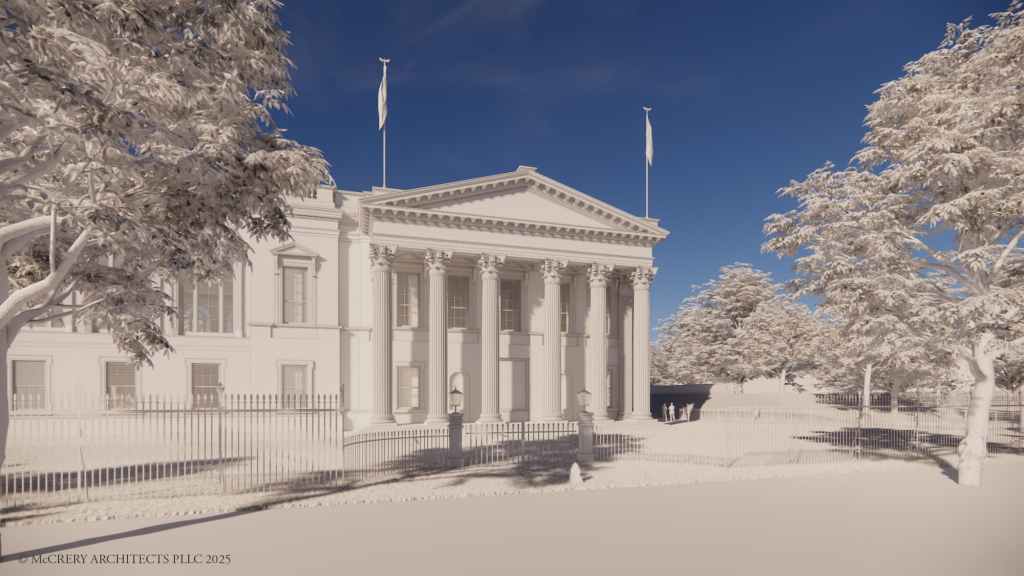
Over the last few weeks, a few friends have contacted me, asking me to write about Trump’s destruction of the East Wing and the construction of a ballroom in its place whose mass will dwarf the original, central wing of the executive complex. My first reaction is: compared with everything else this regime is doing that affects our built and natural environment, this is a minor issue.
Is the new building design bad, both in terms of its scale and the basic traits architects are supposed to be good at producing, such as proportion, spatial sequence, detailing, and ornament? Yes, it is horrendous. Is the process by which it is being constructed wrong and probably criminal? Absolutely. Does it manner? Only in its enshrinement of Trump in yet another way in the symbolic center of our state.
The White House Was Never That Great
But: the East Wing was, whatever personal attraction and memories people have, never a very good building and yes, some sort of ballroom at the White House is a, if not necessary, logical (there is a debate about how needed it is, but I will leave that to the protocol experts) addition. Moreover, the bigger issue is that the White House is not, never was, and never will be, a particularly good building.
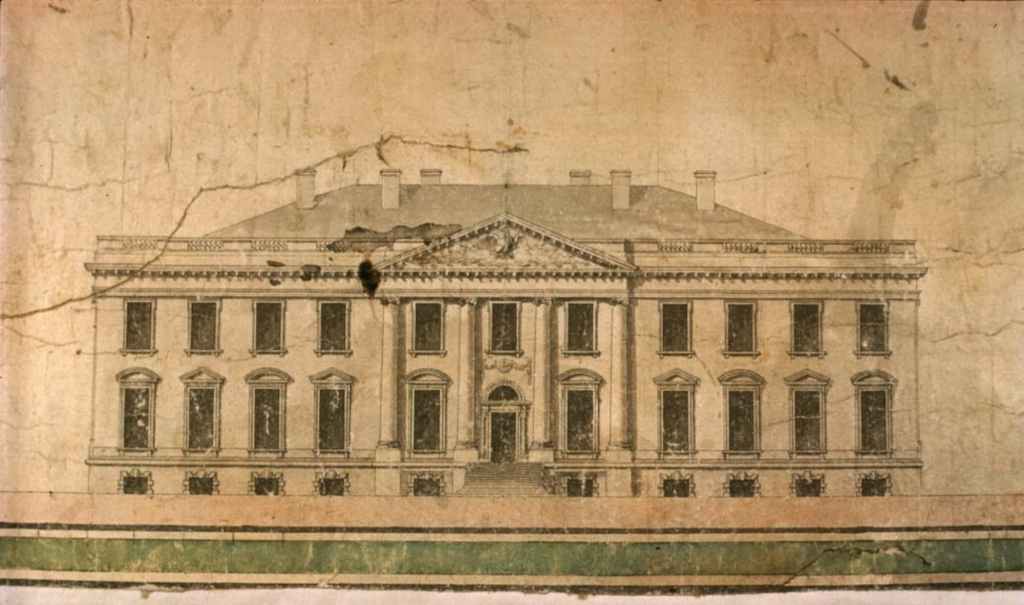
It was designed by a middling architect, James Hoban, as an overblown home. It has been expanded willy-nilly by a series of forgettable designers, starting with porticoes to both its north and south side that are over-scaled and themselves badly proportioned. It has been renovated, expanded, and otherwise altered until it is the ultimate proof that it does not matter how classical or traditional a building is if it is just not that good in its bones.
And the White House is certainly not even Hoban’s best work. Those interiors that are good are later additions, but there are also many that are awkward and forgettable.
Personal Impressions: A Building of Disappointments
My memories of my two visits to the White House are of pompously inane public rooms and rabbit warrens of offices. Just by walking by, it is evident that the exterior as it exists now is out of scale, badly composed, and indifferently detailed.
I would think (or hope) that any student at a classicist school such as Notre Dame who presented such a project would be kicked out of school. Bad classicism is as bad as bad brutalism or just bad building in any other style.
National Icon, Flawed Structure
Yet the White House is beloved. It is not so much a building, of course, but a constructed and well-worn symbol: an image on currency and postcards alike, endlessly recreated in television shows and movies, and familiar as the backdrop of state occasions.
That might be one reason to keep it as it is, except that neither the East nor the West Wings are what make it into a popular monument: it is the central and original wing (albeit with those grand porticoes tacked on), which at least has some measure of grandeur. If you really wanted to make the White House great, I would tear down all the additions and put them underground or somewhere else altogether.
Enter: The Trump Ballroom
The worst that you can say about the latest addition, The Trump (as he would probably love it to be called), beyond that it is a waste of money and will be supremely ugly, is that it overwhelms that original structure even more than the East Wing did.
For that reason alone, we should oppose it –but, in my opinion, not waste as much time and effort on that as fighting the many other initiatives, from getting rid of environmental and safety standards to mandating retarditaire modes of building for the government, that will wreck much greater havoc.
The Arc de Trumph: A Monument in Search of Meaning
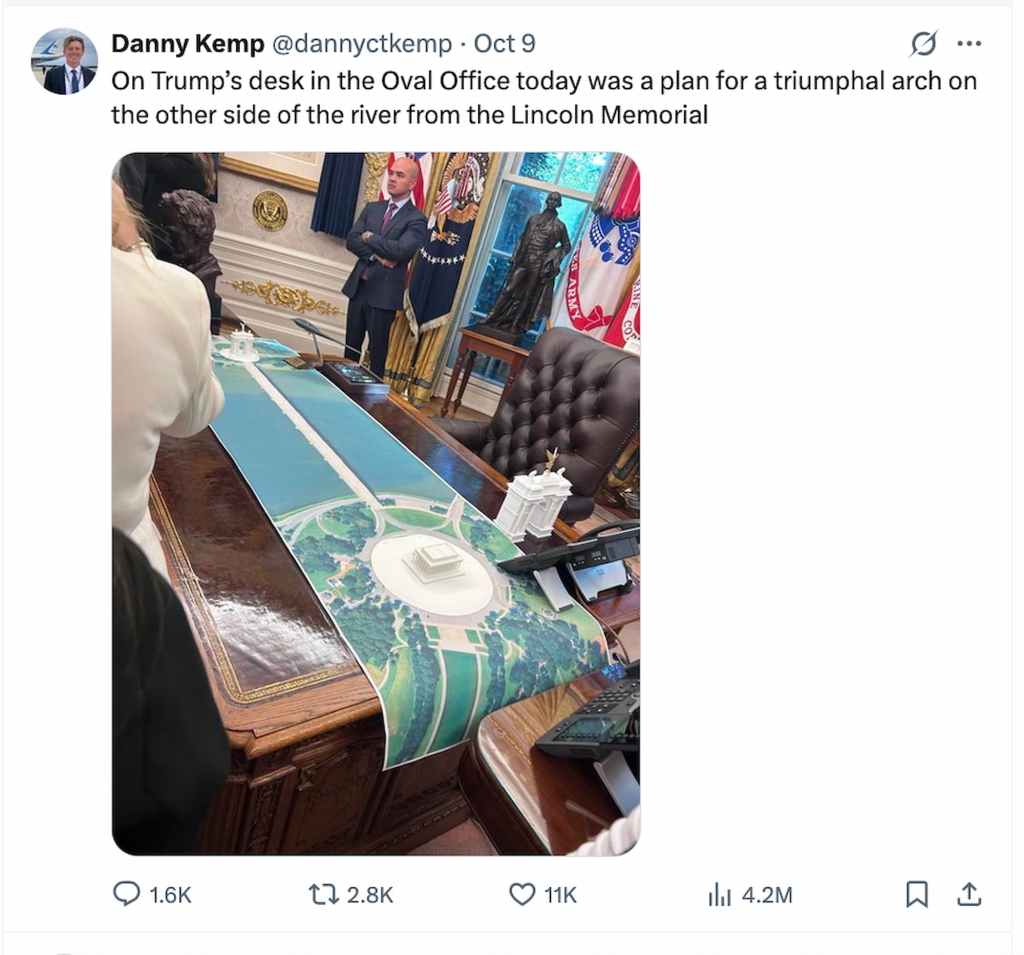
But now there is also the looming Arc de Trumph. Its erection is not at face value such a bad idea. The location calls out for a monument, however isolated it is by traffic (so is the Arc de Triomphe itself). If you want to enhance Washington’s collection of markers and memorials, this would be a good place to do it.
The biggest formal problem with the arch as a proposed form is that there is no real axis for it to mark and thus frame an army led by our Duce to march down and under this gateway into a democracy: it would look across a short bridge at the rear and side of the Lincoln Memorial and to the other direction at the mass of Arlington cemetery. If, as a good classicist, you were going to ennoble this point, an object that would be more omnidirectional would make sense.
What Should a 250th Monument Look Like?
What such a point should celebrate is also important. Its official name is the Independence Arch. The official reason for building is our country’s two-hundred-and-fiftieth birthday, which brings up the question: what monuments memorialize our centennial, bicentennial, or any other milepost since independence?
No significant ones, and I believe that is for a reason: in the past we realized that celebrating our coming together as a free and democratic country should mean making buildings that furthered us as such a nation. Hence the many centennial and bicentennial halls around the country –although, again, I do not know of any in Washington. Our birthday is the occasion for a party, an exhibition or, at most, a naming of some place where we come together.
A Vanity Project, Not a National Statement
Of course, that would not do it for the most vainglorious and narcissistic politician this country has ever had the misfortune of suffering from and under. So, we may well have an arch, which will also act, as the ballroom has, as a bribing opportunity for donors looking for favors from this President.
If that is the case, of course you would wish that there would be a competition, or at least a formal selection process, but Trump has already held up the model of the again not terribly well-designed object (though I think it is at least more correct in its classicism than the ballroom) he wants. Let’s hope we can get rid of him and it before the arch is constructed.
What’s Still Worth Fighting For
And that would be what I would concentrate on. It is too late for the East Wing and its equally hideous replacement. Let us not mourn, I would say but let us instead organize to at least oppose the travesty of an arch long enough that, God willing, it is too late for it being foisted upon us.
The views and conclusions from this author are not necessarily those of ARCHITECT magazine.
Read more: The latest from columnist Aaron Betsky includes reviews of: The Future of Mexico City | On Vitruvius | On Olive Development | Calder Gardens | White House and Classical Architecture | Louis Kahn’s Esherick House | Ma Yansong’s Fenix Museum | The Cult of Emptiness | An Icon in Waiting | Osaka Expo | Teamlab | the Venice Biennale of Architecture | On Michael Graves | On Censorship or Caution? | Uniformity in Architecture | Book on Frank Israel | Legacy of Ric Scofidio| Fredrik Jonsson and Liam Young | DSR’s New Book | the Stupinigi Palace | Living in a Diagram | Bruce Goff | Biopartners 5 |Handshake Urbanism | the MONA | Elon Musk’s Space X | AMAA | DIGSAU | Art Biennales | B+ | William Morris’s Red House | Dhaka | Marlon Blackwell’s new mixed-use development | Eric Höweler’s social media posts,| Peter Braithwaite’s architecture in Nova Scotia,| Powerhouse Arts, | the Mercer Museum, | and MoMA’s Ed Ruscha exhibition.
Keep the conversation going—sign up to our newsletter for exclusive content and updates. Sign up for free.