


Gregory Hiesler
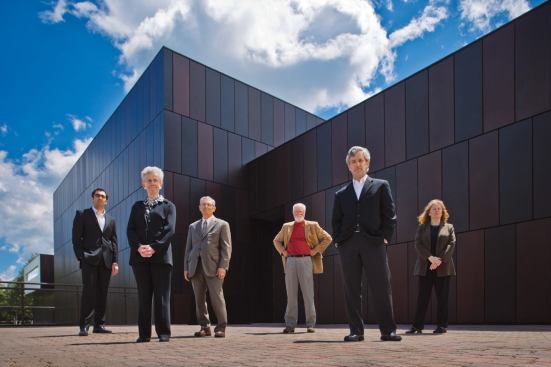
Expanding the Benedicta Arts Center was a team effort. Pictured …
For decades, the Benedicta Arts Center proved to be everything the college had hoped for. But as enrollment grew and fine-arts programming expanded in scope, conflicts started to surface.
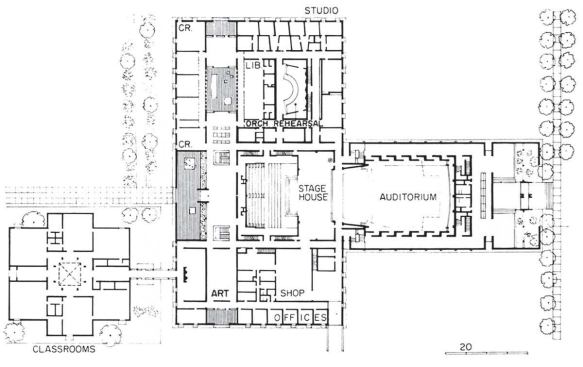
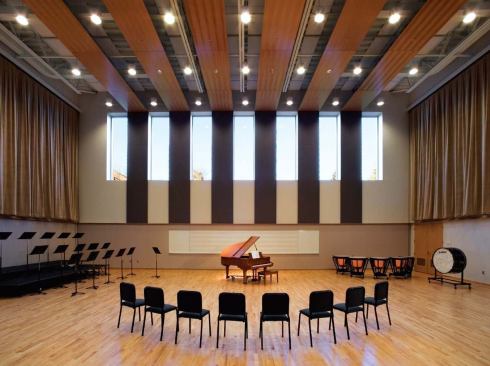
Because the building’s program lacked an adequate rehearsal room, “The largest rehearsal space was the stage itself,” says Fredricks, recounting how orchestra rehearsals required each musician to carry an instrument and a chair through the building to the stage. “Fine-arts programming, dance, music, and theater all arm-wrestled for that space.”
The popularity of the center also meant that traveling theater and dance companies often displaced the students, who depended on the stage for their own needs. Although the basement level housed a warren of small rehearsal rooms, over time these dark, isolated spaces began to take on a more threatening feeling, especially after dark.
Talk of an expanded center began as early as 1998, says Tom Darnall, a retired theater professor who ultimately became a key adviser in the addition’s design. The college’s consulting architect was asked to develop a scheme for added space, and he came back with a sketch showing a separate black box theater and small rehearsal room, grafted to opposite sides of the original building.
Sister Colman, who by then had served a term as college president and had moved on to become the chief development officer, was skeptical. She wanted to show the plan to Curt Green, who had long since retired. A small delegation visited Green at his home, where the group sat on the porch and sipped lemonade. Green was a gracious host, but he didn’t reserve judgment on the proposed additions. As Sister Colman recalls: “Curt looked at it and said, ‘Don’t ruin my building.’”
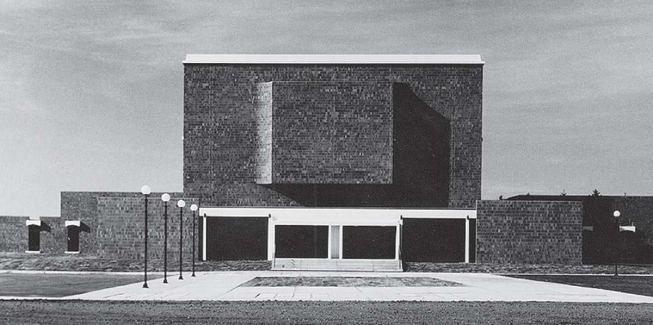
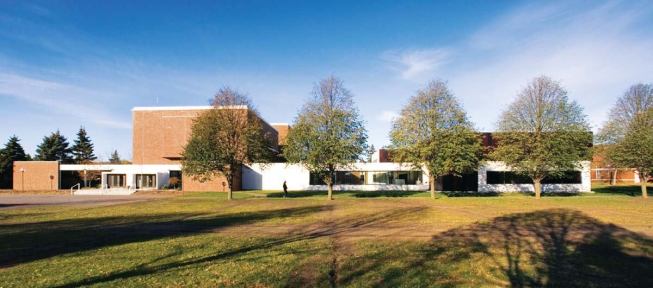
Green (who passed away in 2002) steered them back to HGA, which recognized an opportunity to improve on an important building in the firm’s early portfolio. The job was assigned to design principal E. Tim Carl, whose team included HGA colleague Jamie Milne-Rojek, a specialist in performing-arts buildings for colleges and universities.
“We were all moved by the prospect of adding onto [it],” says Carl. “As we got to know the clients, going through the programming phase and hearing how much they loved that building, it became really apparent that we had to respect it. That history was a real driver of this project.”
Being a strong believer in “putting the right people together at the right time,” Fredricks preselected the general contractor for the project and involved him on the building committee. Although it tends to raise costs a little, Fredricks says the advantage in getting the contractor on board early is that he comes to all the meetings. “He hears directly from the faculty and staff what is important to them. The general contractor has a real depth of knowledge about what the faculty is hoping to accomplish in that space.” Other committee members included Dean Rita Knuesel (now the college provost), Sister Colman, and Darnall, who served as a faculty representative. The committee, in turn, met with the music, dance, art, and theater faculty.
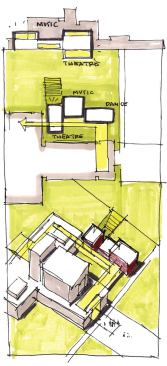
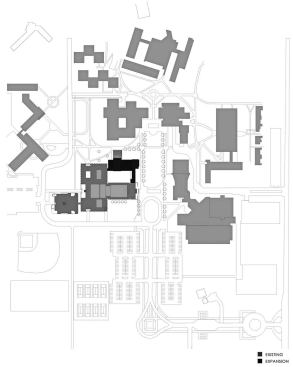
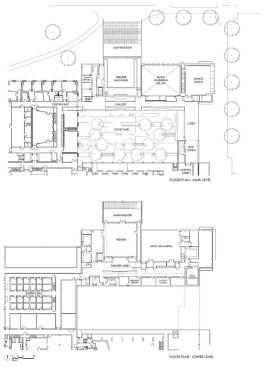
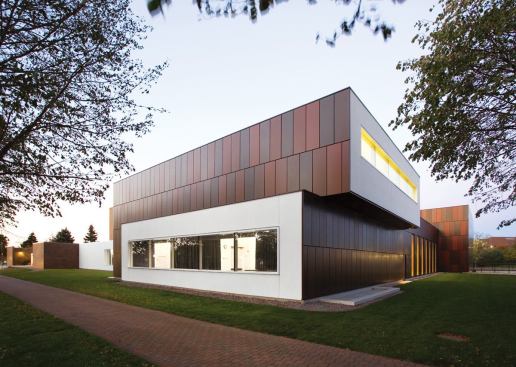
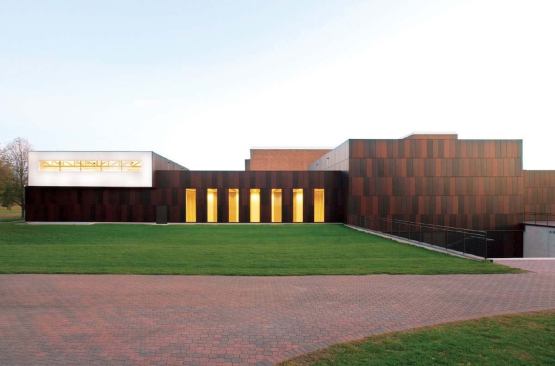
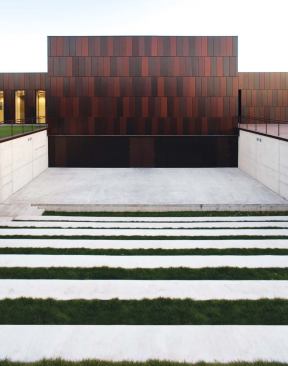
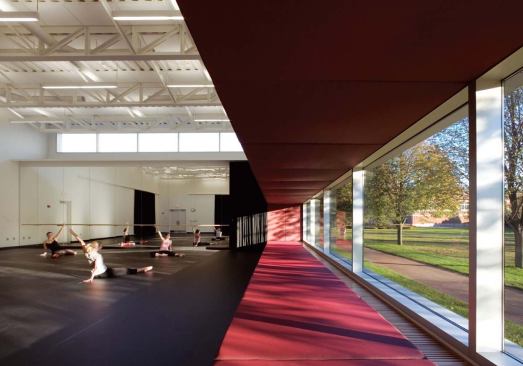
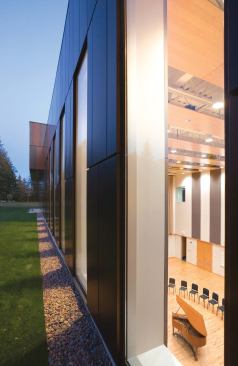
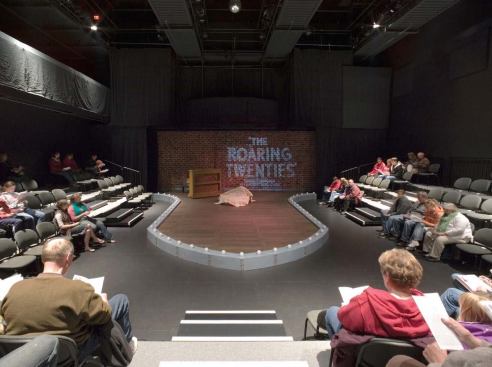
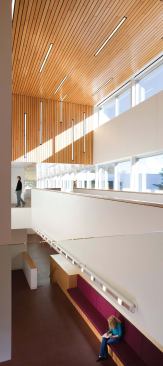
From the beginning, Carl advocated for an addition that would touch the original building lightly, while still maintaining a complementary scale and formal composition. Early studies focused on arranging the three key program elements: dance studio, music rehearsal room, and black box theater. To reduce the scale of the addition, much of the space was sunk below grade. The critical planning move: organizing all the new spaces off of a single corridor. That intervention also created the edge of a new courtyard on the north side of Green’s original building.
Pushing the floor level of the black box theater down to the basement caused some early concern about getting props and equipment from the existing ground-level loading dock. But the architects’ strategy was foolproof. By placing the black box adjacent to existing theater support space, they ensured easy access to the loading dock via the stage lifts in the old building.