courtesy Tsz Yan Ng and project authors
Since working in a clothing manufacturing facility in China almost a decade and a half ago, Tsz Yan Ng, associate professor at the University of Michigan Taubman College of Architecture and Urban Planning in Ann Arbor, Mich., has developed a deep interest in the relationship of clothing manufacturing and architecture (including teaching a course called “Sartorial Architecture”).
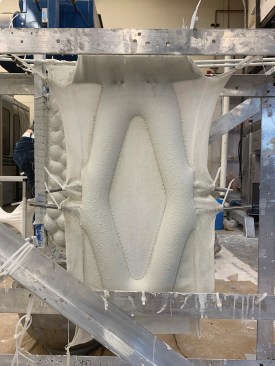
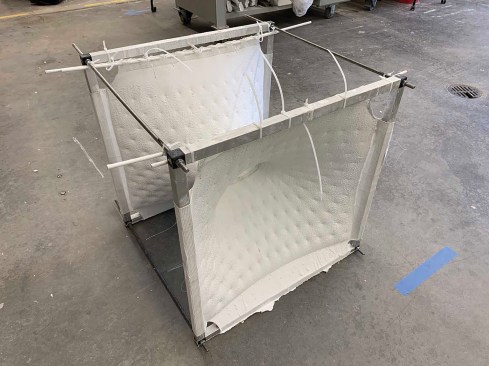
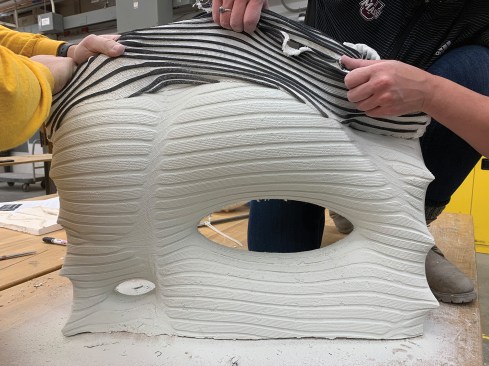
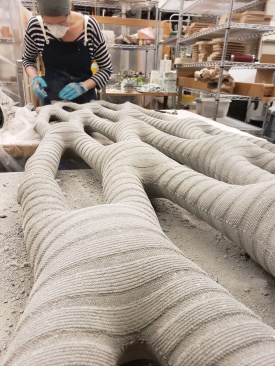
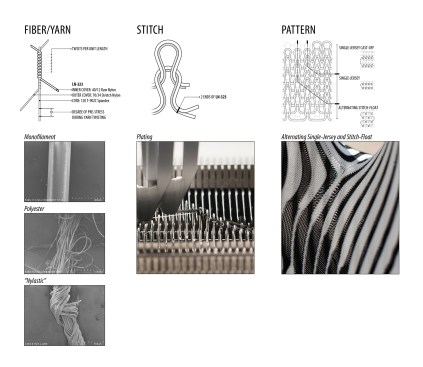
Her knit-casting process uses CNC-manufactured knits as formwork for creating glass-fiber-reinforced concrete. With applications that include serving as an intricate façade panel system or as a remote concrete casting system in situations where formwork or labor are unavailable, the dynamic form-finding process also eliminates the need for typical molding materials, such as wood or foam, and the waste that comes along with them.

courtesy Tsz Yan Ng and project authors
courtesy Tsz Yan Ng and project authors
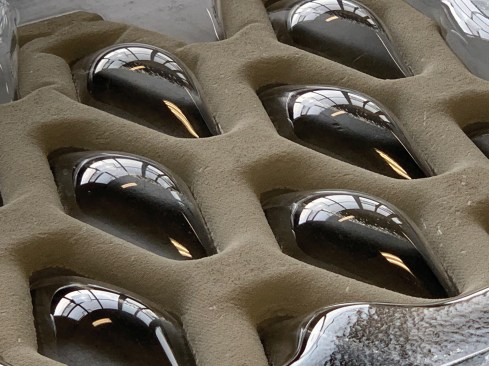
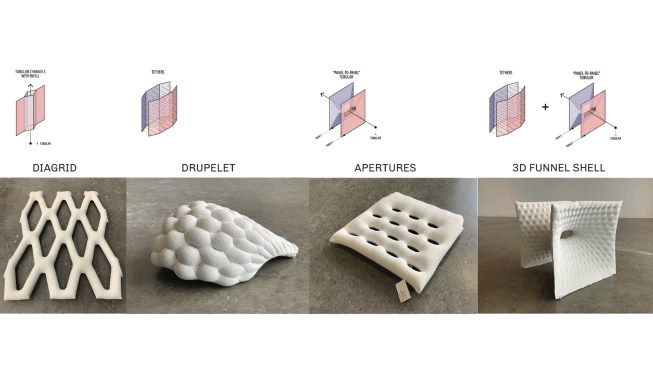
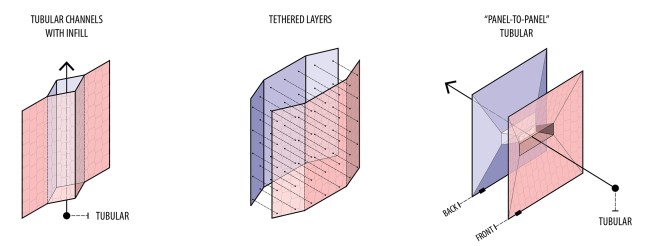
The project was conceived and developed in collaboration with university colleagues Sean Ahlquist, an expert in CNC knitting, and Evgueni Filipov, a structural engineer who specializes in deployable structures. “I was interested in how the knits can be a lightweight material that has the possibility of producing complex geometries that are very difficult to do for concrete,” Ng says. Initial studies have created four distinctive typologies: diagrid, drupelet, apertures, and 3D funnel/shell.
Each uses closed-knit formwork, which Ng considers more desirable than open formwork (which is typical for most concrete structures). “It’s more volumetric [than an open form], almost like inflating a bag,” she says. Plus, closed systems, which allow for greater quality control, require less labor during the pour.
courtesy Tsz Yan Ng and project authors
courtesy Tsz Yan Ng and project authors

courtesy Tsz Yan Ng and project authors
“My interest in textile applications is sort of hybridized in the way that I think about architectural production now that we have advanced fabrications in these different modes of manufacturing, but it opens up other kinds of design opportunities that we haven’t had before,” Ng says.
courtesy Tsz Yan Ng and project authors
courtesy Tsz Yan Ng and project authors
courtesy Tsz Yan Ng and project authors
courtesy Tsz Yan Ng and project authors
courtesy Tsz Yan Ng and project authors
This article first appeared in the October 2022 issue of ARCHITECT.
-
Next Progressives: Delma Palma
The New York City Housing Authority deputy director of design wants to do away with the "idea that one person behind a desk can best understand how to design for a community of users."

-
Laurian Ghinițoiu Offers a Fresh Approach to Photographing the Built Environment
The photographer focuses on its social, political, and physical contexts.

-
In Tuskegee and Pennsylvania, Educators Lead the Next Generation of Architectural Preservation
Leaders from Tuskegee University’s Department of Architecture and University of Pennsylvania’s Weitzman School are spearheading an initiative dubbed “Capacity Building for Sustainable Preservation of Civil Rights Heritage Places.”

-
Open Design Collective Gets Communities Involved in Planning Their Own Neighborhoods
The Oklahoma City–based nonprofit's first major project sought to repair damage from urban renewal in the local, largely Black community of South of 8th Street.
-
Nupur Chaudhury Imagines Public Health as a Matter of the Built Environment
Working alongside Dark Matter University, the urbanist and health-equity expert helped launch a curriculum that trains communities to lead their own design processes.

-
Tonika Lewis Johnson Uses Maps to Explore the Effects of Contract Buying on a Chicago Neighborhood
Called Inequity for Sale, the social justice artist's new project came to life during a 2021 residency with the National Public Housing Museum.

-
With This Knit-Casting Process, Concrete Leans Sartorial and Minimizes Production Waste
Tsz Yan Ng, Sean Ahlquist, and Evgueni Filipov are harnessing CNC-manufactured knits to develop a process that results in intricate and efficient glass-fiber-reinforced concrete.
-
Segregation by Design Examines Systemic Racism in American Cities
Founded by the New York architectural designer Adam Paul Susaneck, the website presents the stark reality of racist urban planning practices in the built environment.

-
This Nonprofit Uses Schools to Anchor Mixed-Use, Income-Diverse Community Development
Helmed by Nora Jendoubi and Derwin Sisnett, Memphis, Tenn.–based Maslow Development aims to create structures for all residents to succeed.
-
TreesAI Shows Communities How to Maintain and Grow Their Urban Forests
The startup, founded by the Amsterdam-headquartered, not-for-profit Dark Matter Labs, offers a software aimed to help cities plan and sustain urban foliage.