courtesy Tonika Lewis Johnson
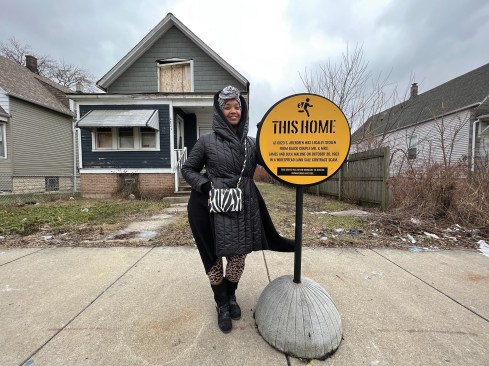
Tonika Lewis Johnson and house markers from the Inequity for Sale project.
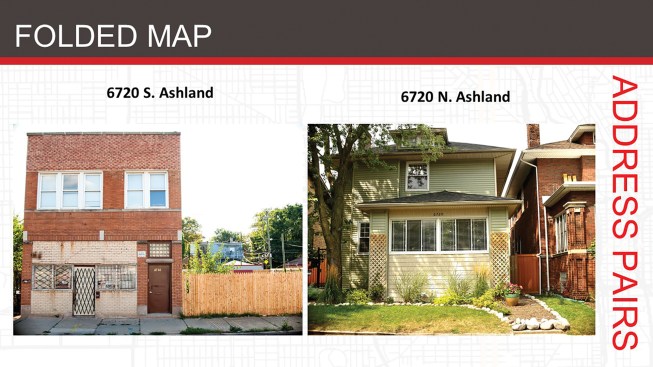
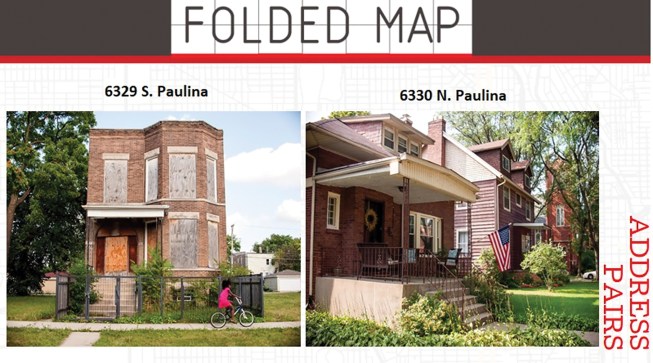
Social justice artist Tonika Lewis Johnson first drew public attention with the Folded Map Project, which uses Chicago’s mirrored addresses across the South and North Side divide to connect residents for vital conversations about property values and a city known for segregation. Now, with Inequity For Sale, the artist has dug deeper into the harm done to the West Englewood neighborhood—a place she’s called home throughout her life—through contract buying, a widespread practice in the 1950s and 60s that preyed upon Black homebuyers through fraudulent home lending.
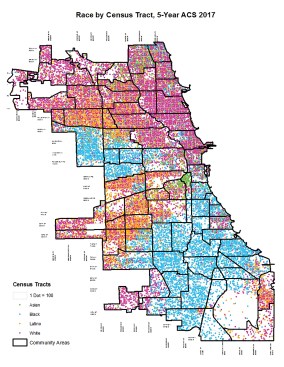
At the heart of both the Folded Map Project and Inequity For Sale are maps. By putting into spatial terms the socioeconomic forces that shape Chicagoans’ houses and neighborhoods, Johnson reveals a city still reckoning with generations of violent neglect. While the Folded Map Project “visually connects residents who live at corresponding addresses on the North and South Sides of Chicago” to create cross-community conversations, Inequity For Sale homes in on the lasting effects of contract buying within just a few square miles, revealing how 3,366 Black families lost their homes.
“The expression ‘You are a product of your environment’ is how I have come to know the importance of geography in my life and its connection to race,” Johnson says. “Not just whatever people’s preconceived ideas about your neighborhood are, but the good and the bad, all inclusive.”

courtesy Tonika Lewis Johnson
Johnson worked on the project during her 2021 Artist as Instigator residency with the National Public Housing Museum, which is set to start construction this fall on a permanent physical home in one of the buildings of the former Jane Addams Homes in Chicago. In the same era that large-scale public housing developments offered some Black Chicagoans a fresh start—only to be betrayed by years of organized abandonment—misleading contract sales to homebuyers cost Black Chicagoans upward of $4 billion in lost wealth, according to a 2019 study by Duke University and the University of Illinois-Chicago.
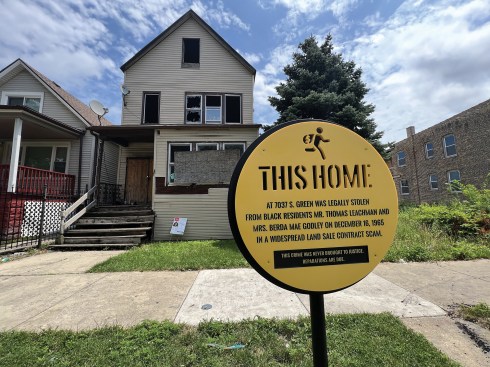
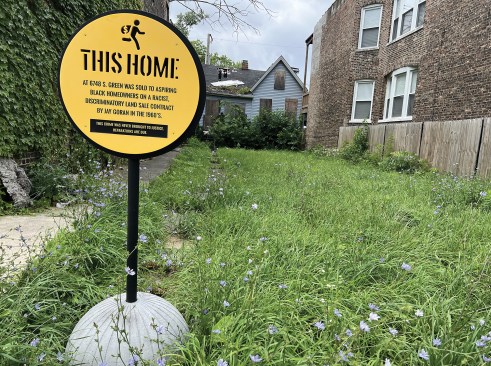
In addition to digital maps that document the thefts, and a multi-part podcast, produced by Johnson and the National Public Housing Museum called “Legally Stolen,” Johnson has created land markers planted in front of people’s homes in the community. These markers—which will soon expand to sites of Native land dispossession, and the banks that facilitated this large-scale theft—aim to remind people why we’re still bound to historical injustices that continue to harm communities today. The discriminatory housing practices perpetuated against aspiring Black homeowners parallels how land has been stolen from Indigenous peoples, Johnson explains. “It’s a throughline across time,” she says.
courtesy Tonika Lewis Johnson
courtesy Tonika Lewis Johnson

courtesy Tonika Lewis Johnson
courtesy Tonika Lewis Johnson
courtesy Tonika Lewis Johnson
courtesy Tonika Lewis Johnson
courtesy Tonika Lewis Johnson
This article first appeared in the October issue of ARCHITECT.
-
Next Progressives: Delma Palma
The New York City Housing Authority deputy director of design wants to do away with the "idea that one person behind a desk can best understand how to design for a community of users."

-
Laurian Ghinițoiu Offers a Fresh Approach to Photographing the Built Environment
The photographer focuses on its social, political, and physical contexts.

-
In Tuskegee and Pennsylvania, Educators Lead the Next Generation of Architectural Preservation
Leaders from Tuskegee University’s Department of Architecture and University of Pennsylvania’s Weitzman School are spearheading an initiative dubbed “Capacity Building for Sustainable Preservation of Civil Rights Heritage Places.”

-
Open Design Collective Gets Communities Involved in Planning Their Own Neighborhoods
The Oklahoma City–based nonprofit's first major project sought to repair damage from urban renewal in the local, largely Black community of South of 8th Street.
-
Nupur Chaudhury Imagines Public Health as a Matter of the Built Environment
Working alongside Dark Matter University, the urbanist and health-equity expert helped launch a curriculum that trains communities to lead their own design processes.

-
Tonika Lewis Johnson Uses Maps to Explore the Effects of Contract Buying on a Chicago Neighborhood
Called Inequity for Sale, the social justice artist's new project came to life during a 2021 residency with the National Public Housing Museum.

-
With This Knit-Casting Process, Concrete Leans Sartorial and Minimizes Production Waste
Tsz Yan Ng, Sean Ahlquist, and Evgueni Filipov are harnessing CNC-manufactured knits to develop a process that results in intricate and efficient glass-fiber-reinforced concrete.

-
Segregation by Design Examines Systemic Racism in American Cities
Founded by the New York architectural designer Adam Paul Susaneck, the website presents the stark reality of racist urban planning practices in the built environment.

-
This Nonprofit Uses Schools to Anchor Mixed-Use, Income-Diverse Community Development
Helmed by Nora Jendoubi and Derwin Sisnett, Memphis, Tenn.–based Maslow Development aims to create structures for all residents to succeed.
-
TreesAI Shows Communities How to Maintain and Grow Their Urban Forests
The startup, founded by the Amsterdam-headquartered, not-for-profit Dark Matter Labs, offers a software aimed to help cities plan and sustain urban foliage.