
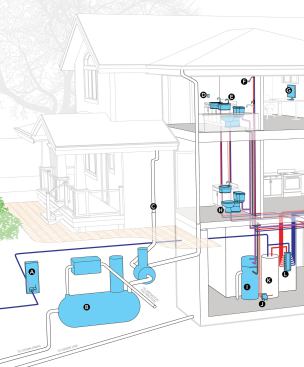
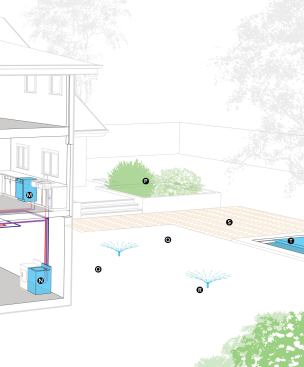
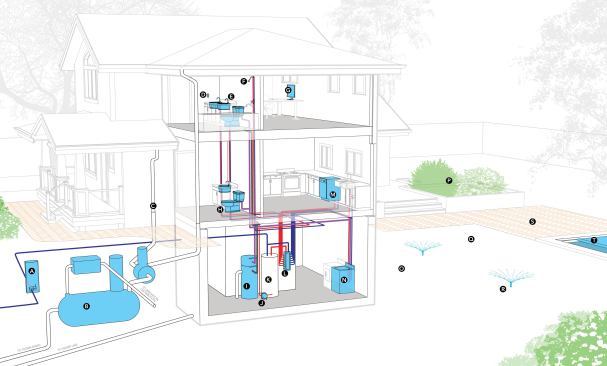
A) WATER METER Subsurface with grade-level display; wireless wit…
In addition to using plants that are indigenous to a given location and thus able to survive (and perhaps thrive) on only what nature provides, water-wise landscape plans feature less turf area within the total footprint, plants grouped by their water needs, and irrigation water delivered mostly via ground-level drippers or subsoil systems that put water at the base of the plants instead of on their foliage.
Meanwhile, what little turf area remains—less than 40% of the overall parcel, per the IGCC and WaterSense standards—is irrigated with smaller, rotating, low-flow spray heads that mitigate overspray onto hardscape areas; less turf also reduces energy and fossil fuel emissions from mowing, a chore that consumes an EPA-estimated 800 million gallons of gas a year and accounts for 5% of our nation’s air pollution.
But the key is control. The most sophisticated irrigation systems feature moisture-sensing timers that not only activate at the right time of day (early morning), but also only when necessary. If it rains the night before, they’re smart enough to shut off until the ground is sufficiently dry; like a structured wiring control hub, they also enable additional modules and reconfigurations to serve new plans and plants.
That level of technology takes money, however; while most low-flow indoor plumbing fixtures are priced competitively with their wasteful counterparts, high-tech irrigation components and control systems often come at a premium and may not be readily available—hurdles that often put the burden back on the homeowner to watchdog the watering schedule.
“The WaterSense standard can be quite different than the norm,” says Jim Szasz of J&R Custom Landscaping in Kissimmee, Fla., who pays four times as much for rotating spray heads, among other premiums, to achieve qualified landscaping and irrigation systems for KB Home’s Central Florida division—a region among those most threatened by freshwater scarcity. “But the water savings is about 80%.” (See “Ground Rules” page 37, for more on landscaping and irrigation.)
WATER INDEPENDENCE
As with any green building practice, there are indoor and outdoor water-efficiency options on the fringe of marketability and affordability that can shed a homeowner’s dependence on a municipal water supply—and the rising rates and use restrictions that come with it.
Greywater Reuse. Greywater is generally defined as water collected from bath faucets, showers, bathtubs, and occasionally clothes washers that is then mechanically filtered and reused to refill the home’s toilets. It is carried by a dedicated, purple-hued, sanitary pipe in a closed loop that keeps it from mixing with potable city water or the sewer lines.
#4 Water-Use Culprit: Showerheads
Average Use/Home: 11.6 gpcd (9,654 gallons/year/home)
Conventional Specs: 2.5-gpm showerhead (16.8% of daily indoor use)
Water-Saving Option: 2.0-gpm showerhead (est. 20% use reduction to 8.8 gpcd; 19.5% of daily indoor use)
Codes and Standards: IAPMO Green Plumbing and Mechanical Code; ICC International Green Construction Code; EPA WaterSense