Here, Ming Thompson, AIA, the New Haven, Conn.–based co-founder of Atelier Cho Thompson with Christina Cho Yoo, AIA, shares her realization that her efforts to increase representation in architecture will also have an impact on Asian Americans like her.
Alicia Cho
Ming Thompson
I’ve been lucky to be part of architectural groups such as AIA San Francisco’s Equity by Design committee and AIA Connecticut that have been thinking about issues of equity for years and pushing to expand the audience for those conversations. For a long time, these discussions felt like they were occurring in a silo outside of the mainstream. Today, dialogue about equity is at the core of conversations about the future of the built environment. Whether this is in a public meeting about a new downtown skyscraper, a design for a public art installation, or a plan for a farmers market, designers and planners are talking about access and equality in frank and direct terms.
But we have to go far beyond words. As young architects, we have the responsibility to hold our firms and our profession accountable—and we have to push for real action. I know other architects who have suffered professionally for speaking too loudly and too often about what our discipline can do better. We can’t let the energy of this moment die with hollow words in a press release. We need to be actively thinking about how we can use our practice, process, and role in the world to fight for racial justice.
Self-Reflection
I’m Asian American and I used to feel that my interests in building a more equitable architectural profession were about how to improve conditions for others. During the recent wave of violence against Asian Americans and Pacific Islanders, I started to turn my lens to my own identity in a way I never had before. What does it mean to be an Asian American? How have my experiences shaped the designer I am today? How has my identity shaped my vision for the future of architecture?
Fewer than 1% of architects in my state are Asian American, and AAPI female firm owners are a rarity. I have been realizing more and more that I have a responsibility to open the door for others like me.
During the recent wave of violence against Asian Americans and Pacific Islanders, I started to turn my lens to my own identity in a way I never had before.
My business partner and I both grew up in southern towns, and we were usually the only Asian people in a room. We’ve realized that our experiences growing up, of being different, and of navigating the complexities of identity have strengthened our ability to empathize with and understand the incredibly diverse group of people we serve as architects. I always tell my students that an architect’s first job is to listen. Understand where someone is coming from and together you can chart a better path. Architecture school teaches us to leap in with design solutions, but we need to bring respect for the value and knowledge of lived experiences in the communities where we work.
Engaging the Community and Next Generation
Last March, we realized that, as architects deeply embedded in our community, we had a unique opportunity. On one side, we had our friends and clients in New Haven who were experiencing incredible problems stemming from the pandemic; on the other, we had a group of brilliant design students facing the lack of available summer jobs. We teamed with Yale University’s Center for Collaborative Arts and Media and created a program called Design Brigade.
The program helps solve community design problems and offers students real-world learning opportunities and mentorship. Its work was founded on principles of equity, transparency, and—above all—collaboration, as the students sought to design with their community, and not just for. As architects, we have the privileged role of interpreting the hopes, dreams, and memories of our communities into the built environment. I’ve been most struck by how our Design Brigade students are better able to see the world through others’ eyes. They are bringing a slower, thoughtful, and community-engaged process to their paths as future architects.
Design Brigade
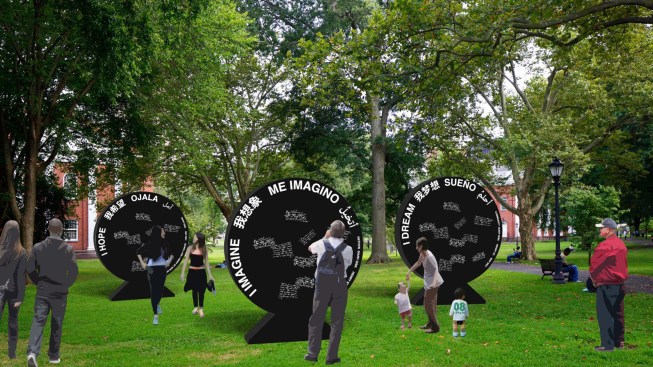
"Diary Disks," an installation by the Design Brigade in New Haven, Conn.

Design Brigade
"Diary Disks," an installation by the Design Brigade in New Haven, Conn.
Design Brigade
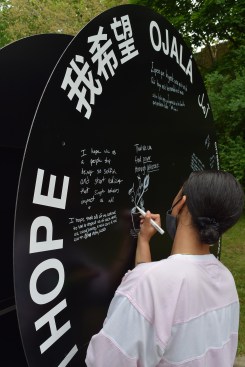
"Diary Disks," an installation by the Design Brigade in New Haven, Conn.
In the depths of the pandemic last year, we also worked with elders in a managed care facility to address wellness issues; with shuttered museums to make their resources accessible to children; and with the residents of our city to design a memorial for COVID-19. The first stage of the memorial is rolling out now across New Haven in the form of “Diary Disks,” a large-scale installation of black 6-foot-diameter boards that help foster public conversation after so many months of isolation.
Good design is for all. If we can do a better job showing how great architecture can lead to a more equitable world—and how our work is deeply relevant to society—then we will draw others to our mission.
As told to Wanda Lau via email. The views and conclusions from this author are not necessarily those of ARCHITECT magazine or of The American Institute of Architects.
-
Kwesi Daniels: Let’s Be Honest About How This Country Operates
The head of Tuskegee University's architecture department shares how this past year has opened the door for deeper conversations—and more opportunities for his students.

-
Kimberly Dowdell: Pursue Societal Change Through Design
The Chicago-based HOK marketing principal reflects on the profession at large, as well as her initiatives, one year after George Floyd's murder.

-
Joyce Hwang: Enough with Incremental Change
The University at Buffalo SUNY associate professor and associate chair of architecture and Ants of the Prairie founder wants to do much more to improve inclusion and diversity in design.
-
Cruz Garcia: Everyone Wants to Be a Savior—Without Giving Up Power
Despite the emotional toll, the WAI Architecture Think Tank co-founder, educator, author, and artist speaks openly about oppression and marginalization because he knows few others can safely do so.
-
Ming Thompson: Our Differences Can Make Us Better
Long active in increasing representation in architecture, the New Haven, Conn.–based co-founder of Atelier Cho Thompson is revisiting her own identity due to the recent increase in anti-Asian violence.
-
Patricia Acevedo Fuentes: I Want People to Know My Name
In order to feel more at home in South Dakota, the 2021 Bush Fellow and JLG Architects market leader got involved in her community—and was pleasantly surprised to find a seat at the table.

-
Rosa Sheng: We Can’t Turn Back Now
The founder of AIA San Francisco's Equity by Design committee and SmithGroup principal translates her advocacy of social, racial, and environmental justice into the business of architecture.

-
Erica Cochran Hameen: A Half Dozen Students Can Lead a Revolution
The assistant professor and Carnegie Mellon University School of Architecture's inaugural director of diversity, equity, and inclusion is emboldened by her students and research to achieve equitable outcomes for everyone.

-
Jonathan Moody: Be Wary of Normal
The CEO of national firm Moody Nolan does not want to lose the momentum—or the discomfort—of the past year as they relate to racial justice.
-
Esther Choi: Courage Is a Muscle
The multidisciplinary artist behind Office Hours is actively fostering relationships and engagement among diverse communities while continuing to learn how to decenter whiteness and heteropatriarchal biases in her speech, thoughts, and actions.