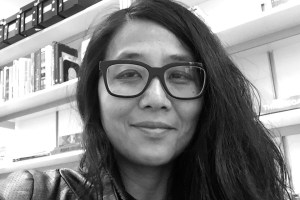
Here, Joyce Hwang, University at Buffalo SUNY associate professor and associate chair of architecture and Ants of the Prairie founder, explains why she feels she can never do enough.

courtesy Joyce Hwang
Joyce Hwang
In the past year, discourse around racial justice has intensified everywhere. Increasing diversity and inclusion has been part of our strategic plan for years, but with the murder of George Floyd, an awareness of the injustices that we face became acute.
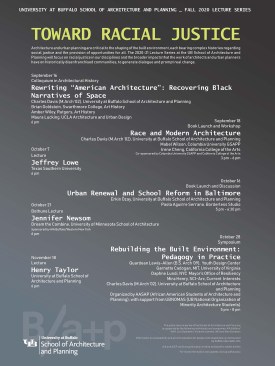
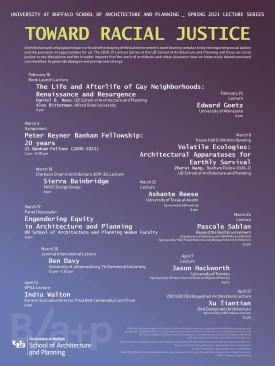
Like many universities, our students, faculty, and alumni organized town halls, which have been happening on Zoom because of the pandemic. Our school’s diversity and inclusion committee grew and attracted more student participation. Samina Raja [a professor in urban and regional planning and the associate dean for research and inclusive excellence at UB’s School of Architecture and Planning] spearheaded much of this committee’s work, which seemed more urgent and amplified. Like other schools, we took on racial justice as a theme for our lecture series and increased our discourse with students around these issues.
courtesy Joyce Hwang
Posters for UB School of Architecture and Planning 2020-2021 lecture series "Toward Racial Justice"
courtesy Joyce Hwang
Posters for UB School of Architecture and Planning 2020-2021 lecture series "Toward Racial Justice"
Uncomfortable Conversations
What always comes up is reviewing our curriculum and adding to our reading lists. We have a number of faculty on the forefront of talking about these issues: [Assistant professor of architectural history and criticism] Charles Davis, for example, is a co-author of Race and Modern Architecture (University of Pittsburgh Press, 2020).
But a lot of underlying issues also need to be addressed, like the culture of the school and how do we actually promote a more inclusive environment? We are thinking about the power dynamics between students and faculty, within department leadership, and even between tenure-track and tenured faculty. We are discussing how to bring up uncomfortable topics in class without feeling anxious, and Samina has organized workshops on microaggressions.
There’s also a lot of conversations happening informally between faculty and students. Having conversations with students in a more open way has been meaningful. In the architecture department, we’ve had discussions within faculty meetings centering on diversity, inclusion, and justice. When we get to the point where we’re talking about things that can be uncomfortable, that feels like we’re starting to make progress rather than ignoring things.
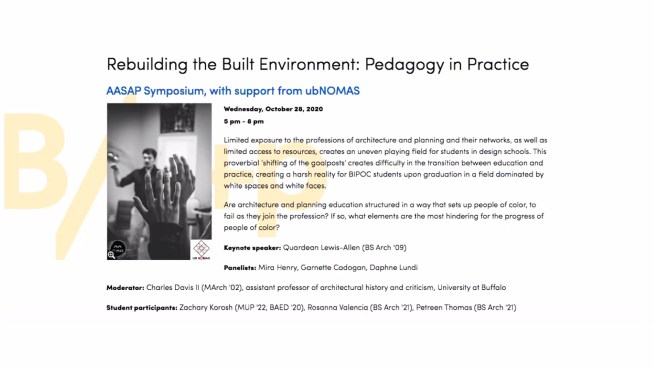
In 2019, The African American Students of Architecture and Planning organization began developing a symposium, which I was working with them on. With the confluence of the horrible injustices that we’ve seen and the conversations we’ve had, the content, participation, and energy led to a truly spectacular symposium last October.
courtesy Joyce Hwang
Zoom still from the 2020 symposium "Rebuilding the Built Environment: Pedagogy in Practice," organized by AASAP with support from University at Buffalo's National Organization of Minority Architects Students

courtesy Joyce Hwang
Zoom still from the 2020 symposium "Rebuilding the Built Environment: Pedagogy in Practice," organized by AASAP with support from University at Buffalo's National Organization of Minority Architects Students
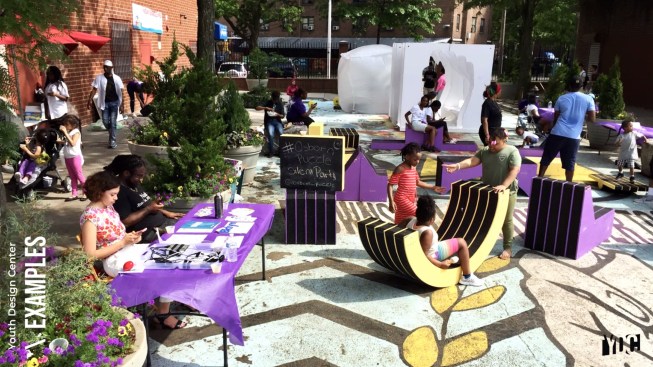
Youth Design Center / screenshot courtesy Joyce Hwang
Zoom still from the 2020 symposium "Rebuilding the Built Environment: Pedagogy in Practice," organized by AASAP with support from University at Buffalo's National Organization of Minority Architects Students
Of course, the increase in violence against Asian Americans and Pacific Islanders has been devastating and horrible. Many Asians—women, in particular—in architecture have been meeting semiregularly to talk through issues. I don’t remember feeling this anxious in my lifetime. As a person of color, I’ve experienced racism in all different ways, but the hate crimes that are going on are just unspeakable. So smaller communities of people are getting together and talking.
More Than Words
Over the past year, there’s been increased urgency to discuss issues of race, but we’ve also [expanded our work in increasing] diversity and inclusion, which had primarily revolved around people with disabilities [the IDEA Center is based at UB]. [Associate professor of architecture] Beth Tauke’s Diversity and Design course has been going on for decades and is a requirement for all undergraduates.
Even with these things in the blood of the school, there has been a shift to make changes that are not so incremental. Institutions are always trying to increase diversity in faculty and students. Like “there’s this many more individuals this year,” or “oh, we’re doing a little bit better this year.” And right now, there’s a lot of exasperation with incremental changes.
I’ve been in administration since 2018, and I have been leading a lot of efforts on the diversity front for a while. But how does one really make a difference? I’ve been thinking about that question a lot. Does trying to get one more person of color onto a faculty or changing reading lists make a difference in the discipline? Or does something need to be addressed at a broader level across institutions and across disciplines?
I had thought if I do my job well at the university, we can increase this and that. But it feels almost too slow. Since July, I started organizing with Dark Matter University. Through it, I’ve been mentoring and thinking about ways of sponsoring and elevating people of color. I’m also on the steering committee for US Architects Declare. Working with like-minded people who want to make changes in urgent ways has been meaningful.
But how does one really make a difference? I’ve been thinking about that question a lot.
Professional Participation
The local AIA chapter’s diversity committee is trying to do a lot of work in terms of outreach to high school students. The design community can also do a better job of recruiting diverse students at a much younger age. Filtering people into architecture in college or grad school is too late. We could improve things at both levels. Many students hit the ground running when they get to college, while many others come from backgrounds where they just don’t have the opportunity to be as prepared.
In the professional design community, offices and schools need to re-examine hiring practices and promotion practices—how they [evaluate] people and their skills, efforts, and works that go beyond the hierarchies that are oftentimes the results of power dynamics and networks that are exclusionary. Recognizing imbalances in the power dynamics that exist and then finding ways to get around them are important.
Career Advice
In response to the pandemic, but also in part to some of the questions of diversity and inclusion, our school implemented a career advisement and mentoring program. Our new career advisement coordinator, Elaine Chow, has asked alumni worldwide if they would serve as career mentors to our students. We explicitly select alumni who do different things, like thinking about alternative ways to practice, perhaps in addition to working in a firm. For example, Kimberly Sass works full-time at HLW, but also is a professional hockey player.
We are trying to showcase these ideas so students are not thinking, “The only way I can be an architect is to go and work at this one firm, climb up the ladder, and become a principal.” Instead, you can stake out a path for yourself in many ways.
As told to Wanda Lau. The views and conclusions from this author are not necessarily those of ARCHITECT magazine or of The American Institute of Architects.
-
Kwesi Daniels: Let’s Be Honest About How This Country Operates
The head of Tuskegee University's architecture department shares how this past year has opened the door for deeper conversations—and more opportunities for his students.

-
Kimberly Dowdell: Pursue Societal Change Through Design
The Chicago-based HOK marketing principal reflects on the profession at large, as well as her initiatives, one year after George Floyd's murder.

-
Joyce Hwang: Enough with Incremental Change
The University at Buffalo SUNY associate professor and associate chair of architecture and Ants of the Prairie founder wants to do much more to improve inclusion and diversity in design.
-
Cruz Garcia: Everyone Wants to Be a Savior—Without Giving Up Power
Despite the emotional toll, the WAI Architecture Think Tank co-founder, educator, author, and artist speaks openly about oppression and marginalization because he knows few others can safely do so.

-
Ming Thompson: Our Differences Can Make Us Better
Long active in increasing representation in architecture, the New Haven, Conn.–based co-founder of Atelier Cho Thompson is revisiting her own identity due to the recent increase in anti-Asian violence.
-
Patricia Acevedo Fuentes: I Want People to Know My Name
In order to feel more at home in South Dakota, the 2021 Bush Fellow and JLG Architects market leader got involved in her community—and was pleasantly surprised to find a seat at the table.

-
Rosa Sheng: We Can’t Turn Back Now
The founder of AIA San Francisco's Equity by Design committee and SmithGroup principal translates her advocacy of social, racial, and environmental justice into the business of architecture.

-
Erica Cochran Hameen: A Half Dozen Students Can Lead a Revolution
The assistant professor and Carnegie Mellon University School of Architecture's inaugural director of diversity, equity, and inclusion is emboldened by her students and research to achieve equitable outcomes for everyone.

-
Jonathan Moody: Be Wary of Normal
The CEO of national firm Moody Nolan does not want to lose the momentum—or the discomfort—of the past year as they relate to racial justice.
-
Esther Choi: Courage Is a Muscle
The multidisciplinary artist behind Office Hours is actively fostering relationships and engagement among diverse communities while continuing to learn how to decenter whiteness and heteropatriarchal biases in her speech, thoughts, and actions.