
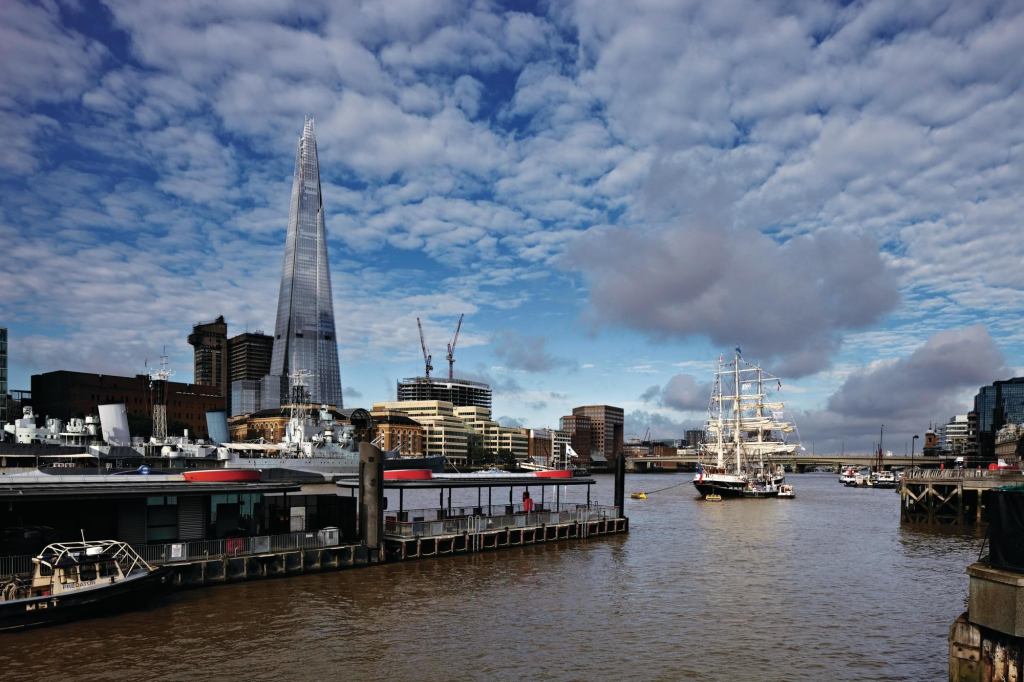
While most urban theorists agree that density holds the key to a more sustainable city, somehow such a goal got warped when all of this building’s functions became blue-chip, including the observation platform (floors 68 to 72, with tickets costing £24.95 [$40.47] per adult). From the multimillionaire penthouses in double-height units (floors 53 to 65, selling typically for £50 million [$81.2 million]), to the five-star Shangri-La Hotel (floors 34 to 52), three stories of luxury restaurants, 26 floors of high-profile offices, a lobby and luxury retail at the base, there is no reason for anyone of the nonprivileged status to enter here, except to serve. The Shard seems uncannily close to the scenario in Fritz Lang’s Metropolis (1927), in which the elite class of the future lives in aerial pleasure domes, while the drones (in London’s case, today’s wage-slave commuters trudging to work) suffer below grade. By law, the project had to provide a certain number of subsidized-housing units, which were conveniently removed somewhere far from the site.
But one cannot deny the Shard’s shimmering fascination: It looms above the city like a vindication of the Futurist’s challenge to the dreary ossification of the historic city. An elongated pyramid, the designers set independent planes of glass in staggered positions to confound an understanding of its true geometry; while at the apex, four glazed flanges peel back at different angles, like shucks of a ripe ear of corn. The tower glistens like the “city crown” dreamed of by Bruno Taut and the Expressionists, creating an exclamation like Wren’s steeples—the excitement of which few can resist.
Piano’s mantra is “lightness,” and he often achieves it through glazed surfaces. Here, he made the Shard’s cladding completely of glass, but to avoid the monotony of a simple box with curtainwalls, he generated a dynamic skin of overlapping planes of glass, or wing-walls. Technically, they have sophisticated double skins, leaving a foot between inner and outer panes in which the air temperature can be neutralized and, if desired, where a computer can slip shades into place to resist glare. (Privacy is not an issue at such altitudes, and the views to St. Paul’s Cathedral, the city, and the Olympic Park are literally worth millions.)
The section of Piano’s skyscraper varies in a few places but, in general, the floor plan repeats 72 times with continually diminishing perimeters, ranging from 2,000 square meters (21,527 square feet) at the base to a quarter of that at the top. Set above the underground’s London Bridge Station, which will be redesigned by architect Nicholas Grimshaw, the tower was developed with an adjacent project—the London Bridge Quarter, also designed by Piano’s office—for a 16-story block of offices, doubling the amount of office space in the high-rise. Nearby is the Borough Market, which has become a gourmet’s tourist trap, and the picturesque Southwark Cathedral. While the glass tower is a thrilling landmark that dominates London, it does not, like most of Piano’s projects, offer a comfortable gathering place. Here, there’s only a tiny, benchless plaza that people race through to get into the station.