
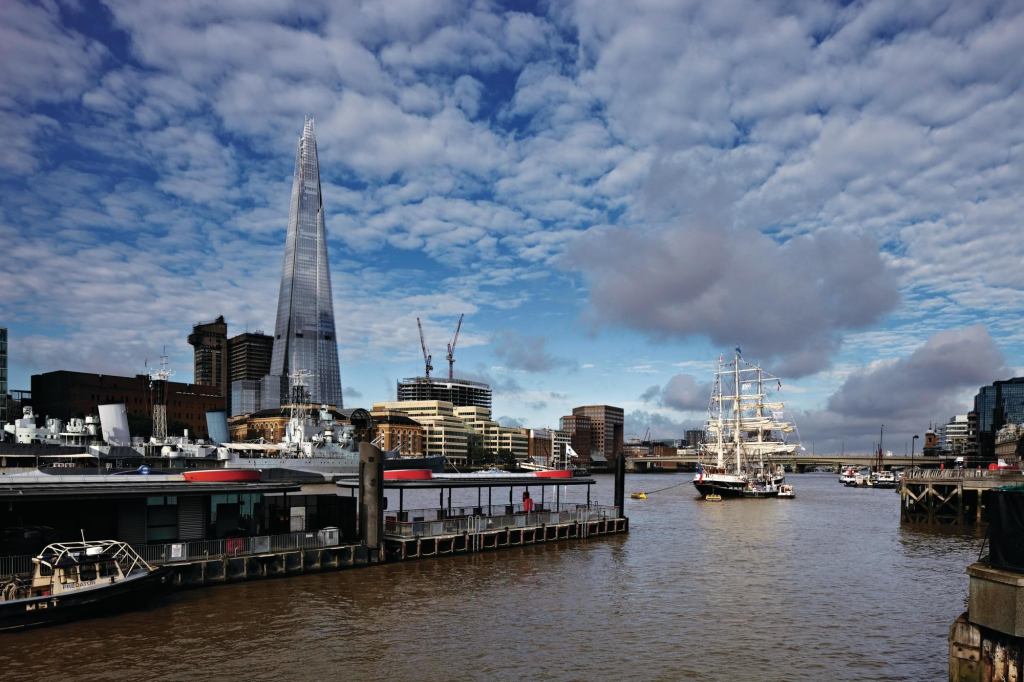
Few projects represent the 1 percent of the population that owns 40 percent of the world’s wealth better than Renzo Piano, Hon. FAIA’s so-called “Shard” in London’s Southwark District. Opened a few weeks before the 2012 Olympic Games, the 309.6-meter (1,016-foot) crystalline tower now reigns as the tallest building in Western Europe, providing a sensational leap in scale—similar to the Eiffel Tower’s effect on the skyline of Paris. Though promoted as a mixed-use complex, it caters exclusively to luxury functions. Meanwhile, across the Thames, the same architect’s firm completed another project, the brightly colored Central St. Giles, in the densest part of the West End. Here the patronage proved only slightly less elite, but the scale has been sensitively handled to fit the existing fabric, and the city has gained an unexpected new public space in an area that previously had been off-limits.
Piano, who consistently provides technologically innovative responses to complex programs, has supplied London with two icons of prime urban value: the monument and the plaza. Each project also unwittingly represents a transition in the historical continuum. The Shard belongs to a syndrome that Lewis Mumford immortalized in his aphorism: “The bigger the monument, the shakier the institution.” Other pundits have consigned it to the “Skyscraper Index,” which claims that the construction of the tallest structure anticipates economic decline (e.g., the Chrysler Building and the Great Depression or the Sears Tower and the 1973 recession).
The Shard began construction just after the fateful debt crisis of 2008—and goes hand in hand with Dubai’s Burj Khalifa, the tallest building in the world—which signaled the beginning of the severe economic crisis of the past three years. The development of the London tower was initiated in 2000 by Irvine Sellar and was salvaged in 2009 by a consortium from Qatar, allowing construction to begin. (Dubai, United Arab Emirates, was bailed out by a sheik from Abu Dhabi, United Arab Emirates, around the same time.)
Central St. Giles, on the other hand, developed in 2007 by the Japanese conglomerate Mitsubishu Estate, had a more straightforward process. While serving both high-end media corporations and high-rent dwellings, the compound contains a significant amount of public housing, and its fragmented orange, green, and yellow ceramic façades offer exceptional porosity and engage the architecture with the street. The complex exudes a desire to redirect private finance toward public benefit.
In theory, Piano objects to tall buildings, yet he has designed some of the tallest of the last decade, including the 52-story New York Times Building in Manhattan (2000–2007). This activity may derive from the banal matter of balancing the books of a very large office, which gains highly profitable fees from high-rise constructions. And he defends the London tower as embodying London’s ex-mayor Ken Livingstone’s ecological quest to densify the city by situating tall structures in nodal positions, in this case on top of London Bridge Station.