The building envelope is often referred to as “the third skin” based on its similarity to other basic protective surfaces. Like our skin (first) and clothing (second), the bulding façade acts as a selective membrane, providing protection from the elements and other threats while allowing access to necessary functions such as views and fresh air.
Although the skin analogy has its limitations, research efforts at the Institute for Chemical and Bioengineering at ETH Zurich point to a more literal relationship. ETH professor W. J. Stark and his colleagues think that a thermoresponsive polymer can be used on buildings to emulate the function of sweat glands in the skin. Poly-N-isopropylacrylamide (PNIPAM) exhibits contrasting behaviors at different temperatures. Below 32 C, the material swells with moisture; but, above this critical solution temperature PNIPAM becomes hydrophobic, releasing water and thus inducing a cooling response.
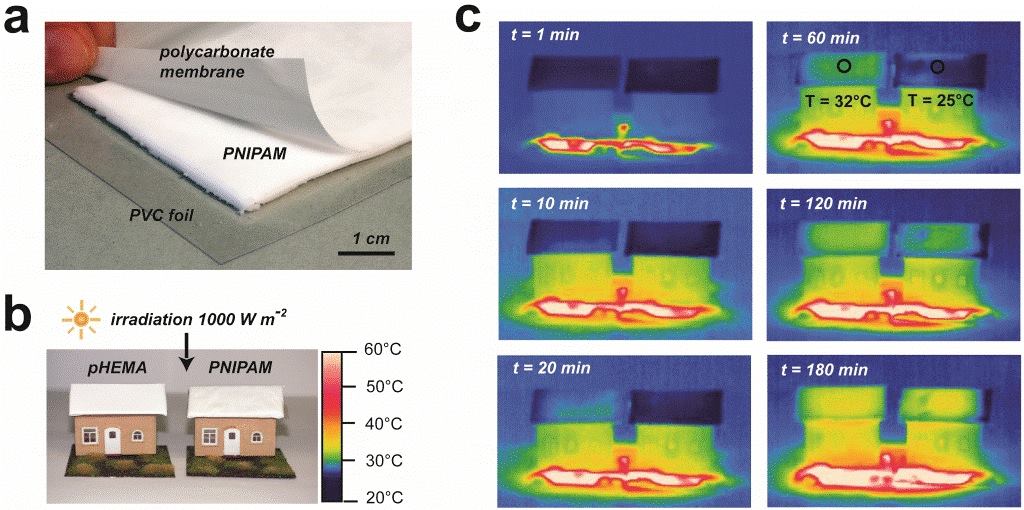
Hypothesizing that PNIPAM’s sweating action could improve the temperature regulation of buildings, Stark and his team used their material in a rooftop simulation, comparing the performance of the thermoresponsive polymer with that of hydrogel. Shown in infrared images above, the hydrogel roof heated up first, and within one hour was 7 C warmer than the PNIPAM roof. Although it eventually matched this temperature, the experimental material successfully delayed the absorption of heat due to its evaporative cooling abilities.
The proposal to apply PNIPAM to building skins raises many good questions, such as how to maintain hydration of the material, how to incorporate an effective moisture barrier, and how to protect the material’s surface without stifling its ability to sweat. Nonetheless, Stark and company’s discovery suggests a more environmentally responsive—and biomimetic—future for architectural façades.