A) WATER METER Subsurface with grade-level display; wireless wit…
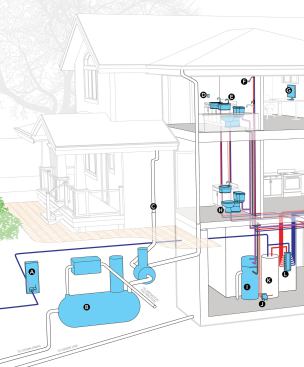
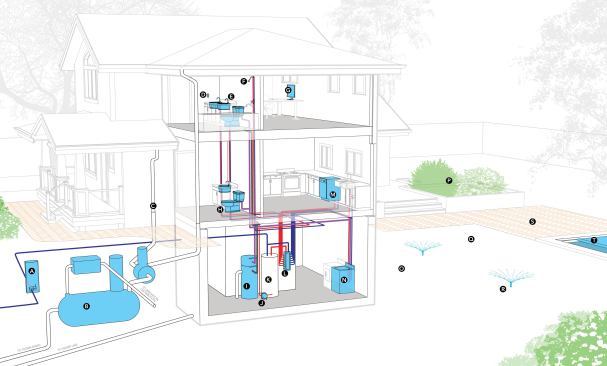
A) WATER METER Subsurface with grade-level display; wireless with leak detection and pressure regulator
B) RAINWATER COLLECTION Cistern, filter, irrigation control; overflow and filtered matter to storm drain
C) STORMWATER DRAINAGE Collect rainwater from roof/gutter system for irrigation; also contains runoff on site versus storm drain
D) HOT-WATER RECIRCULATION Motion detector– or manual button–activated recirculation (all bathrooms)
E) BATH FAUCETS 32% potential water savings per EPA WaterSense standard; also a greywater source
F) SHOWER 20% potential water savings with EPA WaterSense-qualified low-flow showerheads; also a greywater source
G) WATER MONITOR Real-time use via PC per water meter; also leak detection and irrigation control
H) TOILET 20% potential water savings with 1.28-gpf models vs. 1.6-gpf, per EPA WaterSense standard; greywater supply eliminates use of potable water
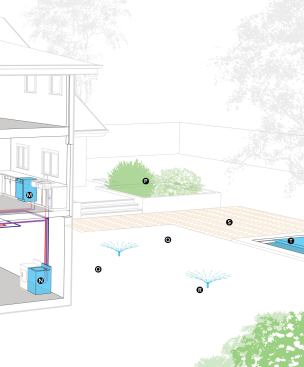
M) DISHWASHER 30% water savings with Energy Star–qualified mo…
M) DISHWASHER 30% water savings with Energy Star–qualified models N) CLOTHES WASHER 33% potential water savings with Energy Star–qualified models; also a potential greywater source O) LEAKS (OUTDOOR AND INDOOR) Average 14% of annual householdM) water use (7,900 gallons per year) P) PLANTS Native and drought-tolerant; grouped by similar irrigation needs; watered by drip irrigation Q) TURF AREAS No more than 40% of lot; native and drought-tolerant; watered by rotating spray heads R) IRRIGATION SYSTEM Smart controls; weather-based and/or soil sensor S) PERMEABLE AREAS Permeable pavers on sand bed reduce stormwater runoff from the site T) POOL COVER Pool/spa cover to reduce evaporation
The pressurized system allows the first 900 gallons in a full cistern to be used for landscape irrigation, car washing, and anything else outdoors—free from occasional citywide use restrictions in the summer. But if the cistern’s capacity dips below 500 gallons, the system automatically reverts to serving only the toilets. And if the power goes out, rendering the pumps inactive, the toilets automatically switch to pressurized city water through second lines into each fixture—a redundancy that costs extra but delivers peace of mind and a hassle-free experience.
The rest of Hollyport’s outdoor water-saving plan includes turf areas that account for only 25% of the entire parcel, water-permeable hardscapes that return runoff to the ground, automated irrigation, and mulched planting areas that work with the cistern to contain 78% of the rainwater runoff on the home’s lot instead of taxing Richmond’s storm/sewer system, which the city is upgrading with a $25 annual tax on residents.
#6 Water-Use Culprit: Leaks
¦ Average Use/Home: 9.5 gpcd (7,906 gallons/year/home; 13.7% of daily household use)
¦ Mitigation: Detection, repair, and replacement results in an estimated 58% reduction to 4.0 gpcd; 8.8% of daily household use
¦ Codes and Standards: None
Next Tech. Beyond greywater- and rainwater-reuse systems, a few other technologies are emerging to further boost efficiency.
Advanced home humidifiers, for example, use far less water than older versions, while whole-house water softeners ease wear and tear on pipes and water heaters, allowing them to work at peak efficiency.
Hydronic (or radiant) heating systems, meanwhile, are being designed to follow the lead of hot-water recirculation with closed-loop schemes that require less make-up water and heating energy to perform effectively.
Meanwhile, next-gen water meters installed by an increasing number of utilities to help manage resources are able to detect leaks (which can account for an average of 14% of a home’s water consumption) and provide real-time water usage and other account data online, allowing homeowners to gain some control of their consumption and alter their lifestyle habits to conserve more.
“Empowerment is the future of water conservation,” says Kathy Nguyen, senior project manager for the Cobb County Water System, which serves the Atlanta area. Financial incentives, such as rebates, fines, and incremental pricing structures, she says, “will only get you so far.”