
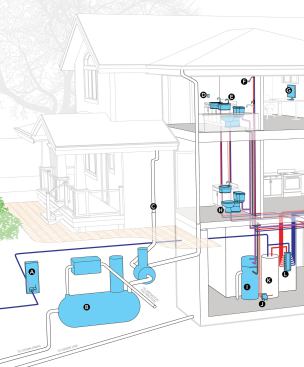
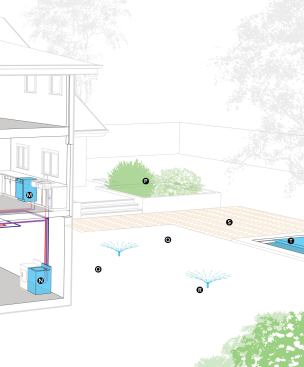
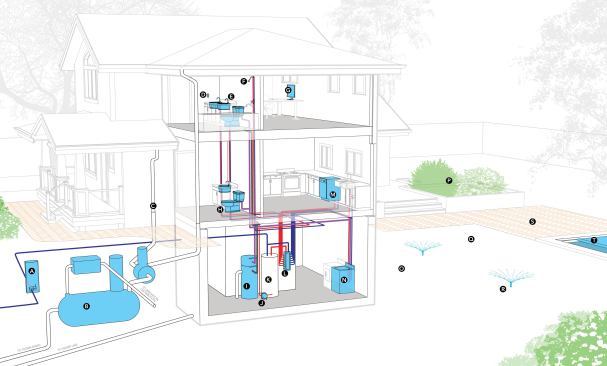
A) WATER METER Subsurface with grade-level display; wireless wit…
Recycled greywater also has been allowed for landscape irrigation under the UPC since the mid-1990s, but what’s collected usually must be used within 24 hours to mitigate potential health hazards, which has limited its use in that regard.
Available greywater can account for perhaps half of a typical home’s indoor water consumption, according to a 2010 white paper by the WateReuse Association. The paper reports that 7% of U.S. households in 2000—led by those in California, Texas, and Pennsylvania—were using some measure of greywater to offset municipal sources, a rate expected to increase to 10%, or more than 14 million households, by 2030. (See “Second Time Around,” page 45, for more on greywater.)
Stormwater Reuse. Similar to greywater, storm (or rain) water collection is regulated in terms of allowable household uses; not every jurisdiction allows it, but its generally “cleaner” sources—primarily a home’s roof and gutter system—make it far less restricted than greywater for landscape irrigation and other outdoor uses.
#5 Water-Use Culprit: Faucets (Kitchen and Bathrooms)

¦ Conventional Specs: 2.2-gpm lav and kitchen/bar faucets (15.7% of daily indoor use)
¦ Water-Saving Option: 1.5-gpm lav faucets (no change to kitchen/bar faucets) (no change in estimated gpcd; 23.9% of daily indoor use)
¦ Codes and Standards: IAPMO Green Plumbing and Mechanical Code; ICC International Green Construction Code; EPA WaterSense
Generally, passive or non-pressurized catchments sold at retail outlets consist of 50-gallon barrels fed by the gutter system; a spout near the bottom accepts a garden hose to help supplement a potable water irrigation scheme.
But more sophisticated systems designed for meaningful water savings comprise underground cisterns, filters, and pumps to manage water drawn not only from gutters and downspouts but also the condensate from air conditioning units (perhaps 20,000 gallons a year alone)—in some cases to completely offset city-supplied water for outdoor use.
That’s the case in Richmond, Va., where Hollyport Ventures built the city’s first LEED-certified house, including a comprehensive rainwater collection and reuse plan anchored by a 1,400-gallon underground cistern that supports the toilets inside and all outdoor demand.