
LIGHTING CONTROLS AND CURFEWS The MLO recommends the use of controls to save energy and reduce unwanted light. Communities are encouraged to set curfews when outdoor lighting is reduced or extinguished. This not only reduces the chance of light trespass, but also saves energy during low-activity times.
COMPLIANCE METHODS The MLO offers two compliance methods, prescriptive and performance. Installations with no aimable lighting can follow a simple prescriptive path. Simpler prescriptive methods such as lumens per parking space are also being explored. More complicated installations with adjustable lighting and higher lighting levels, such as a sports facility, can follow the more complicated performance path. The first MLO edition may be offered without the performance method.
The prescriptive method has a two-part compliance path. The first part prohibits over-lighting by limiting the amount of total lumens allowed. Maximum lamp lumen densities are assigned per lighting zone, with less light allowed in LZ0 and more in LZ4. In order to accommodate different sizes, use types, and shapes, the lumen density limits are calculated as follows: Total initial lamp lumens allowed per site = lumen density (lumens per square feet) x hardscape area (feet) + lumens per linear foot x perimeter (feet) + initial lumen allowance (one per site).
Some additional lumens may be allowed for specific uses such as façades, entries, emergency facilities, eldercare facilities, and outdoor retail establishments.
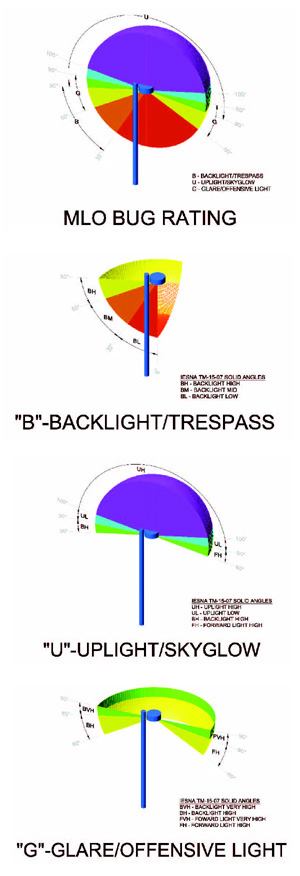
The second part limits the amount of light (lumens) emitting from luminaires in backlight, upward, and glare zones. This has been coined the BUG rating for luminaires. IESNA TM-15-07 “Luminaire Classification System for Outdoor Luminaires” describes the lumen distribution within solid angles required for the BUG ratings.
Each lighting zone will allow different luminaire BUG ratings such that LZ1 will allow less or no light compared with LZ4. Manufacturers will give each luminaire a BUG rating per lamp type and wattage.
The performance method is the more complicated path of compliance. It limits the amount of light leaving the site (sky glow), minimizes light trespass (maximum candela values leaving the site), and also prohibits over-lighting (similar to prescriptive method with lumen density limits). Since the sky glow calculates both direct and reflected light, computer programs will be required to show compliance. The task force has received excellent feedback from computer software programmers in how the performance method will be calculated and calibrated.
PROCESS GUIDELINES To encourage communities to adopt the MLO, it is designed to be easy to use and to provide clear process guidelines for implementing each part of an effective ordinance. For example, residential outdoor lighting regulations need to be extremely simple for the general public to understand. The MLO section on residential lighting suggests limiting the amount of lumens per residence (or watts). In addition, there is a simplified luminaire description of solid tops and sides for luminaires with high-wattage lamps.
The MLO can not possibly cover all the variety of lighting situations, but it does make it easy for any community to create a lighting ordinance that fits its particular needs, and is technically sound and enforceable.
SUMMARY The Task Force is in the final stages of MLO development. Table values are being checked and verified, samples sites are being tested, and performance method formulas are being developed with sample results for the computer programs. Some luminaire manufacturers have been involved in the values assigned to the BUG ratings. The MLO should be available for review this summer, when professional and manufacturer input will be requested. The IDA and IESNA through their websites, member announcements and press releases, will announce the public review process.