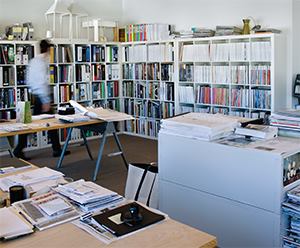
Impromptu meeting spaces allow employees to collaborate on proje…
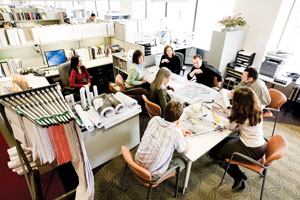
Impromptu meeting spaces allow employees to collaborate on projects and are located throughout the office.
Photo: Stefan Hester
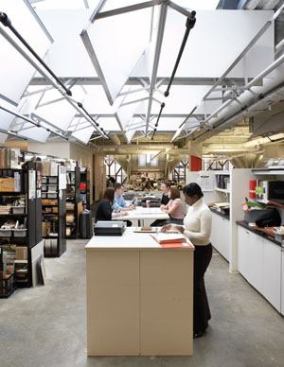
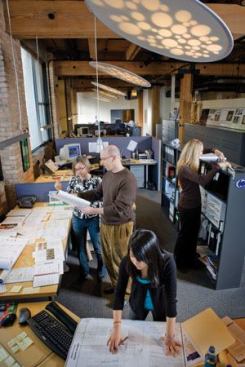
HOK's nontraditional office space in St. Louis features exposed …
HOK's nontraditional office space in St. Louis features exposed ceilings and close working quarters without cubicles or partitions because those discouragecommunication among staff members.
Photo: Brian Smale
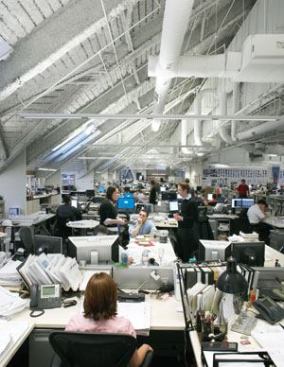
Candela's Seattle office was remodeled in January 2008, during w…
Candela's Seattle office was remodeled in January 2008, during which employee workstations were reduced in size while more space was created for casual collaboration on projects
Photo: Brian Smale
So far, the staff likes the smaller workstations that now also h…
So far, the staff likes the smaller workstations that now also have access to daylight.
Photo: Matt Greenslade
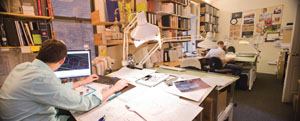
Photos, awards, mock-ups, previous projects, and other itemsare …
Photos, awards, mock-ups, previous projects, and other itemsare spread throughout the office to help inspire employees as they are work on lighting designs.
Photo: Matt Greenslade
The office environment of Focus Lighting, designed to be one of …
The office environment of Focus Lighting, designed to be one of experimentation and creativity, has a homeyfeel as it is located in a row house in Manhattan.
Photo: Matt Greenslade
Large windows allow for daylight and great views of the city.
Photo: Matt Greenslade
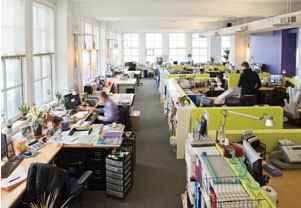
Bold colors adorn the walls of Horton LeesBrogden Lighting Desig…
Bold colors adorn the walls of Horton LeesBrogden Lighting Design's New York office which has low partitions to foster communication.
Photo: Jim Newberry
All employees at Schuler Shook, includingthe principals, have an…
All employees at Schuler Shook, includingthe principals, have an open workarea in the Chicago office. Theopenness of the office is meant to promoteconversation among colleaguesand allow everyone in the office to learnfrom each other.
Photo: Michael Darter
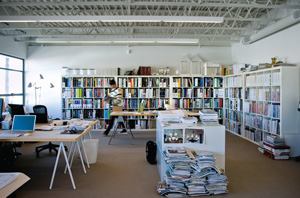
The Los Angeles office for Sean O'Connor Associates Lighting Con…
The Los Angeles office for Sean O'Connor Associates Lighting Consultants has northernand western exposures and offers superb views of the surrounding areas.
Photo: Michael Darter
Having an openoffice results in easier communication and keeps p…
Having an openoffice results in easier communication and keeps projects moving along quickly.
Schuler Shook has been at itscurrent location since 2001. As the third space since the firm was founded, principal Robert Shook says something they added to the current office is more meeting areas, both informal and formal. Principal Jim Baney explains that the office is designed to foster interaction as the lighting designers work in teams of two, with each team’s work area connected by a central drawing storage rack and integrated work surface. By typical open office standards, according to Shook, the designers’ workstations are large, allowing space to spread out and store drawings, in addition to giving designers quick access to documents when a client calls about a project. Everyone at the firm, including the partners, has an open office because “we consider it valuable for anyone to be able to listen to his or her colleagues,” Shook says. “We learn from each other.” The open office space primarily is illuminated by fluorescent and ceramic metal halide sources, and its lighting design is energy efficient, using 1.1 watts per square foot.