

Courtesy Greenscreen
Architecture firm OTAK integrated lanscaping into their design f…
In French botanist Patrick Blanc’s vertical gardens, mesh-supported systems of felt, pipes, and valves deliver hydroponic nutrients to roots by capillary action. Maintenance is considerable: soil dries out faster in containers than at grade. “Those are art pieces, effectively,” says Denise Hoffman Brandt, landscape architecture program director at the Bernard and Anne Spitzer School of Architecture, City College of New York (CCNY). “They’re extraordinarily expensive to install and maintain. A modular, low-maintenance greenwall system hasn’t hit the market yet.”
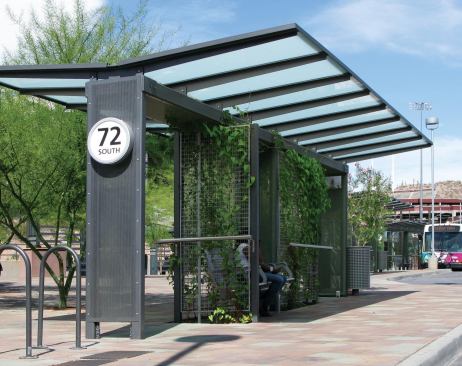
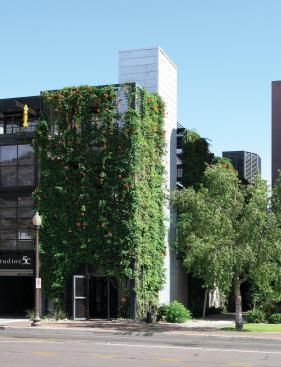
The alternative—green façade systems or lightweight trellises on or near a building’s exterior, with plants rooted in ground-level soil—offers thermal and other benefits with lower operating costs and fewer structural complications. These systems can also be deployed to integrate plantings when “you’re dealing with not as much available plan space to incorporate gardens or large specimen trees,” or when retrofitting an existing project, says James Sable, vice president of Los Angeles–based Greenscreen. On the whole, green façades are more reliable on lower stories or on roofs than on a full skyscraping scale: With a few exceptions in tropical climates (such as towers in Southeast Asia by Malaysian architect Kenneth Yeang, Hon. FAIA), wind loads can make vertical green structures above four or five stories problematic.
Water Management
Green roofs, combined with water-capture methods using infiltration trenches or cisterns, reduce stormwater runoff that contributes to combined sewer overflows (CSOs). Since energy is invested in potable water, capturing rainwater for functions that graywater or treated blackwater could perform (irrigation, fire protection, waste removal, cleaning, or cooling) conserves energy as well as water itself. Toronto’s Bruce adds that any structure holding water at elevation can put its embodied energy to work. There is wide room for creativity where biofiltration and mechanical systems intersect.
The first variables to know in calculations related to stormwater or biofiltration, New York’s Nielsen says, include local soil volume and quality, including the soil’s percolation or infiltration rate (available from shallow studies performed during geotechnical borings). Both vegetated and nonvegetated strategies, she notes, involve specialized maintenance: Porous concrete, for example, accumulates silt in spaces between the aggregate and needs periodic power-washing or vacuuming. Blue roofs—designed to store water—are an intuitive strategy, though their enthusiasts often face opposition because “architects are trained to get rid of water as fast as possible off a roof … even if it’ll work in the first five years, over time that membrane will fail.”
“I think the primary focus of green machines would be essentially water management,” Bruce says. “If you look back in the history, just about every landscape has been optimized for aesthetics … and we’re just reaching the nexus point where landscapes are being mandated to perform work, whether it’s bioswales or rain gardens.”
As knowledge about stormwater management evolves, Bruce expects green infrastructure to assume the functions of a utility. “If you extrapolate from the past and look at solar energy, it’s only been recently when individual property owners can capture solar energy and sell it back to the purveyor. If I look at stormwater … and the degradation of water quality, there’s an opportunity or likelihood in the future that we could end up selling polished stormwater back to the utility as a resource.”
Green roofs will capture and store about 75 percent of annual precipitation, Bruce says. Some skyscrapers may never capture enough water to go off the hydrologic grid, but “integrated water management that tries to achieve net-zero water” can assign appropriate uses for different water sources and separate them from sinks where they are unhelpful or harmful, as when urban infiltration puts phenols and other pollutants into aquifers. “Water becomes almost instantaneously classified and siloed depending on what it touches,” Bruce observes. “If it hits the roof, it becomes rainwater, and there’s a whole series of regulatory requirements that glom onto it. If it hits the ground, it becomes stormwater, and there are regulatory environments that hit it. Once it goes into the combined CSO, it’s classified as blackwater and requires enormously high treatment levels. … Right now there isn’t much of a classification system for exterior water use.”
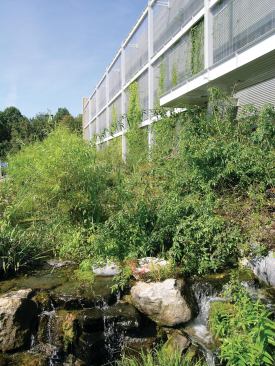
Among Bruce’s projects, the Kauffmann Center for the Performing Arts garage under construction in Kansas City, Mo., will include a 147,000-square-foot green roof whose soils will handle a 100-year storm, holding half of the stormwater for 12 hours and another 25 percent for 66 hours. “We really had a significant reduction in stormwater runoff based purely on soil pore space, and we were able to eliminate a half-million-dollar stormwater-detention facility, take that budget allowance, and put it into two 50,000-gallon cisterns, which would harvest all of the water coming off-site and recycle it for irrigation. So we’re pretty close to achieving what I would consider a net-zero-runoff 2-1/2-acre site.” Permeable pavement, bioswales, rain gardens, and other best-management practices at Southern Methodist University’s George W. Bush Presidential Center in Dallas will likewise capture and treat condensate, vehicle-washing graywater, foundation drainwater, and cooling-tower blowdown as well as rainwater, recycling all these sources to irrigate the 22-acre site.
But in systemic contexts, not all green structures produce a net energy benefit. “Buildings that appear very green in every likelihood are not functioning in the way that would be ecologically viable in the long term,” CCNY’s Hoffman Brandt says. With lightweight extensive green roofs, cooling and hydrologic benefits may be meager; “in order to do a more meaningful green-roof system, you would want to use actual soil that retains water … that means it would have depth, and then it would also be heavy,” he says, noting that such systems require more steel to support them. “Where’s the tipping point … [where] the carbon footprint of the steel and construction expansion doesn’t make it worth the benefits of the green roof?”
Planning for green surfaces should occur early, Hoffman Brandt suggests. “When you actually start designing the green roof as part of the building should be right from the start in schematic design, and it should be engineered and costed in design development. That means linking up the landscape architect, the architect, and the structural engineer.” Plants usually need irrigation during their first two years, particularly in desiccating rooftop or vertical-wall conditions; with a lightweight soil system, value-engineering irrigation out of the plans may also shorten the life of the plants.
Bruce’s office has a standing joke about value-engineering: “We’ve said ‘it adds no value, and it really ain’t engineering.’ But it’s why I’m so interested in this living-machine or green-machine concept … if it becomes a regulatory mandate, then it’s much more difficult … [to remove] from the project.”
Biodiversity and Ecosystems
Flora attracts fauna, and vegetated features often become complex and unpredictable local ecosystems with butterflies, hummingbirds, bees, and worms, plus new plants colonized via wind and pollinators. The preference for local species is an expression of what Simmons calls “ecological intuition,” but intuition isn’t perfect; a sustainable site-wide ecosystem can involve scientifically informed trial and error.
Most early green roofs were in northern Europe; sedums and similar succulents perform well both there and in the northern United States. But they have not translated as well to the South, Simmons observes, and botanists are not sure why. “It might be that the root temperature gets too high; it might be that when you get a lot of rain in the spring and it’s warm, then weeds come in and outcompete them, and they seem to rot,” he says.
Changing plants in an established green roof involves many sensitive variables: water requirements, growing media, drought-mitigation structures, and unexpected organisms that find a niche in the system. ”Once you change one thing, you have to start thinking about changing everything else,” Simmons says. His group has been pilot-testing a wide range of plants on roofs in the hot climate of Texas. A drought-tolerant local perennial that they expected to thrive, damianita (Chrysactinia mexicana), defied ecological intuition and failed because the roofs stay wet for too long. A deep-rooted prairie grass fared better. Simmons calls the grass “morphologically plastic: they … [the grass] can change their architecture to the conditions, so if you give them 6 inches of soil, they’ll still grow in it. They’ll just be a much smaller plant.”
Dean Hill, director of sustainability at Greenscreen, recalls another situation with a poor match between a species and a support system: creeping fig (Ficus pumila) on a vertical screen held about half an inch from the first story of the Energy Centre parking garage in New Orleans. The species attached to the precast concrete surface and rendered the screen superfluous. Had this happened in a climate with a freeze–and–thaw cycle, Hill says, moisture introduced by the plant would have caused flaking and chipping in the precast. If a more appropriate native plant species with a twining habit had been selected such as Trumpet Vine (Campsis radicans), the system would have been better suited to the site and application.
Earn 1 LU/HSW/SD hour
There is still much to discover about interface systems, though they are rooted in ancient practices. Hoffman Brandt, having worked in Near East archaeology, warns that “the popularity of the Hanging Gardens of Babylon comes from a kind of idealization of nature in the city—and archaeologically, there’s not a ton of evidence for [them].” Knowing these gardens from historic references and not direct material remains, it is easy to romanticize them and their descendants. The legend “reinforces the kind of Western dualism between seeing humans and urban systems … [as] antithetical to natural systems; this is a way to bridge the gap,” Hoffman Brandt says.
Inviting vegetation into the human environment may appear remarkable only to the degree that we see built and organic structures as antithetical. But by integrating the two, “you have a lot of opportunity to refine, reconstitute, and treat landscape as a visual texture as well as an important benefit in integrating into how … a building or a site program works,” Greenscreen’s Sable says. And viewing the two as integrated, and not opposing, forces strengthens the ties that unite our technologically driven modern architecture with nature’s wild wisdom.