
Project Description
Living all inclusive
Berlin is booming! The number of employees is rising and the housing market is being upgraded. In other cities like London or New York serviced apartments or shared-living models are already longestablished housing standards for urban nomads; now they are also becoming increasingly interesting for the capital of start-ups.
SEHW have now designed such a building in the district of Moabit, Berlin. It is a living machine, feel-good house, nest, community hub … And it’s made of wood!
What can this smart apartment-house do? On the one hand, it reacts to the current developments of the housing market and creates a place for new forms of living. On the other hand, the modular construction of prefabricated solid-wood elements is economically favorable due to the short construction period of only six-months, while also taking sustainability into account.
How do we want to live? New modes of work demand new living concepts. Modern workspaces are often only temporarily linked to a place and require frequently changed residences. However, the city centers are increasingly in demand for investors; making affordable housing units, or even temporary rentals near the workplace, nearly impossible to find. Our new building reacts to these developments with modern shared-living apartments. The new building provides space for a total of 50 residents in ten modern business flat-shares.
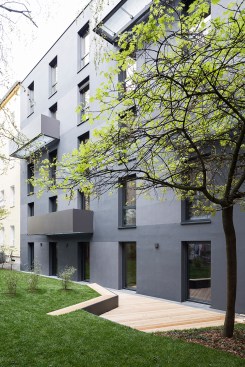
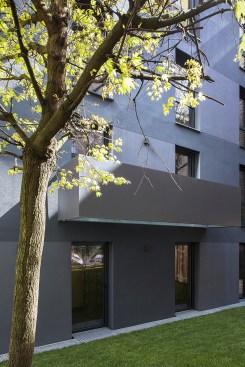
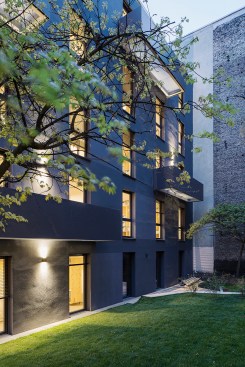
The compact, five-story building stands as a courtyard building in a typical Berlin block. It is oriented, in building depth and cubature, on the adjoining neighboring buildings, but projects out from the existing buildings through its modern façade-design made of anthracite-colored plaster, floor-length windows, and metal balconies interconnecting pairs of residential units.
The building’s supporting structure is designed as a partition, with the supporting façade made entirely of wood. The only exceptions are the foundation and the core. The residential units of the ground floor are barrier-free; courtyard and outdoor areas are designed as green areas with a playground, and provide areas for bicycles, prams, and wheelchairs.
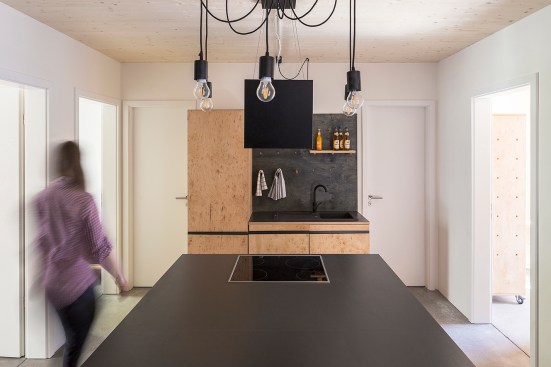
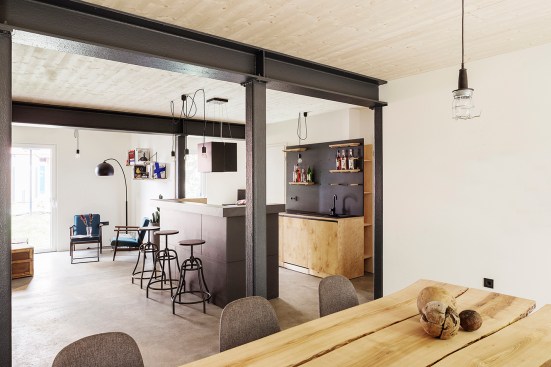
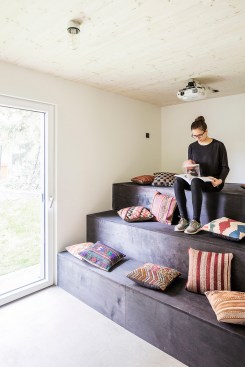
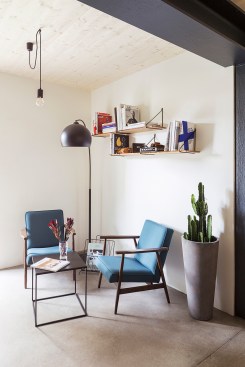
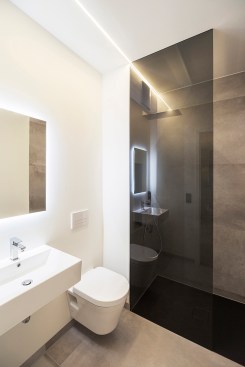
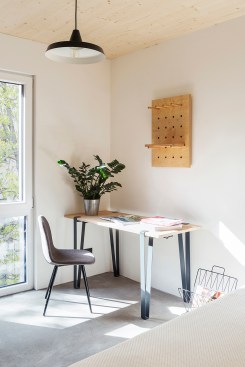
Living all-inclusively, what does that look like? The ten residential units offer solutions to be able to live fully equipped ad-hoc. For the digital nomad, fast connections are important, not only to data networks, but also to social ones. Therefore, adjacent to the fully furnished private rooms, there are also high-quality communal areas, which invite communication and facilitate the start in a foreign city. The private rooms are primarily designed for sleeping and working, while all other uses are designated for the common areas. Special features such as a large community kitchen for cooking and eating together create a feel-good atmosphere. In the communal area on the ground floor, next to the laundry room, is a large dining area for parties, as well as a lounge with a bar and a home cinema. The house has state-of-the-art communication and security technology.
Thanks to prefabrication, it was realized in a construction period of just four and a half months. It was even possible to finish the wooden structure within two weeks. On your marks, get set, live!