
Project Description
The archives of France were long housed in the center of Paris in the
Hôtel de Soubise, a gracious, two-story, 18th-century palace whose
symmetries, proportions, and stately order expressed in stone the
humanistic rationalism of the French Enlightenment. By the turn of the
millennium, however, the archives had outgrown the palace, and a new
repository was needed.
Following long-standing state policy and recent studies of a “Grand
Paris” that promote a decentralized—and democratized—culture in the
suburbs rather than in the city center, France’s Ministry of Culture and
Communication staged a competition in 2005 for a new, expanded archive
for the post-revolutionary nouveau régime material in a
state-of-the-art facility outside the city center. The site in the
Parisian suburb of Pierrefitte-sur-Seine is located at the end of the
extended Saint Denis Metro Line 13, adjacent to a new University of
Paris campus, and not far from the Cathedral of Saint Denis, where the
French kings and queens of the ancien régime are interred. (Their archives, dating back to the seventh century, remain ensconced in the Hôtel de Soubise.)
If reason is to the French what beauty is to the Italians, the new context for the archives was not only a vote for égalité,
but also for rationality. The new archive would, the ministry hoped,
play a role in building a new, expanded French cultural ecosystem that
embraced the overlooked and marginalized outer edges—and societies—of
the city. The move was smart.
The winning design, by Roman architects Massimiliano Fuksas, Hon. FAIA,
Doriana Fuksas, and their eponymous studio, is arguably as rational as
the Hôtel de Soubise was in its time. After all, when René Descartes, a
father of the Enlightenment, wrote his philosophy Discours de la méthode
(1637), he admitted only what was clear and self-evidently true. For
the archives of the country that invented and first adopted the metric
system, the Fuksas scheme was a model of methodical and measured
clarity, laid out in a straightforward Cartesian grid, and built in the
materials of our time—glass, steel, and aluminum.
The 10-story structure is a virtual translation of 18th-century
rationalism into a modern idiom, minus the Hôtel de Soubise’s
aristocratic lineage, and minus any sense of craft—here, abstraction of
the mind has replaced any evidence of the hand. The architects, with
Studio Fuksas’s Michele D’Arcangelo acting as project architect, have
sited the building not only in the context of the new cultural ecosystem
but also in the context and tradition of French reason, without
concessions or apologies.
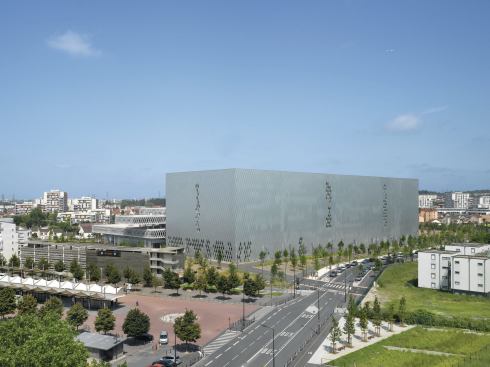
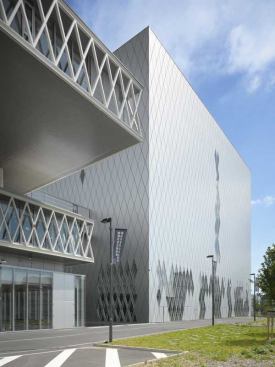
The clarity of the nearly 1,165,000-square-foot building declares
itself from the street, where a pedestrian just off the Metro can see
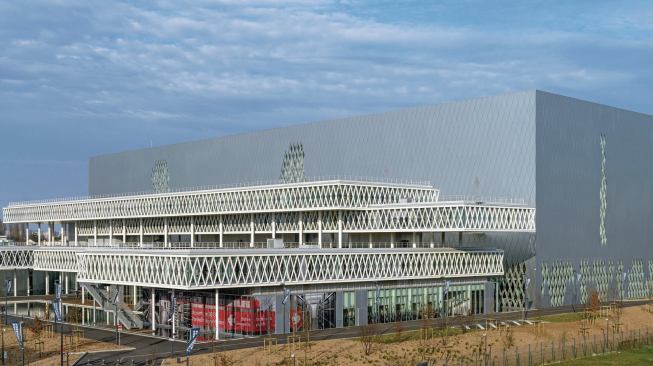
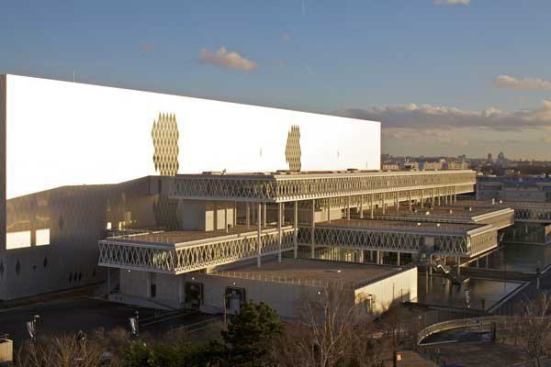
the whole complex in three-quarter view. Long, juxtaposed, stacked, and
cantilevered prisms—each with a triangulated, exoskeletal façade—stand
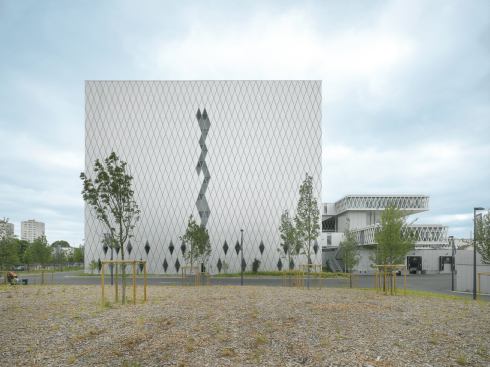
in front of a huge 10-story, aluminum-clad box, housing the archives
behind its very crisp edges. “I intended to design a jewel box,”
Massimiliano Fuksas says, “with scattered elements and suspended
functions in front.”
Reflections in the anodized aluminum cladding the archive dissolve its
mass, while providing a plain, ethereal backdrop that silhouettes the
stack of prisms to the fore—these volumes house conservation labs,
administrative offices, conference rooms, lounges, and reception areas.
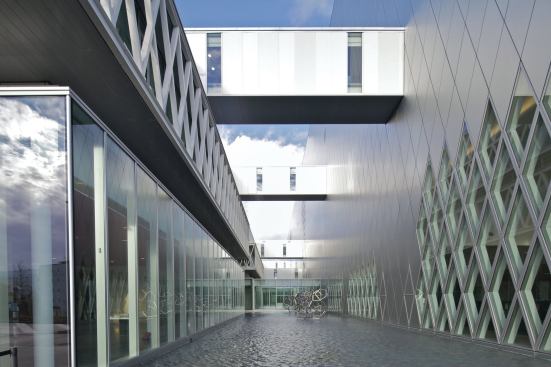
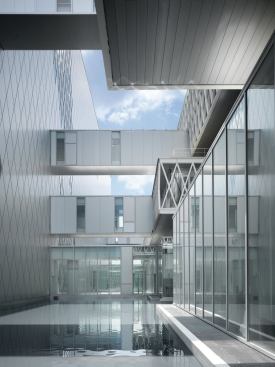
The architects have separated the individual prisms with wide gaps that
act as reveals allowing light, air, and shadow between the sections.
Enclosed bridges link the front and back structures over a canyon of
space that sits between the archive and the office volumes.
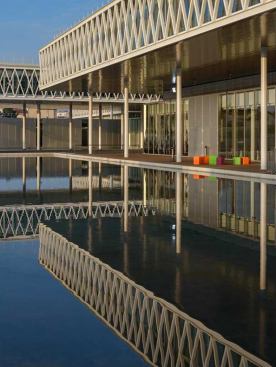
At ground level, shallow pools meander in and out of the
sections—filling the space between the two structures and under the
bridges—reflecting light and mirroring the building above. These form a
calming context that recalls the great gardens of the French
Enlightenment. The architects speak of the ensemble as a landscape, but
the gaps between the sections tilt the landscape, creating dynamic
vertical and diagonal views in a porous, three-dimensional field of
structure.
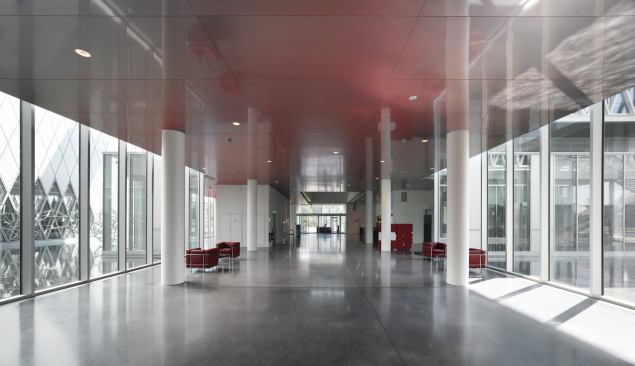
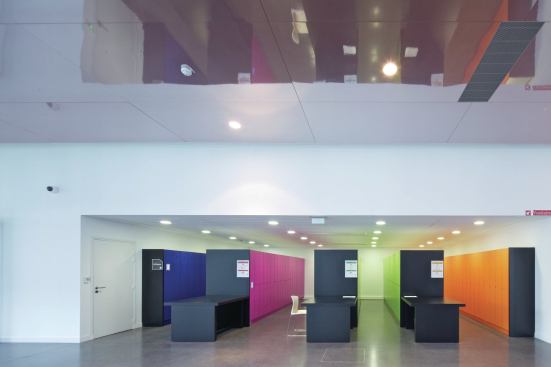
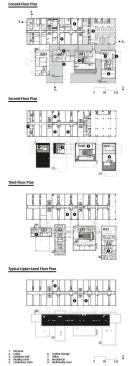
The ground level offers three access points: for visitors, personnel,
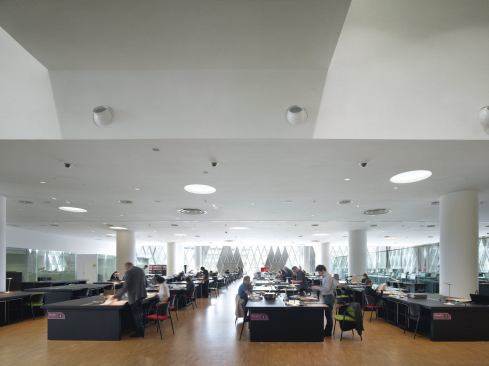
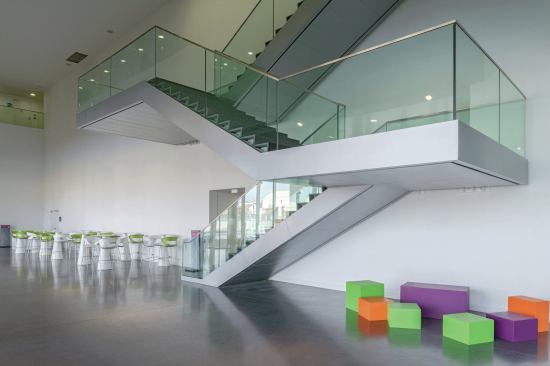
and deliveries. The main entrance and reception lobby link to the main
reading room, the heart of the entire complex, which has the spatial
volume and presence of a modern cathedral. Massimiliano and Doriana have
kept the space visually controlled and neutral, with a sea of ebony
desks forming a datum that visually anchors the triple-height space.
Natural light enters through a brise-soleil replete with fins that
adjust to allow light, while still protecting books and researchers from
glare. The architects have calmed and simplified the interior to a
point of academic monasticism.
Staff members work at desks and in rooms on the inboard side of the
reading room; librarians are seated at a raised control point that gives
them a visual overview of the space. Behind the desks is the access
point to the 10 floors of archives, which are arranged in a
double-loaded plan, with a central trunk corridor branching into
separate stacks, each separated from the other with a full-height void
of space. Each stack is windowless, to protect the materials inside, and
each is separately air-conditioned and heated via equipment in a
decentralized system. The archives give way to bridges that connect to
the administrative satellites.
Despite the non-aligned geometries of the stacked volume, the
satellites connect with perfect clarity via internal corridors. All
interiors have windows off balconies serving as service galleries, which
ring all the office blocks. The cantilevered upper prisms shade the
lower buildings, while also creating cavernous exterior spaces spotted
with columns that rise from the squared pools of water below. Although
the pools evoke the landscape and bring a natural element into the
environment that forms a common “ground” between the satellites and the
archives, the water is also treated as an architectural element,
conforming to, and extending, the geometries of the building. The effect
is environmental, reflecting the buildings above, sending dappled
effects onto walls and soffits, and generally softening the experience
with water’s tranquilizing effect. The water is not treated as an object
but as an environmental base for the building complex.
The whole enterprise, including both the institution itself and the
building that now houses it, is an appropriate response to its larger
urban context. “The building is scaled to the small houses [across from
the] front, and the scale graduates, stepping up to tall structures that
will eventually be built behind,” Fuksas says. But besides the
appropriateness of its scale here, the design abstracts the rationalist
essence of French culture and builds on it, and so belongs to this
institution and site. Unlike the Pompidou Center, designed by Renzo
Piano, Hon. FAIA, and Richard Rogers, Hon. FAIA, to which this campus
seems visually related, the archives do not play on technical imagery or
allude to the Industrial Revolution. The design strips the architecture
of any fetishizing of the machine, taking the building back to pure
Enlightenment rationalism.
For all its conceptual clarity, the simplicity is deceptive. What
appears at first to be a rudimentary Cartesian layout that builds off
the grid seems, at moments, to introduce chaos theory. In the tall
underbelly of the satellites, the columns are so multitudinous that they
become a forest of piers, all set into a playful parallax within the
spatial push and pull of the office blocks above and the basins of water
at grade. There is an added twist of Italian chiaroscuro as the openings among the stacked blocks create shifting compositions of light and shade, solid and void.
Yet an excess of reason can breed irrationality. The satellites, so
apparently clear, edge toward the irrational as the columns multiply
within a complex void that expands and contracts in shadow and light.
Through the apparent complexity, one cannot comprehend the whole from
any single viewing point, even from a frontal position, as one could the
Hôtel de Soubise and the Pompidou Center. If there is a whole, it is
elusive. There are subversive strains of counterintuitive logic in this
building that shade and nuance what is otherwise a thesis of
architectural clarity. —Joseph Giovannini