
Project Description
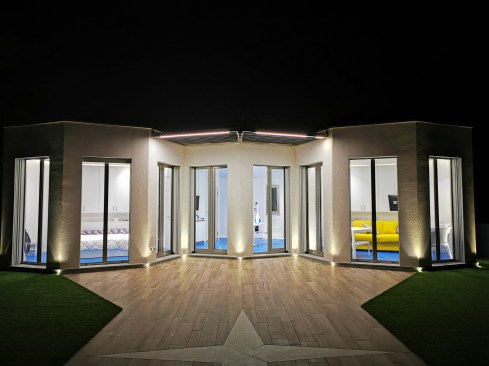
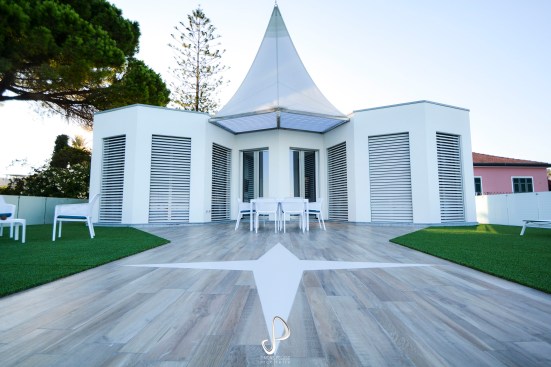
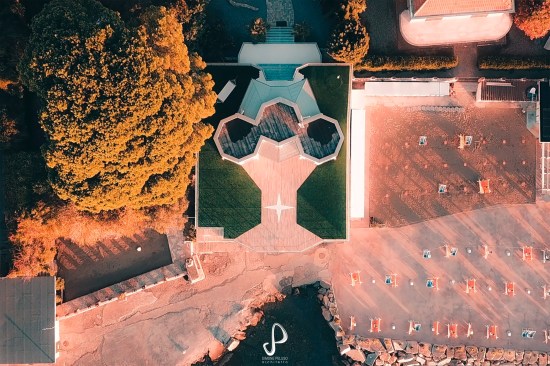
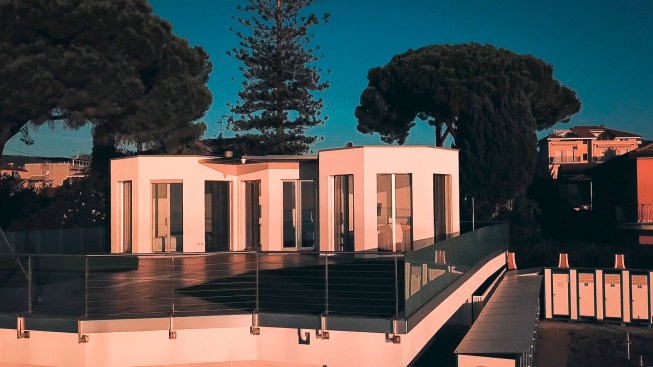
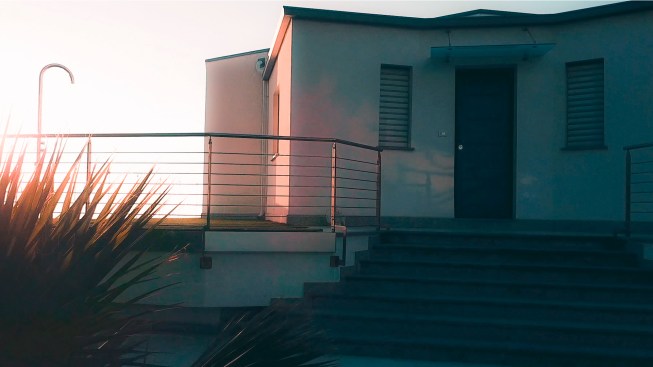
Made of reinforced concrete, the building is on two levels: on the ground floor a large room – commonly called “darsena” – overlooks the quay at the foot of the sea offering itself as a shelter for boats. On the first floor three octagons draw the plans of the building and the three eight-pitch wooden roofs baptize the property with the name: Le Pagode.
The house was born in 1957 as a wooden depandace and died in 2015 with a fire that razed it to the ground. It was in that year that the architect took over the project of the house to give it a new life.
A large garden in exotic style breaks the bark built between the sea and the Aurelia leading to the house. A double flight of steps in Luserna stone raises the residence to the first floor, accompanying the civilized dwelling.
The structure, completely deteriorated, has undergone a major consolidation in response to structural needs and antisimic regulations. Narrow-mesh metal meshes now wrap around the pillars and beams, providing them with a new and more resistant reinforcement; geolite reinforcements adhere to the existing structural elements, increasing the section of the beams and pillars; the remaking of the foundation plinths, the anti-passivation of the metal elements and the restoration of the iron covers constitute an important engineering work that has contributed to the re-functionalisation of the existing skeleton. This intervention has resulted in the creation of a mixed type of structure, characterized by vertical elements in reinforced concrete, crowning beams with metal girders and a wooden roof frame.
A white marble wind rose stands out in the centre of the large terrace. Even outdoors, the architect Peluso searches for geometry by drawing, or rather tracing the original motifs. The blue and white of the existing tile puzzle is now replaced by the wooden colour of the ceramics and the green of the lawn.
The characteristic elasticity offered by the underlying screed solves any problems caused by surface overheating. The installation work of the satin-finish glazed elements, placed on the parapet, solves the aesthetic-functionality equation. The elegance of the glass evolves particularly technologically when the slab meets the frame on the ground, becoming a rainwater drainage channel.
The parapet at the perimeter of the solar slab changes material according to the orientation. The glass panes placed to the East and West give way to a fine and elegant AISI 316 steel structure that gives a perennial sea view.
Only large windows divide the space from the interior.
The windows offer a new focus of beauty in the domestic landscape proving to be suitable to dialogue brilliantly with the structure. Large windows and doors in thermal break aluminium (“Schuco”) allow you to fully enjoy the natural light in the interiors for all daylight hours. The finish of the frames is in the same colour as the steel details made both as a parapet and as cantilevered sunshades. Adjustable blinds (“Griesser”) installed at each opening regulate the amount of interior lighting, allowing you to find the ideal solution for every atmosphere: it regulates light and shade, illuminates and heats, darkens and repairs.
Efficiency and comfort are also combined in the choice of radiant panel heating which, with its distinctive radiation system, ensures even heat diffusion.
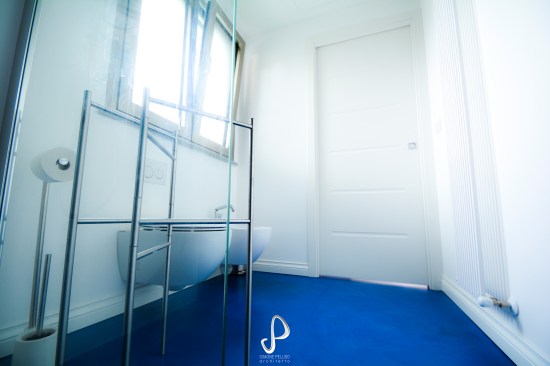
“I want to bring the sea into the house” is how the architect responds to the need not to lose the link with the surrounding environment. The solution is found in the use of blue microcement, a contemporary and extremely flexible material. The constraints imposed by the particular octagonal geometry of the environments force the choice of an element “without shape”. The decorative coating composed of cement, water-based resins, additives and mineral pigments laid in several layers, give movement and three-dimensionality to the floor: noble and versatile allows to create a space full of colour.
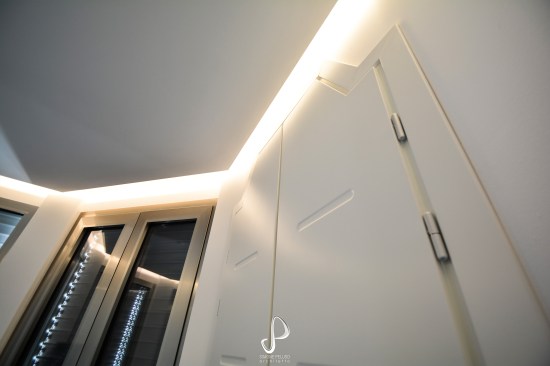
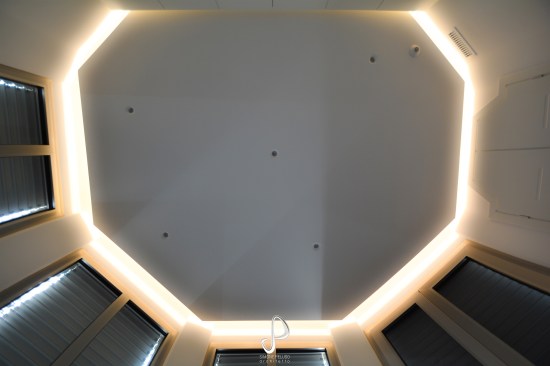
The plasterboard false ceiling, born from the need to camouflage electric corrugated and piping for the cooling of the rooms, becomes a refined detail that recalls the octagonal geometry: an aesthetic expedient for a functional need.
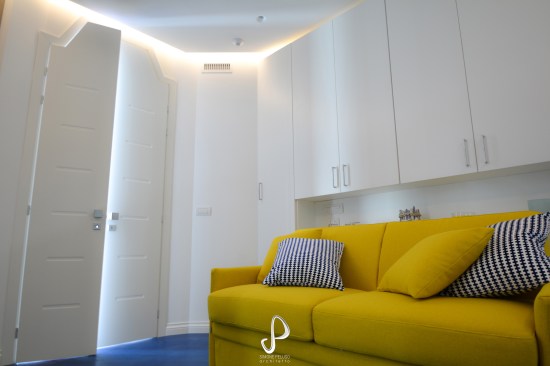
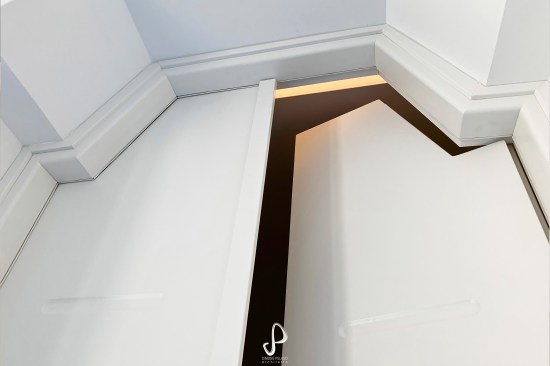
Light is an element that creates spaces: designed to allow a warm and comfortable atmosphere, it is the key to designing environments. LED strips trace the perimeter of the false ceilings, spotlights emphasize shapes and technological details offering and enhancing, with a bottom-up orientation, both elevation of the house and the natural heights of the maritime pines that surround it.
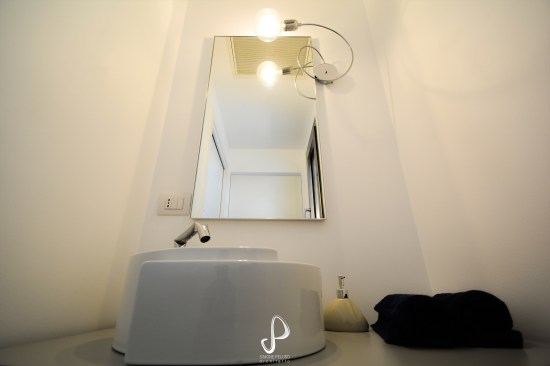
The bathroom in a minimalist tone, is presented with a combination of square lines and, this time, also rounded. The microcement floor overhangs the shower wall, giving continuity with the other rooms. A glass backdrop divides the sanitary area, leaving it intimate and personal, from the shower, enriched with comfortable shelves for objects. The particular shape of the mixers, with their clean aesthetics but strong expressive power, recalls the imagination of a bent pipe (Flaminia Fold).
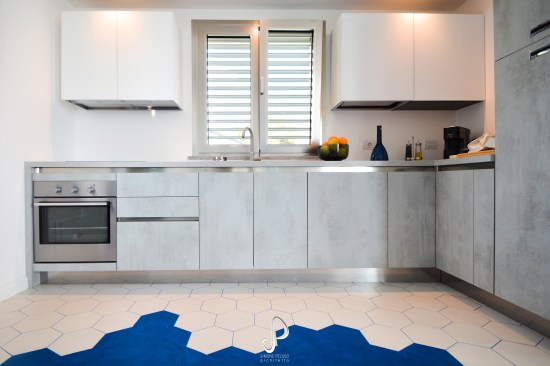
The geometry of the three octagons can be found in the interior spaces in a triple division of volumes respectively kitchen, living area and sleeping area.
The kitchen is bordered by a jigsaw puzzle of white hexagonal tiles, surrounded by a blue joint that attenuates the passage to the surrounding micro-cement, finely defining the spaces. Also in perfect harmony with the environment: it is geometric, essential and linear. The living area remains open, occupied only by a glass table with aluminium structure and a living room unit. The space, in close connection with the terrace, becomes the nerve centre, the cohesion point of the house.
The access to the other two rooms is allowed by internal doors and windows on the ceiling, restructuring of a portal by means of a pre-existing hexagon.
The sleeping area and the living area are furnished to design to meet space requirements and above all constraints arising from the octagonal plan. The solution adopted by the Architect in both rooms is a “bridge” furniture in lacquered wood in total adherence with the wall structure to the point that it could be a container wall. The geometry also finds expression in the symmetry of the two rooms. The coffered bed in the sleeping area is replaced by a yellow sofa which, while bursting into the colours of the house, evokes summer and recalls the maritime landscape.