



Project Description
FROM THE ARCHITECTS:
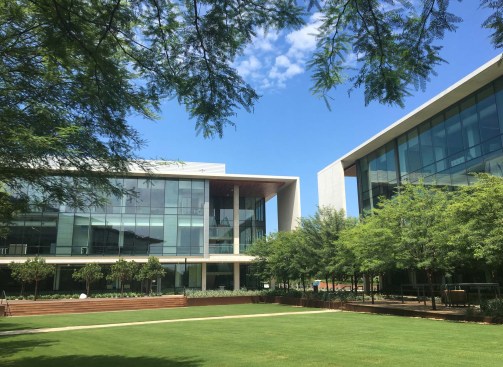
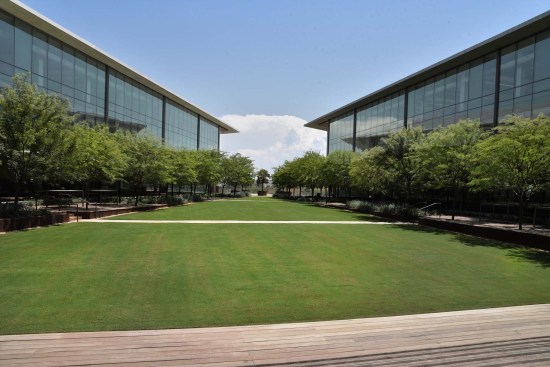
A new architectural icon in the University Town Centre area is redefining the traditional notion of a corporate research park in both form and function. Designed by architecture firm Perkins+Will, the set of three trapezoidal, all-white concrete buildings off Interstate 805 and La Jolla Village Drive make up the new BioMed Realty i3 campus, now the home of leading genomics research and life sciences company Illumina. Along with an amenity-rich outdoor courtyard, landscaped gathering spaces, and underground parking, the architecturally striking buildings offer employees an open, interconnected work-play experience unlike any other office park environment.
“The campus turns the stereotypical concept of a suburban research park right on its head, and makes it infinitely better,” said Ryan Bussard, principal at Perkins+Will. “Instead of a trove of uninviting office buildings surrounding a sea of asphalt parking lots, the i3 campus empowers people to connect, engage, collaborate, innovate, and—perhaps most important—be inspired.”
The three buildings are situated such that each creates an “edge” of a campus “triangle,” at whose center is a 33,500-square-foot outdoor courtyard featuring a performance stage, a bocce ball court, an herb garden, a fitness area, a restaurant and a café. Additionally, parking is obscured from view below ground, allowing for employees to enjoy a beautifully landscaped outdoor area for sports and leisure activities.
“Together with Perkins+Will, we breathed new life into an undervalued site, and delivered fresh, creative and eco-friendly thinking to attract a world class tenant and exemplifies our goal of building science around a park, not a parking lot,” said Kevin Tremblay, senior director of leasing and San Diego market lead with BioMed Realty, a Blackstone company. “The result truly delivers on the ‘i3’ name: an Iconically designed campus; Innovative in the buildings’ extreme flexibility and sustainability; and Inspired by the tenant’s work and culture.”
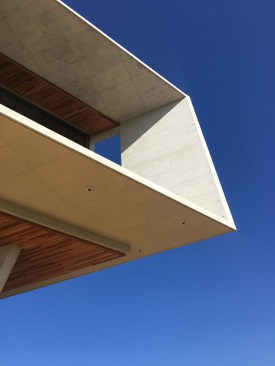
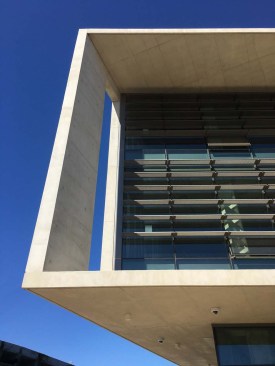
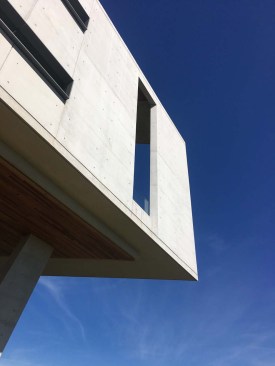
Architecturally, the campus’s three buildings join a family of well-known scientific institutions—the Salk Institute and the J. Craig Venter institute—with all-white architectural concrete skin. Dramatic cantilevers create iconic views of the campus from the outside while internally framing the upper level terraces and outdoor staircases.
The project’s interior design was inspired by Illumina’s “work anywhere” culture, enabling staff to work wherever they feel most comfortable at any time of day. The campus is 100 percent wireless and provides a variety of work areas to accommodate different work styles and preferences.
Wall-to-ceiling glass capitalizes on views to the surrounding mountains and infuses the interior space with natural light. Collaborative areas, such as lounges, break rooms, and conference spaces, are connected directly to outdoor terraces and bookend the research and office areas.
Employing environmentally progressive design strategies that reduce energy and water use by 30 percent and 20 percent, respectively, the i3 campus is on track to earn [LEED Platinum certification for core and shell, and LEED Gold certification for interiors]. Key sustainability attributes include:
· On-site fuel cells, generating efficient, clean energy with low emissions.
· On-site bio-filtration system, improving storm water quality and reducing the impact on the city’s local infrastructure.
· Green roofs atop all three buildings, with heat- and drought-tolerant native plants regulating temperatures inside and filtering pollutants from the water.
· Recycled water (from the local utility), irrigating the site and used for cooling towers, eliminating the need for potable water usage in these areas.
· Natural light, permeating the buildings’ workplace interiors during daylight hours.
· Motorized and fixed sunshades, helping control temperatures inside (e.g., shades that close to keep the buildings cool, and open to harvest daylight).
· Permeable pavers, allowing storm water through the surface and helping reduce runoff while restoring the site’s original natural water system.
· Below-grade parking, minimizing the project’s impervious surface footprint (whereas most research parks feature large grade-level lots).
· Site-water mitigation located under the courtyard’s wooden decks, reducing the burden on the city’s storm water infrastructure.
· Repopulating the surface area of the original site (which was a building in a massive parking lot) with vegetation, significantly reducing the heat-island effect of the campus while adding native and adaptive plant species to attract local fauna.