





Project Description
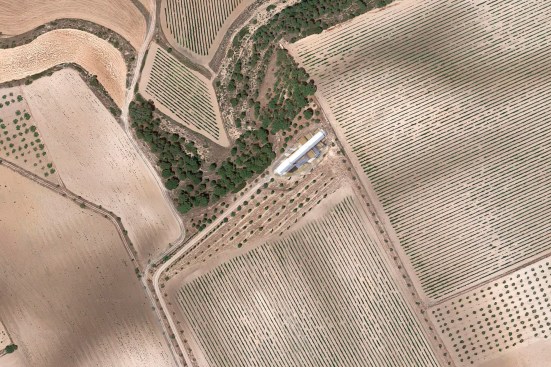
For a retreat outside Fontanars dels Alforins, Spain, architect Ramón Esteve wanted to reinterpret the traditional forms of the rural area. “In vernacular architecture, the dominant typology of houses is the gable,” Esteve says. So the architect extruded a gable form of poured-in-place concrete almost 170 feet across the landscape, punctuating it with a series of minimal, balloon-framed, pine-clad boxes that extend outward from the north and south sides of the main volume.
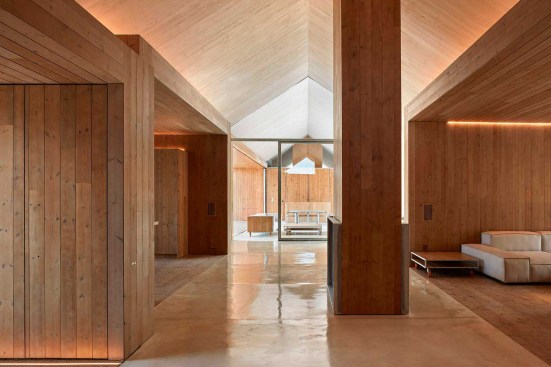
The 4,464-square-foot residence lies on the edge of a vineyard, about a mile west of the town of a thousand residents and about 50 miles southwest of Valencia, the Mediterranean port city where the architect’s office is located. The house was designed for sporadic use—on weekends, for vacations, and for entertaining. Visitors enter through the largest wood volume, which serves as a porch and outdoor living space. Inside, an open plan under the central gable connects each of the wood-lined volumes, which individually contain the living room, kitchen and dining space, and three bedrooms.
There is a subtle hierarchy of heights within the interior spaces: the gable is nearly 20 feet tall; the living room and kitchen ceilings are about 9.5 feet high, the master bedroom ceiling is nearly 9 feet high, and those in the guest rooms are just over 8 feet high. Vertical timber planks, each 20 centimeters (7.87 inches) wide, clad the living spaces, inside and out. Even the concrete formwork followed this module, so that the exposed surfaces bear imprints of the same dimension.
The gabled form is as wide as it is tall and formed by 50-centimeter-thick (nearly 20-inch-thick) walls and roof. Esteve chose concrete because “it takes the texture of the wood mold,” he says. “The house collects patterns of traditional typologies and integrates that into the landscape.” The house was designed according to passive principles, with highly insulated volumes and an orientation that facilitates cross ventilation. Solar panels are obscured from view on top of the wooden boxes, and the sloped concrete roof diverts rainwater to a 26,417-gallon cistern in the basement.
Each wooden volume can open completely to the outdoors: Frameless wood doors integrate seamlessly into the wall when they’re opened, with the intention of blurring the boundaries between inside and out. “The house envelopes you with the idea of being a refuge from nature, but each opening offers a view of the landscape,” Esteve says. “Every space has an intentional view, like a painted picture.” The doors can be closed securely when the owners aren’t in residence, providing a secure perimeter.
With this simple approach to space making, combined with a celebration of elemental building materials, Esteve has crafted a contemporary take on dwelling that still seems at home in the traditional landscape of the region.
Project Credits
Project: Cottage in the Vineyard, Fontanars dels Alforins, Spain
Client: Withheld
Design Architect: Ramón Esteve Estudio de Arquitectura, Valencia, Spain . Ramón Esteve (architect); Anna Boscà, Víctor Ruiz (collaborating architects); Tudi Soriano, Patricia Campos (collaborators); Emilio Pérez (technical architect)
Contractor: Covisal Futur
Size: 414.74 square meters (4,464 square feet)
Cost: Withheld