
Project Description
FROM THE ARCHITECTS:
Approximately, 4,300 homeless individuals live in the City of San Jose, according to a 2017 report from Applied Survey Research. The region also has the third-highest percentage of unsheltered homeless and fourth-largest number of chronically homeless, meaning they have lived on the streets for a year or longer. Effective January 1, 2017, Bill AB 2176 amended the Shelter Crisis Act to authorize a five-year pilot program allowing the City of San José, upon a declaration of a shelter crisis, to create emergency Bridge Housing Communities (BHC) as one model of interim housing for homeless residents. The sites are yet to be determined. Each site will have community restrooms, showers, a dining facility and common space for residents, and onsite case management that will work with the residents. The sleeping cabins will be built at each site by Habitat for Humanity and Homefirst will operate the sites.
On December 12th, the San Jose City Council approved the Bridge Housing Community project. Currently one site is approved and will have 40 cabins. The next step is choosing the site. The proposed schedule is for the site to be complete by January 2019.
Scope:
The City of San Jose approached Gensler to design sleeping cabins and develop site design strategies for the Bridge Housing Communities. Over the past year, Gensler San Jose’s Community Impact group has worked with the San Jose Housing Department, seeking input from the community and end-users, to create two final cabin designs and two site plan strategies.
A press conference was held on Monday, December 4th at Gensler’s San Jose office with Mayor Sam Liccardo and the San Jose Housing department to unveil the designs. Gensler presented two schematic designs for the sleeping cabins as well as two conceptual site designs for a bridge housing community, and described the various features integrated into the designs.
Design Process:
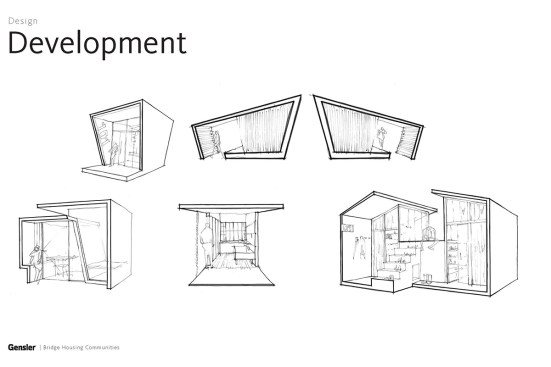
The design process included visioning sessions, community outreach including church visits, conversations with homeless advocates and the homeless, and design charrettes presented to the project partners. Through a participatory process, Gensler developed five designs that where narrowed down to two final solutions.
The visioning sessions resulted in two goals for the design of the sleeping cabins: 1) address the basic needs of the end-user, 2) build an environment that provides a sense of dignity, equality, and hope that redefines the homeless community and pushes them forward.
Design:
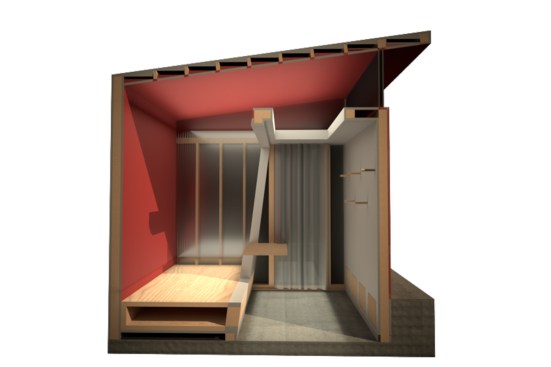
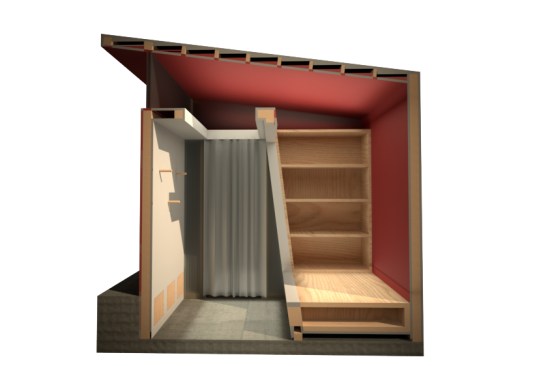
It was determined that the sleeping units needed to be single and double occupancy sleeping cabins, 80 to 140 sf, mainly for sleeping with minimal storage/power, no plumbing, and mobile. The program of the site was determined to be shared facilities for eating, showering, and homeless outreach services. The initial five designs looked at contemporary styles of tiny homes, the lightness and softness of Japanese tea houses, pre-fab construction, units that embraced the outdoors and the south bay climate.
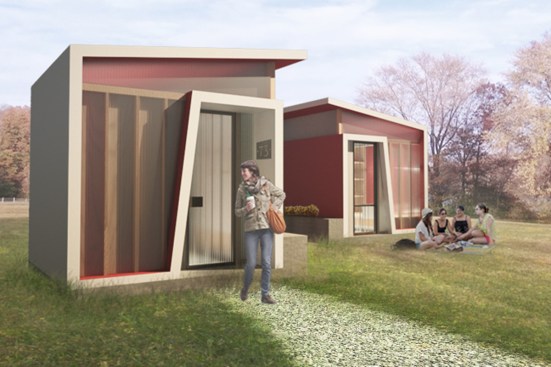
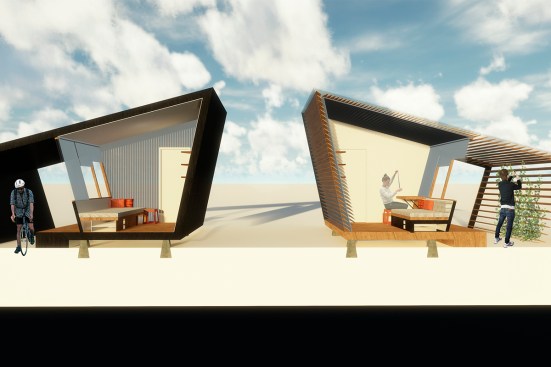
Design Option 1, Folding Home
The concept of a Folding Home began with the idea of a Pre-fab or Modular home, and this type of rapidly built housing. In trying to think about the ease of construction and foldable homes, it reminded us of pieces of origami, folded Christmas cards, and pop-up children’s books – specifically, the simplicity of such objects and the way these pieces of paper become a sculpture and a structure at the same time. This inspired the design of the cabin as a standalone sculpture floating in a park.
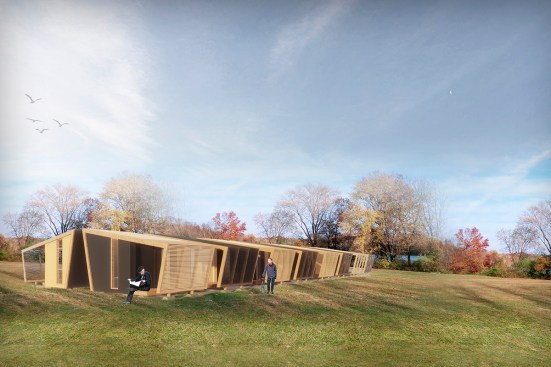
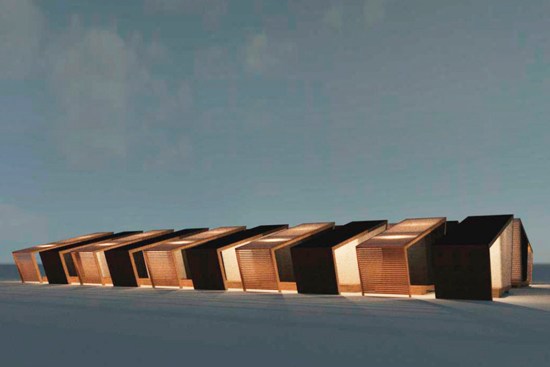
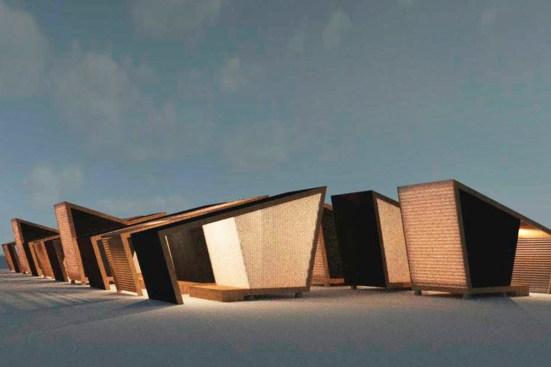
Design Option 2, Better Together
Option 2, approached the project as building a community. The units are pieces that compose a whole, a larger mass/volume that would be comparable to its surrounding neighborhood. Variations in materiality generate rhythm when placing the units together, making it Better Together. The group of units live as a community within the larger community – like many neighborhoods and cities. The design also gives a sense of both permanence and place.
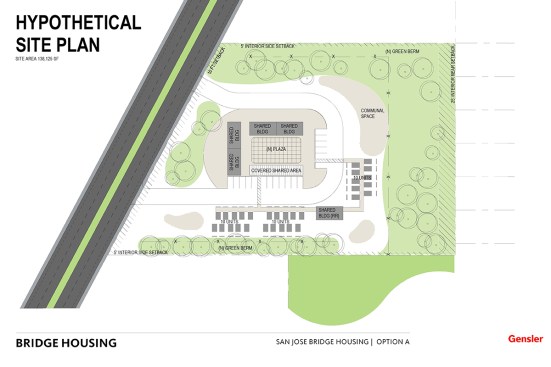
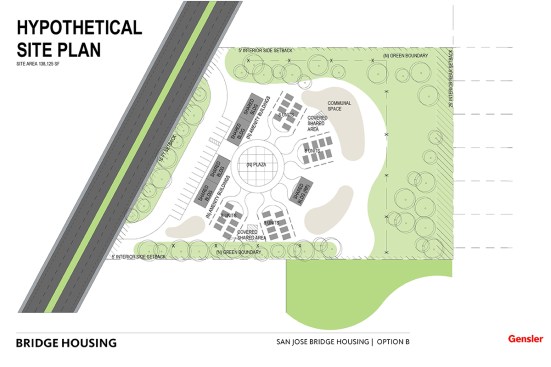
A series of hypothetical site plans were developed to approximate how 30 units could be arranged on a site and offer a design framework that can be adapted to different sites that might be designated in the future. The site plans consider vehicular access, car parking, support services such as dining and showering, and a homeless outreach services buildings on the site and also how use of trees and landscape can form natural welcoming edges on the perimeter of the site.
Site Plan, Option 1
In Option 1, the cabins and shared support spaces are arranged around a central hub space that acts as a public space where all residents can come together and socialize. Near each group of cabins are smaller communal areas to engage in smaller group interactions. The larger communal spaces would support resident driven or outreach supported activities which could include the local community.
Site Plan, Option 2
The second plan looks at a more radial arrangement. It reduces the road footprint and provides more green space. The site is centered around the larger communal space with easy access to shared support services. The cabins are grouped to provide smaller communities within the larger one and have smaller shared space for interactions.
Fast Facts:
• The City of San Jose has over 4,300 homeless people.
• According to the U.S. Department of Housing and Urban Development's 2016 Annual Homeless Assessment Report, among the 48 Major City Continuums of Care, Santa Clara County has the third highest rate of unsheltered homelessness and the third largest number of chronically homeless person.
• Effective January 1, 2017, Bill AB 2176 amended the Shelter Crisis Act to authorize a five-year pilot program allowing the City of San José, upon a declaration of a shelter crisis, to create emergency Bridge Housing Communities (BHC) as one model of interim housing for homeless residents.
• Habitat for Humanity will build the cabins and villages.
• Homefirst will operate the sites.
• Size of units approximately 80 sf to 140 sf.
• One site with 40 units approved by city council as of 12/12/17.