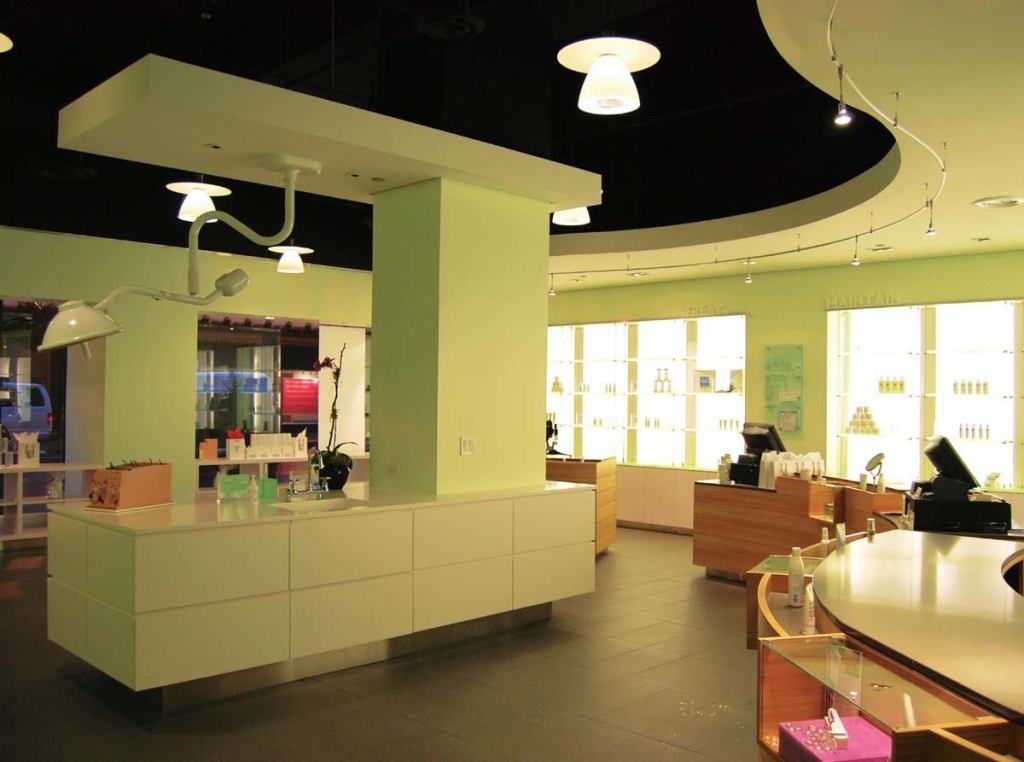
The success of any pseudo material—whether it’s perceived as faux or phony—depends on a combination of factors. “We use faux suede because it’s better than real suede,” says Chicago-based SCB’s Drew Ranieri. “It looks exactly the same, takes wear and tear better, holds up to spills, doesn’t fall apart, and it’s cheaper.” An unexpected benefit is that faux suede has no odor. You would expect people to prefer the rich smell of leather, but SCB’s designers have found that about half the time, people complain about it.
Another new entry that manages to walk the same line with aplomb is a new porcelain tile series called Touch, from Stonepeak Ceramics. The American-made tile replicates the look of leather, even offering the option of a frame-stitched border. Leather flooring has always been a rarefied material selection that requires extraordinary maintenance in order to retain its rich look. Unfortunately, the simulation offers neither the smoky smell or soft feel of the real stuff.
While faux and phony materials are as old as architecture itself, it’s just during the last few centuries—when Modernism and its puritanical cult of honest structure took hold—that architects have tried to dismiss certain finishes and technique as inauthentic. David Hoffman prefers faux materials that walk the knife’s edge between real and fake. “It’s like Pringles,” he says. “Nobody’s ever going to try and tell you that a Pringle was cut out of a potato. It performs in a certain way because of what it is.” From Vitruvius to Palladio to Venturi, many architects would agree.