Scagliola is an ancient technique for making hardened plaster look like stone. Because of the strength scagliola offers, artists from the Renaissance on have used it in molds to produce 3-D reliefs and decorative sculpture as well as wall and ceiling finishes. Today, South Bend, Ind.–based classical architect Duncan Stroik uses a German-made product called Jahn M60 Plaster/Stucco Mortar, available in the United States from Cathedral Stone Products. He used it for the exterior trim of a remodeled building in Maysville, Ky. “It’s not like foam,” he says (referring to the fuzzy look that conventional EIFS systems can display when used for traditional cornices and moldings). Stroik calls it “a fancy synthetic stucco,” although he notes that while it’s less expensive than actual stonework, it’s not a low-budget item. For interior applications, Stroik often uses conventional cast plaster for many decorative details. “Palladio used it,” he says, underscoring the distinctly real lineage of the faux technique.
Patrick Costin at Portland, Maine–based Harriman Associates notes that many of the firm’s New England clients stipulate the traditional wood clapboard look on their buildings. One old standby is HardiPlank—a fiber cement siding material—which they recently used on a medical office building in Westbrook, Maine. Due to its cementitous makeup, the product can be hard on contractors’ saws, so Costin and his colleagues are increasingly using NuCedar, a PVC siding material that can be more easily worked in the field with common tools. Both sidings are available in either a wood-grain or smooth finish. Costin doesn’t profess a preference for one over the other, although Michael Graham of Chicago-based Liederbach & Graham Architects is more opinionated about the subtle difference. “I don’t like the stuff that has wood grain in it,” he says. “It’s gauche.” Chalk up one vote against phony. But he and his firm regularly use the smooth-finished version in their various projects.
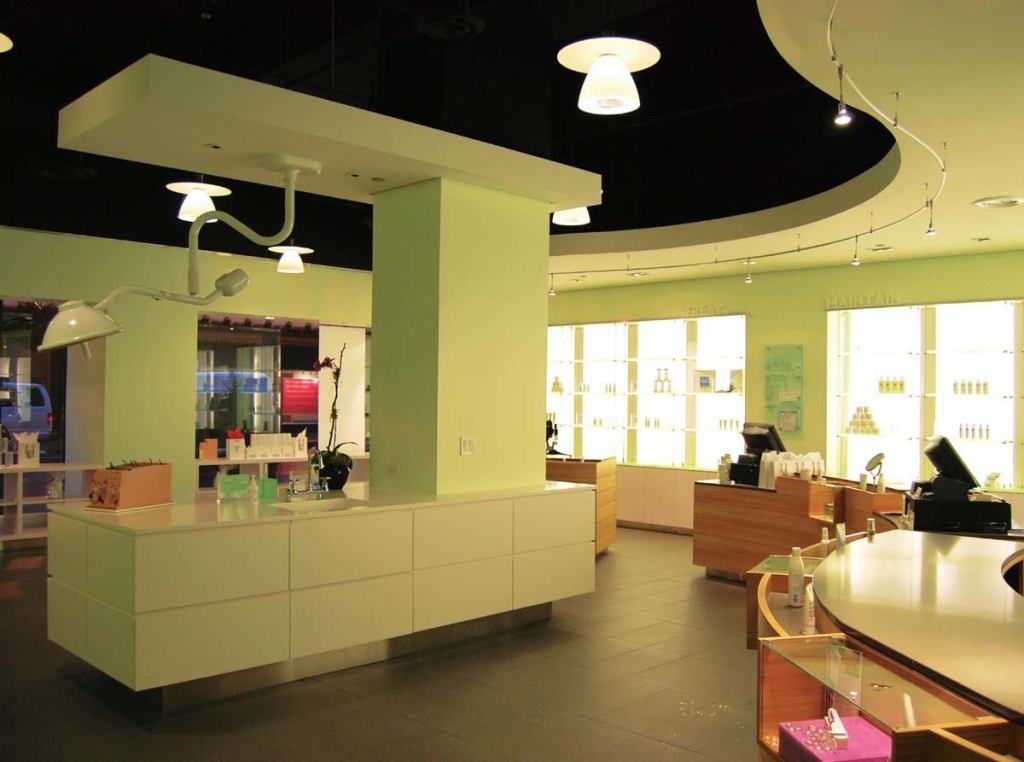
In specifying the flooring for a new retail store in Chicago’s Loop, architect David Hoffman would have liked to use Balsatina, an Italian volcanic stone, but there was never room in the budget for such an extravagance. He chose a Spanish-made porcelain tile—Apavisa’s Lava Antracita Natural—which mimics the texture and color of the natural stone. “It’s a great material that looks upscale and is durable,” he says. Hoffman used another faux material, Caesarstone, as the countertop in Dr. Memar: The Store, a skincare boutique. The quartz-based surfacing material has been around since 1987. “Caesarstone was chosen because of what it is, not what it was pretending to be,” says Hoffman. “It doesn’t pretend to be something else; it’s reconstituted.”
At Our Lady of the Most Holy Trinity Church at Thomas Aquinas College in Santa Paula, Calif., Duncan Stroik almost lost the 135-foot-tall tower from his design because of its initial cost. But the tower, conceived as masonry, was eventually fabricated (at a savings of $1 million) in aluminum by Munns Manufacturing. The Utah-based company has a complete catalog of cupolas, turrets, and towers that can be ordered without additional design services. As with many companies that offer stock designs, they’re not all of the custom quality that Stroik could provide, but a good percentage of them can readily be recommended as faux rather than phony. Stroik even found a West Coast precedent: a series of early 20th century churches in San Francisco whose masonry structures were augmented by metal towers. “I know it’s not the same,” he admits, “but there’s a connection.” One product that became pervasive in the 1980s postmodern moment was Zolatone, a spray-paint finish. Zolatone “imitated” granite in its flecked appearance (although you had to be standing pretty far away to make a mistake about its provenance). Today, the company still makes these finishes, but they’ve moved them away from their architectural offerings, which are decidedly more upscale and faux. These mimic the more subtle gradations of sandstone and metals. For those who miss the 1980s, the old “granite” look can still be found in cans at local hardware stores and automotive repair establishments.