










SOM/Cesar Rubio
Critical to extending the building’s longevity, and of crucial importance to the earthquake-wary client, was seismically isolating the sanctuary. A matrix of friction-pendulum base isolators rests beneath the sanctuary’s thick concrete walls and floor slab. In the event of an earthquake, the 34 base isolators—each incorporating a 4-foot-diameter steel bearing—would allow the building to move back and forth much more gently than it would if it were fixed firmly to the ground.
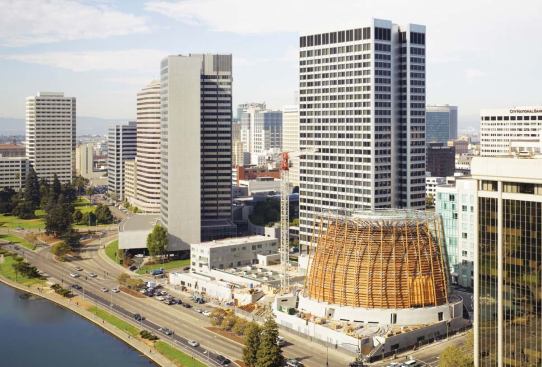
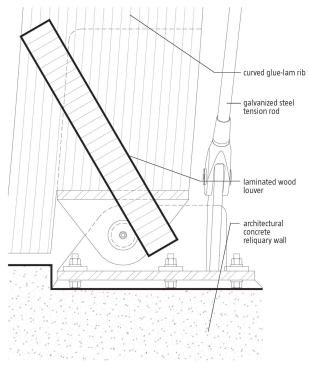
The architects refer to the massive, cast-in-place concrete base of the cathedral as the “reliquary wall,” in part because it contains a series of small chapels. The twin 15-foot-tall walls that constitute this base create an anchor for the wood structure. The sanctuary’s curved, tapering Douglas fir ribs spring from the top of the walls, held in place by steel pins at the base. A steel compression ring joins the ribs at the top. Weaving the vertical ribs together are hefty, glue-laminated fixed louvers that bind the ribs together like a diaphragm or shell.
The outer walls, shaped like segments of a cone, are formed by slender wood columns connected horizontally by thin steel members. The columns provide a repetitive framework for panels of fritted glass, whose translucency was carefully studied to produce the desired luminous effect. Joining the outer glass and inner wood shell are slender steel tension rods, most about 1 inch in diameter. The extreme lightness of the structure is one of its important assets, Sarkisian says. “The only way to achieve this solution was because we’ve isolated the building seismically. Otherwise, the structure would be robust or quite clumsy in proportion because the member sizes would be so large.”
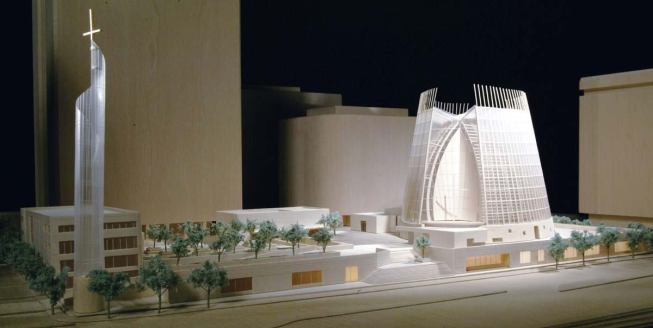
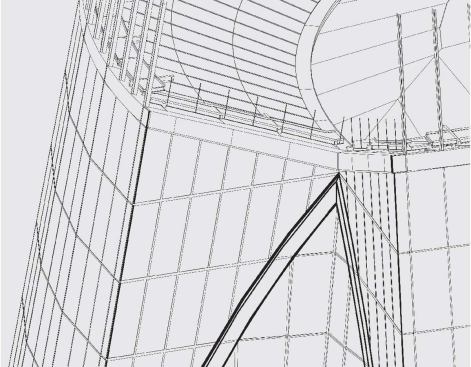
A tubular steel framing system supports the Alpha and Omega walls. (The Alpha Wall is about beginning, a place where visitors enter the building and encounter the baptismal font, and the Omega Wall is about conclusion, rising behind the altar and above the mausoleum.) The dynamic shape of the Alpha and Omega walls, which appears at first glance to resemble an inverted wedge on either end of the sanctuary, created another set of challenges, but the organic form was important to Hartman, who likens the faceted panels to flower petals. In terms of the sanctuary’s overall composition, the walls stitch together the building’s spherical and conical geometries—curving at the base, tipping inward, and folding like a crease at the top.
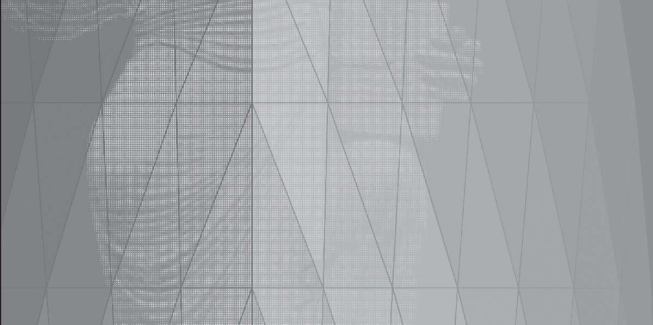
Their complex geometry required a three-dimensional study to develop suitable details for installation and fabrication of the exterior glass and interior aluminum panels that enclose them. Using AutoCAD and Rhino 3D software, the team first experimented with rectangular panels or parallelograms for the enclosure, says SOM technical director Keith Boswell. “But we were trying to twist or bend material, making it do more that it could do.” That’s when they settled on triangular shapes. Due to the shifting plan and section geometry of the end walls, the panels vary in size. The 3-D model facilitated the design and detailing of the panels with a high degree of accuracy, Boswell adds.
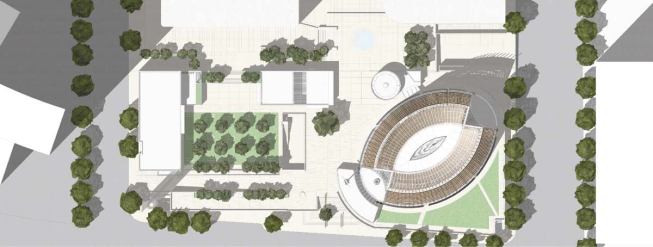
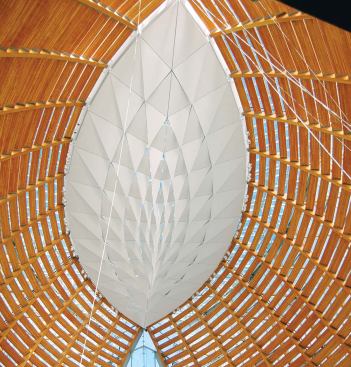
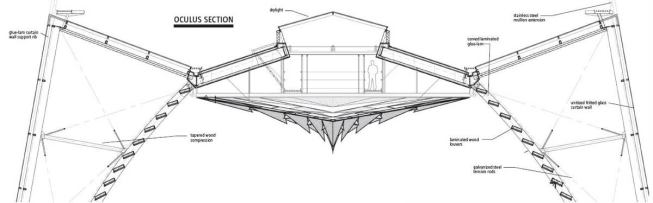
Given the function of the building, Hartman took care to consider the quality of light that parishioners will experience inside, seeking an ethereal effect produced by the combination of reflected light, the warm wood surfaces, and the glow of the transparent glass. An oval oculus at the top of the sanctuary will admit additional daylight through an arrangement of triangulated baffles. SOM repeatedly modeled the entire space in 3-D, but it also built and tested physical models to help predict the lighting effects.
From a mechanical standpoint, the firm’s objective was to provide the most efficient system for occupant comfort without heating or cooling the air above the occupied height. The sanctuary will be tempered by radiant heating concealed in the floor. Air conditioning will occur through “displacement cooling,” in which cool air is fed through small floor openings. This allows pools of conditioned air in a 10- to 15-foot zone near the floor, says Boswell. As cool conditioned air warms, it rises to the top of the sanctuary and is vented outside through motorized dampers at the base of the oculus.
A structural tour de force, the Cathedral of Christ the Light—expected to be completed in September— promises to be an awe-inspiring gathering place of soaring proportions, luminous light, changing moods, and soothing natural materials. If that doesn’t inspire wonder, what will?