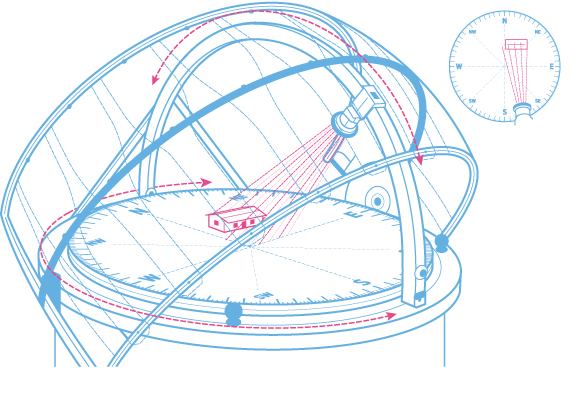
In recent years, as green building practices have infiltrated mainstream architecture and construction, the term daylighting has been adopted as a broad way of describing sustainable approaches to lighting. Design professionals often apply the term without a comprehensive understanding of the myriad techniques it describes, such as toplighting, sidelighting, and solar shading. But as daylighting seemingly becomes more complicated, lighting designers and architects can turn to traditional physical modeling tools and techniques that may help simplify matters.
Some of the confusion arises from the fact that daylighting strategies have been used widely in a new generation of high-rise buildings that incorporate sophisticated curtain wall assemblies. Given such high-end associations, it is easy to assume that daylighting is a complex technique requiring a suite of advanced software.
But this is not always the case; in fact, daylighting is rooted in basic architectural principles of siting and location. Elaborate calculations and software are not a prerequisite to form a daylighting strategy. As a result, traditional physical modeling tools such as sun angle calculators, sun path diagrams, sundials, and heliodons often are overlooked as resources for performing daylighting analyses.
ADVANTAGES OF PHYSICAL MODELING “Physical modeling is an extremely intuitive way to interact with the built form of whatever you are studying,” says Keith Yancey, principal at Cambridge, Mass.–based Lam Partners, a firm known for its focus on daylighting. A traditional architectural model can serve as a quick, hands-on study tool, helping designers understand what is happening to daylight inside the space, and outside as well.
“With electric lighting, daylighting has become an amenity in lieu of the primary source of illumination for interiors,” Yancey explains. “Architects used to make their decisions about building geometry and space allocation based on a solid understanding of solar dynamics such as the sun’s relative movement across the sky or its changing color and quality throughout the day or year.” Physical modeling techniques reclaim a connection to fundamental principles of how best to use sunlight, climate, and site.
Besides the immediacy a physical model offers in seeing how light will move through a space, another benefit is an improved understanding of the materials to be used. For instance, by adding clear acrylic to a model’s window openings, it is possible to simulate spectrally accurate interreflectance—the bouncing of light off surfaces. The use of materials and textures in a model provide a level of dimension and reality to the space, nuances that still are limited in computer simulations.
The 3-D computer models that architects work with are not typically constructed in a way that is best suited for incorporation into daylighting analysis software. As Jamie Perry, an associate at Lam Partners, explains, “Nowadays the architect is starting with some sort of 3-D model. It’s very easy to take that model and put it in another program. It no doubt gives you some very important information, but it is difficult to replicate the dynamic quality of the way sunlight penetrates a space and interacts with materials without a physical model.”
Another benefit of physical modeling is a decrease in set up time. Compared to the amount of time involved in preparing some computer models for accurate daylight simulation, given each program’s rendering times, a good physical model can enable an architect or lighting designer to make a relatively quick study of multiple scenarios for times of day and year. “It’s all right there in the model. It’s fast, accurate, very flexible, and intuitive,” Perry says.