
To the question, “Is insulated concrete forms (ICF) exterior wall construction compliant with NFPA 285 in multistory applications?” a recent Intertek test and Jensen Hughes engineering judgement answers with an emphatic yes.
The investigation shows ICF exterior wall construction is NFPA 285 test compliant across 14 thick- and thin-cladding applications, including brick, CMU, stucco, thin brick, ceramic tile, EIFS, fiber cement, plate metal, and other common veneers, as well as dozens of water resistive barrier (WRB) products.

Photo credit: Tremco
New Report Now Available
The new 40-page report, titled Investigating ICF Wall Construction Meeting the Requirements of NFPA 285, comes at a propitious time for architects, building owners, real estate investors, and the property insurance industry.
Growing home repair and replacement costs brought on by extreme weather events have heightened interest in resilient construction. ICF is widely recognized for its exceptional wind, fire, impact, seismic, thermal, and acoustic characteristics. The fire test report conclusively shows ICF meets Section 2603.5.5 of the International Building Code for Types I, II, III, and IV construction.

Photo credit: Tremco
‘Two Very Healthy Passes’
“An architect can now go to a building owner and say ICF is safe to use from an NFPA 285 perspective,” explains Arthur Parker, PE, principal fire protection engineer with Jensen Hughes, a global fire protection consulting firm. “A pair of baseline tests at Intertek’s testing laboratory in York, Pa., resulted in two very healthy passes for ICF. The tests achieved a very good and definitive result.”
The Jensen Hughes report details two related tests, examining flame behavior on a pair of full-scale mock-ups:
- Noncombustible standard brick veneer exterior wall
- Combustible aluminum composite material veneer exterior wall
The twin assemblies allowed Parker and his Jensen Hughes colleague, Daniel Martin, PE, CFEI, CVFI, to offer engineering judgments on a wide range of facades and WRBs.

Photo credit: Tremco
High-Rise Applications
One project lead, Shamim Rashid-Sumar, says the Jensen Hughes analysis is “… a very good resource for architects and designers. This is official confirmation the heavy lifting is over with respect to ICF fire performance.”
Rashid-Sumar, PE, FSFPE, is the senior vice president, codes and standards, for the National Ready Mix Concrete Association (NRMCA), part of an industry consortium that sponsored the testing and report.
“Architects, owners, investors, and insurance companies now have access to clear, authoritative ICF code compliance data,” Rasid-Sumar continues. “Fire does not propagate within ICF walls. The report affirms ICF is not just a solution for one- and two-story buildings, or low mid-rise structures.
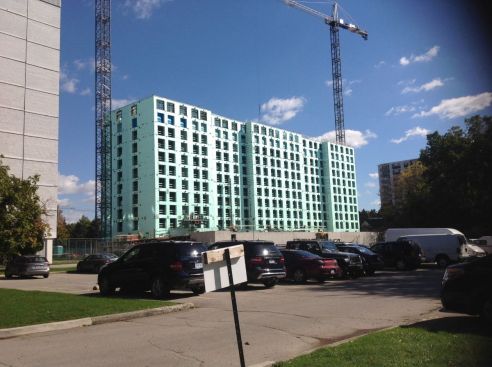
Photo credit: Tremco
Resilient Design Option
“ICF can be confidently specified for nearly any type of project, including high-rises. The door is open for wider ICF adoption, including larger multi-story projects.”
ICF technology also represents other benefits, such as construction speed. Slab floors, for example, can be placed in as few as 7-10 days after a wall pour. The rapid, Lego-like block assembly of ICF walls accelerates project timelines and is minimally slowed by adverse weather.
For Parker, ICF’s NFPA 285 compliance is welcome news. “It’s another arrow in the architect’s quiver,” the 30-year fire testing veteran observes. “ICF meets the requirements of building code and offers designers a proven fire-safe building solution.”
Learn more about how ICF exterior wall construction complies with NFPA 285 testing and IBC standards.