Suppose you could propose to owners a way to reduce embodied carbon in all concrete placements by at least 25% with:
- No schedule impact
- No cost impact
- No structural performance impact
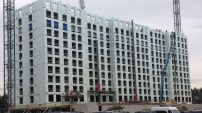
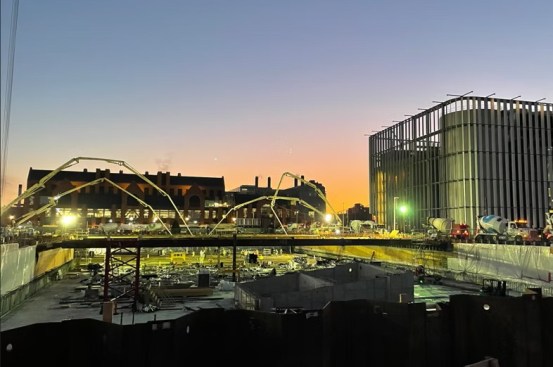
For Breakthrough Properties, the developer of the new 510,000-square-foot OneMilestone life science research project in Boston’s Enterprise Research Campus, the proposition earned an emphatic thumbs up.
By leveraging early supplier engagement, the construction partnership of Turner Construction|Janey|J&J raced past the promised 25% minimum and documented a 49% reduction in embodied carbon from the National Ready Mixed Concrete Association (NRMCA) baseline. And, yes, with no schedule or cost premium.
“What I love about this project is the way everyone came together early in pre-planning,” recalls Jim Carreira, technical director for Boston Sand & Gravel. “Early engagement allowed us to show our strengths from a concrete production standpoint.”
Those strengths turned out to be project difference-makers, much to the surprise and delight of the project team. “Yes, we were surprised by the tested concrete mix performance,” says Caroline Murray, regional sustainability manager for Turner Construction. “We have our own commitments to carbon reduction. Turner is always looking for ways to push the envelope.”
What other lessons does OneMilestone offer architects? At least four, according to Carreira and Murray:
- Engage early and often. Both agree early collaboration at the pre-planning stage allowed the project to streak past the initial carbon reduction goals. “Get your ready-mix supplier involved in the conversation before you develop specs,” advises Carreira, a 20-year building material veteran. “It’s too late if we’re introduced after specs are released and placement is a month away.”
- Go with performance-based specs. “A prescriptive spec is too limiting,” admits Murray. “It puts a ceiling on what you can accomplish. A performance-based spec allowed us to engage early with Jim [Carreira] and his team. For example, there was an 8000 pounds-per-square-inch (PSI) mix that netted a 60% carbon reduction. Let the experts identify the best mix recipe. It can lead to dramatic results.”
- Find your local Jim Carreira. Concrete veterans like Carreira can help open unexpected sustainability doors, presenting project stakeholders with high-value differentiators that lift project prestige and the reputation of everyone connected to it. “It’s not necessarily the architect’s job to be a ready-mix expert,” counsels Carreira.
“But it helps to know who they are. We work hard to establish contacts within the design community. It’s likely my counterpart is available locally to help meet your carbon reduction goals.”
- Embrace a powerful differentiator. Murray and Carreira recognize there’s a buzz building around low-carbon concrete. Carreira estimates he’s given at least 30 plant tours within the last two years to groups eager to learn more about concrete production. Murray agrees with the surging interest. “Architects, engineers and GCs learn what others are doing. This is a market transformation. I expect performance-based specs for concrete will become compulsory before too long.”
Carreira attributes the growing break from the status quo to a phrase he once heard, “The six most expensive words ever spoken are, ‘We’ve always done it this way.’”
Owner: Breakthrough Properties, a joint venture between Tishman Speyer and Bellco Capital
General Contractor: Joint Venture of Turner|Janey|J&J
Ready-Mix Contractor: Boston Sand & Gravel
Green Certification: Pursuing LEED v 4.1 BD+C Core and Shell targeting Gold (certification pending)
Winner: Concrete Innovations 2025 BE+ Green Building Showcase Award for Construction Innovation
Learn more about how recent advances in low carbon concrete can benefit your next project.