
Project Description
FROM THE ARCHITECTS:
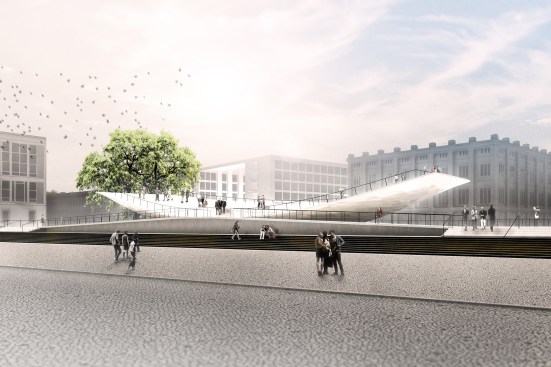
The memorial will honor the men and women who, in a peaceful revolution in 1989, caused the Wall to come down and Germany to be reunited. It is designed to be a kinetic object, a platform enabling people to interact with each other: they will actually walk on it and set it in motion. Its appearance will be shaped by its visitors through their participation and interaction – a true social sculpture.
The monument invites visitors to communicate and to act together. The movement will be achieved by visitors working together as a group: by the strength of their movement, it will come alive. It will be animate and not merely an object for contemplation: an aesthetically ambitious, continually changing expression of the peaceful revolution in Germany of 1989.
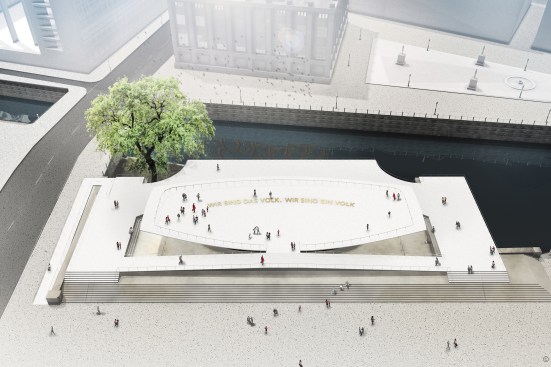
Freedom and unity aren't static conditions, they require participation and interaction. As with the peaceful revolution of 1989, people need to communicate and decide on joint action, in order to create the motion. It shows the strength in numbers: when there are at least 30 more people standing on one half of the bowl than on the other, the bowl will start to move, slowly and gently. New perspectives open up. The performative, changing nature of the monument is something to be seen and personally experienced.
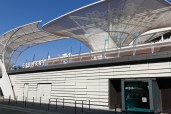
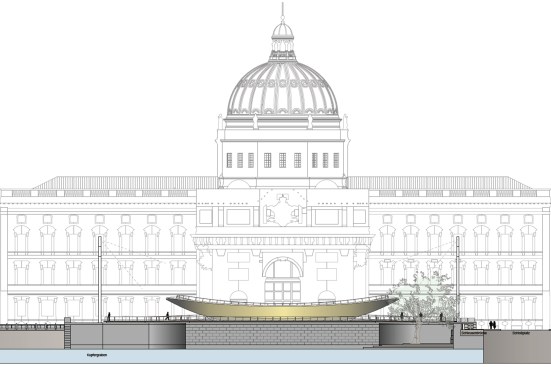
The bowl is to be built using a weight-optimized framework structure of steel components, as used for the construction of bridges. It extends over a longitudinal and lateral axis of 50 meters and 18 meters. At its thickest point, the bowl measures 2.50 meters thick and tapers to just a few centimeters at the edges. The unhurried motion of the bowl is triggered by its visitors. Their weight determines the degree and speed of its movement. A combined spring and damping system means that the motion will always be gentle. Faceted metal alloy panels clad the exterior of the bowl. The upper surface is fitted with compacted high-grade chippings that adhere to the surface and provide a highly slip-proof layer with excellent rainwater seepage properties. The safe and barrier-free use of the Monument is made possible due to its design in accordance with the Berlin construction code and the corresponding stipulations of barrier-free construction.
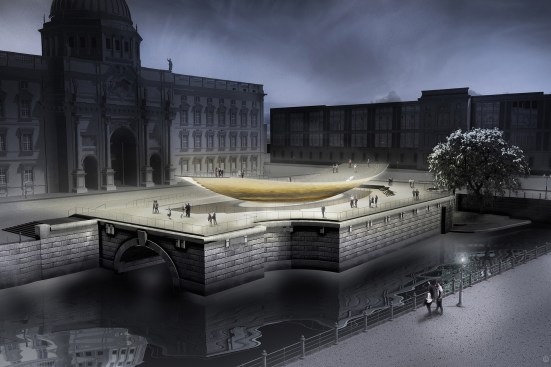
The Monument to Freedom and Unity will be erected in the center of Berlin – a modern design statement contrasting the current drift towards historical resurrection, such as the Berlin Stadtschloss. It will be built on the existing plinth of the former equestrian statue of Kaiser Wilhelm I as a contemporary architectonic layer. This principle of layering makes it possible to combine the different levels of the old monument and the new without blurring the differences. The chequered history of the location is still there to see – but now, Kaiser Wilhelm will be replaced by the people.