
Project Description
Pity the museum that finds itself in possession of a masterpiece. Not
an artwork—those are great: works like a Duccio and a Michelangelo, the
Cézannes and the Picassos, the divine Bohdisattvas and the Ganeshas, all
of which can be found in the galleries of the Kimbell Museum of Art in
Fort Worth, Texas. No, the problem is when the masterwork is a work of
architecture.
Between 1966 and 1972, the Kimbell got the right man at the right time
at the right place. Louis Kahn—despite his brief career and with due
deference to Frank Lloyd Wright, Louis Sullivan, and Thomas Jefferson—is
America’s greatest architect. Beyond any measure of taste or style,
Kahn’s best buildings combine, in enduring and astonishing ways, methods
and virtues that confound commonplace distinctions—between ancient and
modern, natural and artificial, practical and poetical—all with a
palpable feeling for the dignities and liberties of their inhabitants.
An entire city of this particular perfection, lacking the stimulating
misfits of everyday life, would pall. Yet each of Kahn’s few works is a
glimpse into an unbroken world.
Kahn’s Kimbell is iconic: Those rolling cycloid vaults, those porticoes
and courts and pools, those hidden skylights and suspended reflectors,
and all that silvery daylight they steal from the gods. Those divine
proportions and overlaid rhythm of 20-foot vaults and 10-foot service
bays, with all their built-in devices and services as integrated and
resolved as watchworks, and the travertine and concrete that bring
together gloss and grit, intimacy and monumentality, in a way that is
just right for a Texas treasure palace whose founding fortune was
wrought from livestock feed and oil.
Inseparable from that architectural design, Kahn’s landscape design
(developed with George Patton and Kahn paramour Harriet Pattison, now
well-known as the mother of My Architect filmmaker Nathaniel
Kahn) incorporated century-old trees that had lined a street formerly on
the site, mingling in red oaks and elms and aligning grids of crepe
myrtles and yaupon hollies with the multilevel platforms and courts and
pools that brought together building and plantings—all making, for this
car-bound and desert-dusted city, a dappled garden. In a June 1969
letter to patron Kay Kimbell, Kahn described the villa-in-a-garden
concept of the building, calling its west garden-facing façade and
porticoes the “entrance of the trees.”
The last project Kahn saw completed, that building and its grounds are
as much an essential record of a human nature, and of a humanist
mission, as the Michelangelo artwork it shelters. And like that painting
it should be stewarded in such a way that another 500 years of
humankind can fully experience its original effects. If the Kimbell
Museum were an insurance company or a car wash, it would face the same
ethical duty, but as an institution explicitly concerned with the
propagation of aesthetic experience, and with the long durations of
conservation and curation, the assignment is closer to home.
It’s not an easy thing, to have greatness thrust upon you. A little
Kahn goes a long way. Familiarity breeds, if not contempt, then a
certain situational blindness. Forty years come and go, and a museum’s
collection and mission grows. It finds itself in need of additional
gallery space. And an education center. And a bigger auditorium. And
even more parking. What then? First, a fiasco. Then, Renzo Piano, Hon.
FAIA. The fiasco was an aborted 1989 expansion plan, designed by Kahn
office veteran Romaldo Giurgola, FAIA, that suggested extruding Kahn’s
iconic vaults to the north and south like so much toothpaste—a
not-unsupportable proposal given that Kahn’s early schemes for the
original building had not dissimilar features, yet one that drew an
arts-pages firestorm, and was unceremoniously withdrawn.
In 2007, without the usual competitions and consultations, the Kimbell
announced a new addition to be designed by Piano. He had done well with
small Texas museums, like Houston’s 1986 Menil Collection and Dallas’s
2003 Nasher Sculpture Center—establishing, with his signature louvers
and skylights, a reputation for knowing how to daylight a gallery, and
for directing the busy traffic of high-end institutions. A formerly
prodigious practice that is now merely prolific, Piano’s Building
Workshop has produced many buildings of notable efficacy, applying
architecturally scaled technology to the programmatic essentials and
perfecting an aesthetic of apparent systematicity. New York’s Whitney
Museum and the Los Angeles County Museum of Art, after their own failed
additions, found in Piano a kind of fixer and controversy-cooler—a
signifier of good taste and seeming guarantor of critical approbation,
if not unalloyed praise.
Reviews since the November opening of Piano’s addition have been
dutiful, mostly of the “two masters meet at the top of their game”
variety; or even more decorously, they have followed a narrative of
“today’s masterpiece joins yesterday’s and shows admirable deference.”
But neither of those tales is especially true. Somewhere between
commission and construction, the site of Piano’s freestanding addition
got moved from an unimpeachably deferential position across the street
from the Kahn’s building’s east entrance, up and over into the garden
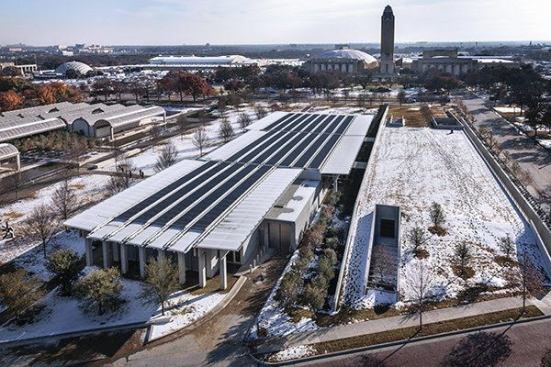
itself. Piano’s 100,000-square-foot, $132 million building now goes
head-to-head against Kahn’s 120,000-square-foot original across less
than 200 feet of parking-garage-capping lawn. Kahn’s “entrance of the
trees” now faces not old oaks and elms, but the blind concrete wall and
antic overhanging canopy that are the main features of the new
structure’s front façade.
Building in Kahn’s garden, next to his villa, one might incline towards
two possibilities: A diaphanous architecture of steel and glass that
complements-by-contrast with its substantial concrete antecedent, or a
grassy berm that, like Piano’s green roof for San Francisco’s California
Academy of Sciences or his Paul Klee Center in Bern, Switzerland,
becomes part of the garden itself. Piano’s new building does a bit of
both, while fully committing to neither.
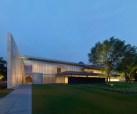
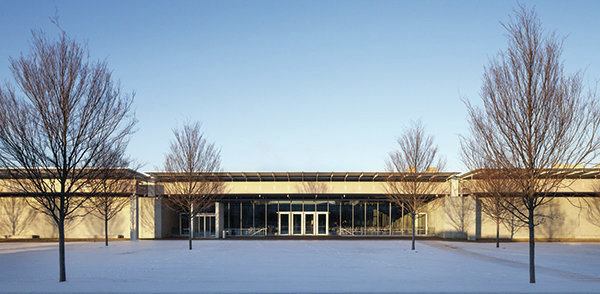
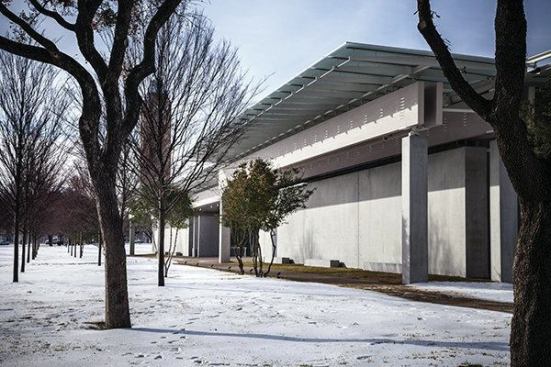
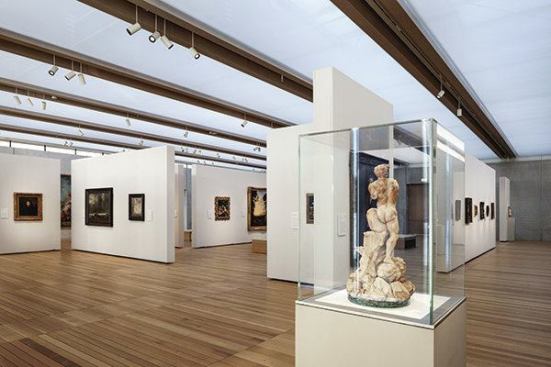
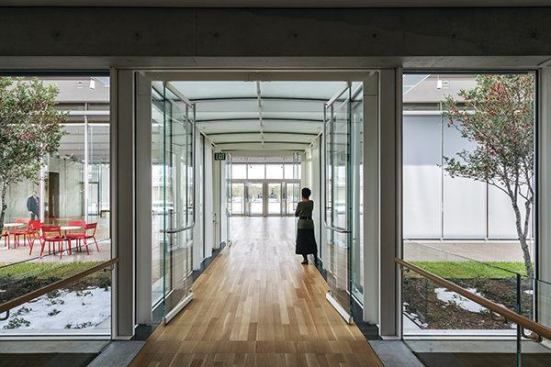
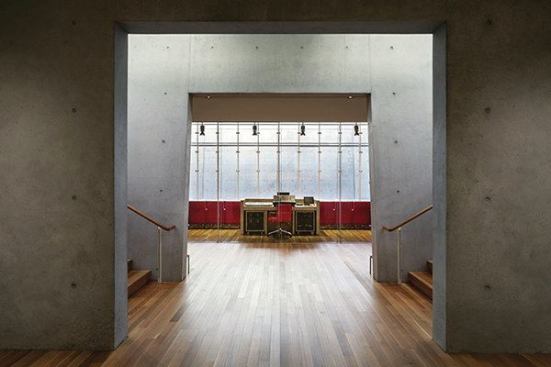
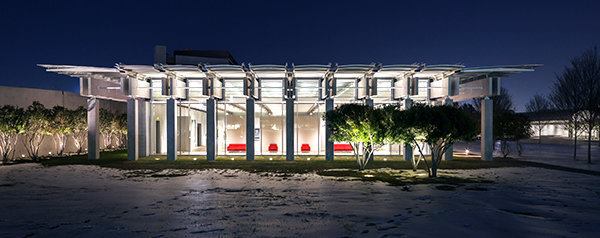
A partially glazed pavilion in front houses a very big lobby (which
presumably will be primarily an event space), and some
smaller-than-expected temporary exhibition galleries (one sharing space
with a generously scaled gift shop) featuring 11-foot-tall
reconfigurable partitions and clever air vents in the gaps between the
widely spaced floorboards. There’s a berm-like barrow to the back that
houses a 300-seat auditorium along with education and support spaces and
a low-light gallery. But the barrow, much-incised with loading docks
and light wells and parapets, isn’t all that buried.
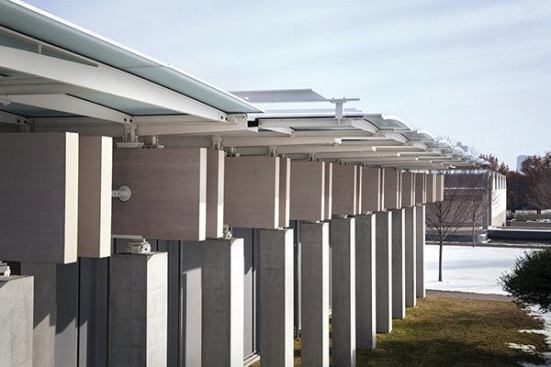
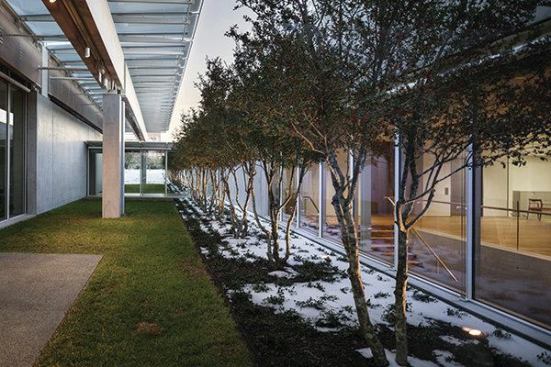
And the pavilion isn’t all that glassy. It features a familiar catalog
of Piano details: As at the Art Institute of Chicago, there are
structural columns that sneak outside the enclosing walls, supporting a
thin but deeply overhanging roof; and as at the Nasher, there’s an
insistent striation of walls and beams (this time, 10 feet on center,
running north–south) that sets up the finer grain above of the glass
roof and associated gadgets (this time, operable louvers with solar
panels over fritted glass over fabric scrims). The beams are 104 feet
long, 4 feet deep, and made from laminated Douglas fir, although their
bleached grayish color renders them—especially from that critical
200-foot distance to the Kahn—virtually indistinguishable from the
concrete walls below. On the building’s south and north façades, this
results in a massive and deeply articulated top for what is, at 23-feet
tall, a low-slung building—its miniature monumentality and rusticated
modernism reminiscent of a Hugh Stubbins Jr., or a Harry Weese, or a
Kevin Roche, FAIA.
To his own signature features, Piano appears to have added several
direct references to Kahn’s. The two buildings share a tripartite plan,
with the meter of Piano’s beams paralleling and equaling the length of
Kahn’s vaults, whose profile is distantly referenced by the very slight
convex curve of Piano’s skylights. A strip window between the base of
those Douglas fir beams and the top of the perimeter concrete wall
recalls the similar reveals between Kahn’s vaults and end walls. Paired
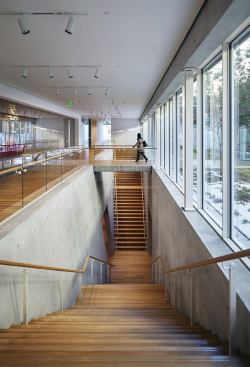
staircases down to the auditorium and the under-lawn parking vaguely
parallel the twinned staircases that famously slip visitors up from the
deliberately unpromising east entrance of Kahn’s Kimbell, to the
astonishing plenum of gallery and garden above. For some reason,
however, one concrete side wall of both sets of Piano’s stairs, and a
retaining wall elsewhere, are canted by about 10 degrees. A case could
be made that these quasi-Kahnisms pay tribute to their originals next
door. But the opposite may also be true: By placing not-quite-duplicates
nearby, Piano lessens the effect, in memory and anticipation, of the
originals—a kind of distant defacement.
The “uncanny valley” is that famous zone of experience in which a
copy’s approximation of an original is so close and yet so far, so that
the distinctions between the two become acutely visible, and causes the
whole to be repulsive. It is into this valley that much of Piano’s
psuedo-Kahn falls, especially in the significant management of the many
mechanical and structural elements—pipes, tubes, beams, frames, reveals,
channels, panels, brackets, spacers, sealants—that in Kahn’s building
reliably converge into resolved assemblies far greater than the sum of
their parts. In Piano’s building, many of these same components
complacently compound—clips on clips, tubes on tubes—but by Kahn’s
standards they are more coincident than truly convergent: adding and
adding, without ever quite adding up. In this, the 23rd museum produced
by an admirably busy practice, the resulting quietude may be less the
result of restraint than of a finite capacity for taking
pains—suggesting less the humility with which Piano’s building has been
credited, than a kind of smarm.
Perhaps the closest analogy to what has happened at the Kimbell is
Cabell Hall at the University of Virginia, with which, in 1899, Stanford
White closed off the view from the famous Lawn to the distant mountains
and Western Frontier at which Jefferson had deliberately directed
it—turning a Founding Father’s “architectural commandment” into a mere
quadrangle. Kahn’s garden was far more modest, but there’s a lesson in
how White’s Beaux-Arts bowdlerizing of Jefferson’s Georgian classicism
took much of the thrill and the enlightened strangeness out of its
neighboring originals.
When asked at a November lecture in Fort Worth what he thought of his
work at the Kimbell, Piano replied, “We need the trees to grow.” He
elaborated, wisely and touchingly, that even the greatest new buildings
take time for their rough edges, flaws and features both, to be worn
smooth by use, “to become part of the day-to-day life of the city. It
needs a patina. … Architecture relies on a long time, it is made real
only in time, like forests are.” Yaupon hollies are tolerant and hardy
and evergreen. They grow fast. Soon, they and other new plantings may
restore something of the proportions and conversations Pattison and Kahn
imagined between branches and arches: between museum and garden and
city. They may someday moderate the dire tuba-in-the-strings-section
presence of the neighboring University of North Texas Health Science
Center that, absent big trees, looms over what’s left of the garden.
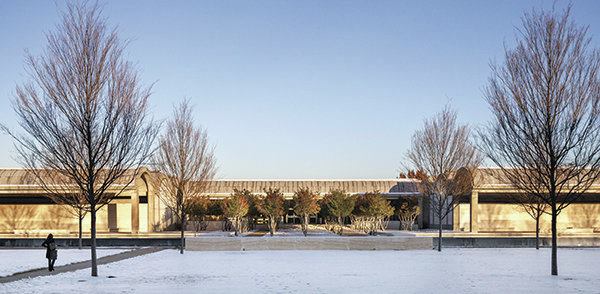
But for now, those yaupons perform a different kind of miracle:
Currently head-height when viewed from the sunlit forecourt at the heart
of Kahn’s Kimbell, the trees’ delicate-yet-dense canopies blend
seamlessly into the remaining garden landscape, and in a perspectival
trick worthy of Duccio or Michelangelo, perfectly align with the
elevation of the new building to the west—erasing it, as if it had never
come to pass, from view. —Thomas de Monchaux
For more on the Renzo Piano Pavilion at the Kimbell Art Museum, including critiques, videos, and photo galleries, click here.