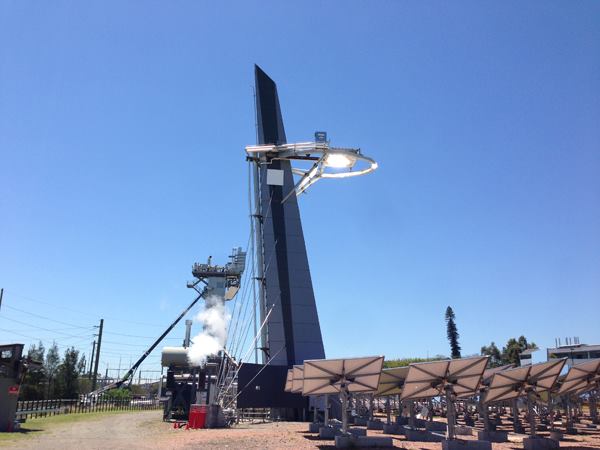
Renewable energy technologies continue to make exciting progress as fossil-fuel alternatives. Earlier this month, scientists at the CSIRO Energy Centre in Newcastle, Australia, announced the unprecedented achievement of producing supercritical steam using solar-thermal power. Supercritical steam is steam that is high enough in heat and pressure to drive advanced power plant turbines—something that has only been possible through the use of fossil fuels.
To achieve the necessary output levels, the Energy Centre team constructed a heliostat mirror array that focuses sunlight at a central receiving tower. Unlike other concentrating solar-power plants, which have only been able to achieve sub-critical energy levels, Newcastle’s Advanced Solar Steam Receiver uses an automated control system that predicts the heat levels of every heliostat and dynamically adjusts in order to optimize heat transfer without overtaxing the receiver. The resulting steam is 570 C (1058 F)—hot enough to melt aluminum—at 23.5 megapascals (3,408.39 pounds per square inch) of pressure.
Heralded as a world record, the achievement demonstrates solar-thermal energy’s competitiveness against fossil fuels in steam-power generation. Although the Energy Centre claims that the technology “may be a fair way off commercial development,” it promises to deliver comparable output to coal-derived steam power at lower economic and environmental costs.
Blaine Brownell, AIA, is a regularly featured columnist whose stories appear on this website each week. His views and conclusions are not necessarily those of ARCHITECT magazine nor of the American Institute of Architects.