
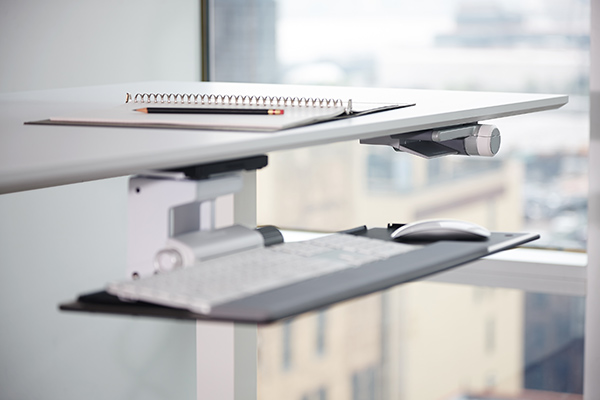
The Living Product Challenge, organized by the International Living Future Institute, asks participants to create a product that functions as if it derived from nature—meaning that it must have a net-zero impact, perform efficiently, and be aesthetically inspiring. New York–based design studio Humanscale recently received Living Product Certification for two products: Float table and Diffrient Smart Chair. The production and materials also meet net-positive standards in “respect to impact categories such as water, energy, climate, waste and ecological impacts.” according to the company’s website. [Humanscale + International Living Future Institute]
Rushing to bring virtual reality and augmented reality mainstream and cheap would ruin the growth of the technologies itself, argues Fast Company‘s product director, Cliff Kuang. [Fast Co. Design]
MIT’s Self-Assembly Lab creates a transformative, self-building, and pod-like workspace that can be altered for different degrees of privacy. [Self-Assembly Lab]
ICYMI: New Lab, a co-working space for high-tech companies in Brooklyn, N.Y., officially opened its doors this past week, boasting full-scale fabrication and prototyping shops stocked with 3D printers, CNC-milling machines and lathes, a laser cutter, and more. [ARCHITECT]
Elon Musk has announced his plan to colonize Mars by using reusable rockets, carbon-fiber fuel tanks, and ultra-powered engines. [Wired]
Pouncer, a drone concept design by U.K.-based Windhorse Aerospace, could help deliver supplies to victims of natural disaster. [New Atlas]
The world’s first hydrogen-powered passenger train was unveiled at Berlin’s InnoTrans trade show, and is set to be in operation by December 2017. [The Local Germany]
The National Science Foundation (NSF) has awarded $94 million to four new Science and Technology Centers (STCs) across the U.S. These centers are dedicated to integrating research, education, and training in science and engineering fields. Each recipient will receive up to $24 million over five years, with the potential for five more years of support. The four STCs are: the Center for Bright Beams; the Center for Cellular Construction; the Science and Technology Center for Engineering MechanoBiology; and the Science and Technology Center on Real-Time Functional Imagine. [NSF]