With health care workers churning through face masks to prevent the further spread of COVID-19, the École Polytechnique Fédérale de Lausanne EssentialTech Center and Empa, the Swiss Federal Laboratories for Materials Science and Technology, have developed HelloMask, a transparent surgical mask made from a see-through, 99% biomass derivative material. While conventional, opaque masks muffle voices, obscure facial expressions, and preclude lip-reading, HelloMasks’s transparency level could ease communication and comfort level between health care workers and patients. With funding secured, bolstered by the global demand for surgical masks, EPFL and Empa have created HMCARE, a startup to manufacture the masks. The group plans to launch the masks to the commercial market in 2021. [EPFL]
The National Organization of Minority Architects (NOMA) and the AIA Large Firm Roundtable (LFRT) issued a statement and letter strengthening their partnership to combat systemic racism within architecture. “Now more than ever, i is vital that we stand together to combat the insidious impact of racism in our profession,” write NOMA president Kimberly Dowdell, AIA, and LFRT chair Carole Wedge, FAIA [ARCHITECT]
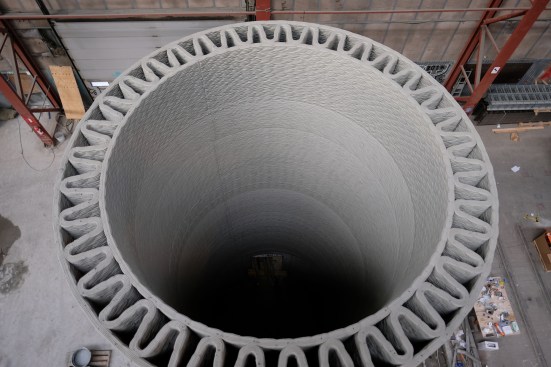
courtesy COBOD, GE Renewable Energy, and LafargeHolcim
A 3D-printed concrete base for a future wind turbine of soaring heights
Energy and building industry giants GE Renewable Energy, LafargeHolcim, and COBOD have collaborated to create record-tall wind turbines with the help of 3D concrete-printed bases. Although most turbines fall short of 328 feet, due to the transportation constraints of a precast concrete base, these turbines that can soar past 650 feet using a variable height concrete base 3D printed directly on-site. Thanks to the extra boost in height, the turbines can capture stronger winds, generating even more renewable energy per unit. “With our groundbreaking 3D printing technology combined with the competence and resources of our partners, we are convinced that this disruptive move within the wind turbines industry will help drive lower costs and faster execution times,,” said COBOD founder Henrik Lund-Nielsen in a press release. [LafargeHolcim]

Photo by Andrew Pielage
The revered School of Architecture at Taliesin, founded by Frank Lloyd Wright, will be moving to a new location and assuming a new name. [ARCHITECT]
Gensler has internally released Blox, the first in a series of products in the global design firm’s “inFORM” ecosystem uniting information metrics and geometry form-finding, according to a LinkedIn post by principal and global director of design technology Joseph Joseph, Assoc. AIA. Blox enables users to conduct design studies and evaluations at the “building(s), city block(s), and masterplan levels”, as well as compare models in the context of client requirements such as parking, programmatic ration, zoning, and proforma projections. [Gensler via LinkedIn]
AIA has released 3D design models and strategies that can assist education officials with the process of reopening schools during the COVID-19 pandemic. [ARCHITECT]

The entry deadline for the 2020 AL Light & Architecture Design Awards has been extended to June 24. Now in its 17th year, the annual program recognizesinnovative projects in the field of architectural lighting design. Winners will be featured in the September 2020 print issue of ARCHITECT, in AL’s and ARCHITECT’s newsletters, and online. [ARCHITECT]