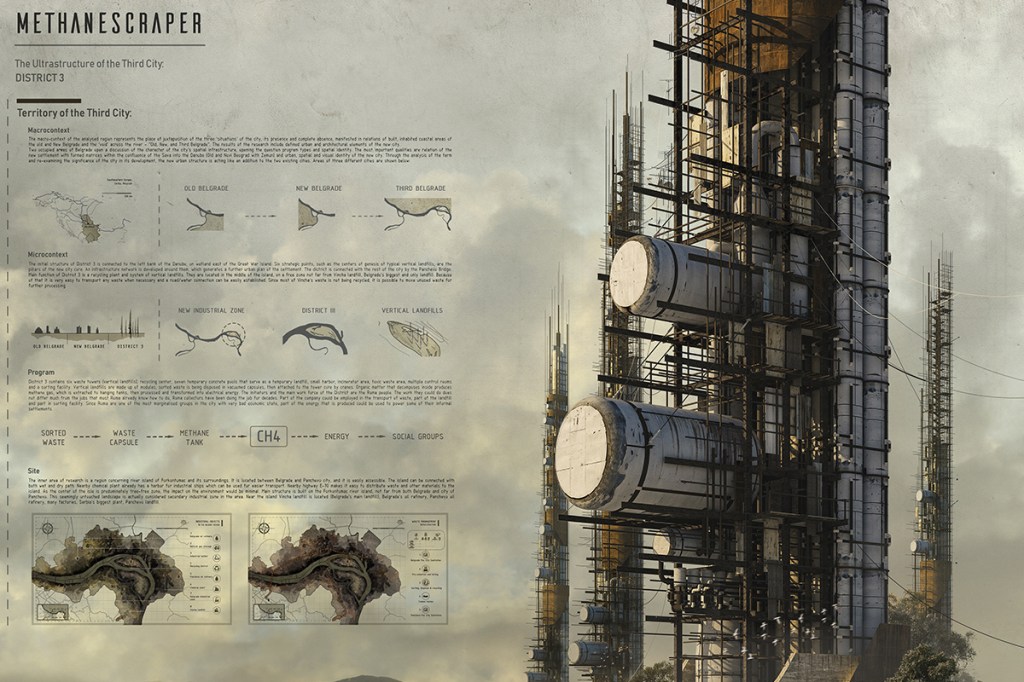
Evolo magazine selected three winners from 478 submissions to its annual Skyscraper Competition, launched in 2006. Serbian designer Marko Dragicevic took the top prize for his Methanescraper proposal, which is intended to address excess waste in urban settings. Envisioned for the city of Belgrade, Serbia, Methanescraper is a modular vertical landfill tower comprising a concrete core with attached waste capsules. According to its project description, waste is sorted by type, with organic material collected in the capsules. Using an inhaler and pipeline system, methane gas from decomposing matter is captured and turned into energy. Once the process is complete, each capsule can be cleaned and refilled for continued energy production. “This type of landfill not only greatly reduces the negative impact on the air and ground (since it emits zero toxic gases and prevents any air and ground contact with waste), it also massively reduces the amount of space needed to store waste,” Dragicevic writes. [Evolo magazine]
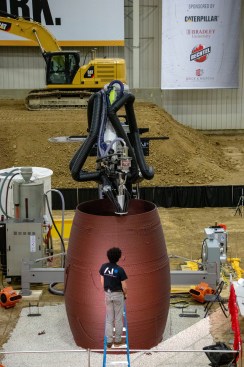
Courtesy AI Superfactory
New York–based multiplanetary architectural and technology design agency AI Spacefactory won the $500,000 award in the third and final phase of NASA’s 3D Printed Habitat Challenge, which called for each team to 3D print its design. AI Spacefactory’s Marsha prototype took approximately 30 hours of printing using a biodegradable and recyclable biopolymer basalt composite similar to materials found on Mars. Marsha topped out at 15 feet and featured two robotically placed windows. After pressure, smoke, and impact testing, AI’s proprietary material was found to be more durable than concrete competitors. [AI Spacefactory]
The American Institute of Architects has announced four grant recipients of its Upjohn Research Initiative. Now in its 12th year, the annual program awards between $15,000 and $30,000 to up to six projects that aim to advance the future of architecture. [ARCHITECT]
A team of researchers at the U.S. Department of Energy’s (DOE) Lawrence Berkeley National Laboratory in Washington, D.C., has developed a new kind of plastic that “can be disassembled into its constituent parts at the molecular level, and then reassembled into a different shape, texture, and color again and again without loss of performance or quality,” according to a press release. Historically, the performance and aesthetics of plastics diminish when they are recycled, if they are recycled at all. The team hopes that its new material will limit the amount of plastic that ends up in landfill and encourage recycling by manufacturers. [DOE]
We reviewed 171 new fixtures submitted to our sister publication ARCHITECTURAL LIGHTING’s 2019 product call. Here are 21 products that demonstrate the advancements in LED performance and color control technology dominating the market today. [ARCHITECT]