According to a recent Fast Company article, design startup Geoship has partnered with online shoe and clothing retailer Zappos to build a series of bioceramic domes in Las Vegas to be offered as housing for the city’s homeless population. Geoship reports that its structures are less expensive to construct than conventional housing, can withstand fires and hurricanes, and “reconnect human communities with the natural world.” “[T]o really solve the affordable housing crisis you have to … transcend the single-family home with land ownership and take land speculation out of the picture,” Geoship founder Morgan Bierschenk told Fast Company. The company expects the houses to go into production in two years. [Fast Company]
This week, the Cradle to Cradle (C2C) Products Innovation Institute opened the forthcoming version of the C2C Certified Product Standard to comments from the public. “Recognized as the world’s leading multi-attribute, science-based standard for responsible production and consumption, the Cradle to Cradle Certified Product Standard provides a continuous improvement pathway for optimizing and verifying products for the circular economy,” the institute writes in a press release. The new standards draft calls for new frameworks for product circularity, compliance assurance, and environmental policies. The public comment period will close on Oct. 4. [Cradle to Cradle Products Innovation Institute]
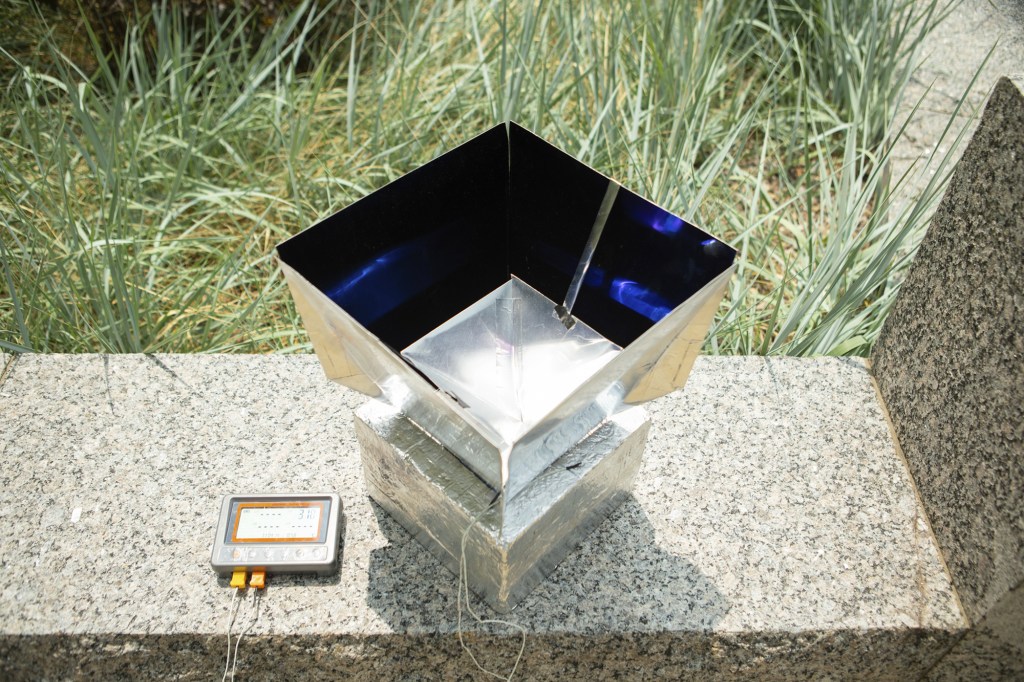
Engineers at the University at Buffalo, in New York, have developed a cooling system for city buildings that uses no electricity. Relying on an inexpensive polymer and aluminum film to keep the surrounding environment cool, the solar “shelter” absorbs heat and transmits it through the Earth’s atmosphere into outer space. To effectively cool a structure, multiple units of the system would need to be installed to cover the roof. [University at Buffalo]
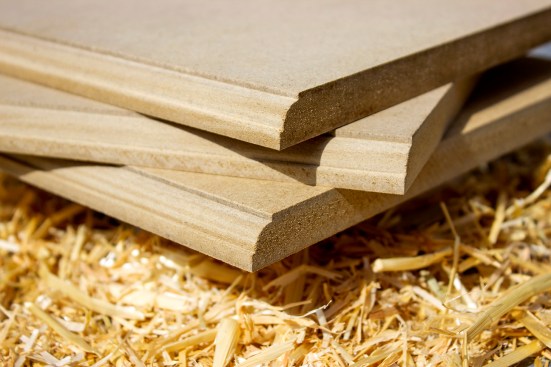
Courtesy CalPlant
CalPlant's rice straw–fiber MDF panels with routed edges
About two decades in the making, Willows, Calif.–based CalPlant will offer soon composite panels made of agro-waste from its $315 million manufacturing facility. Not only is CalPlant the first commercial-scale producer of rice straw–based MDF, which will be formaldehyde free, but the company will source its primary raw ingredient from farms all within a 25-mile radius. [ARCHITECT]
According to a recently published report by University of California, Los Angeles (UCLA) researchers, using biofuels from converted waste across various industries could help cut emissions in the United States. While waste-to-energy plants are common in Europe, those in the U.S. cannot produce the volume of energy needed to make the intensive process worthwhile. The study assessed 15 energy conversion technologies and 29 waste types, ultimately finding that the U.S. could produce enough energy to power the states of Washington and Oregon. [UCLA]

courtesy SOM | Slashcube GmbH
View of Earth from Moon Village
2019 R+D Awards: Sparked by mutual interests, Skidmore, Owings & Merrill (SOM), the European Space Agency (ESA), the MIT Media Lab, and the MIT Department of Aeronautics and Astronautics have developed a vision for a permanent human settlement on the moon’s surface. The proposed habitation modules can fit into the largest rockets currently made by SpaceX and Blue Origin. [ARCHITECT]