
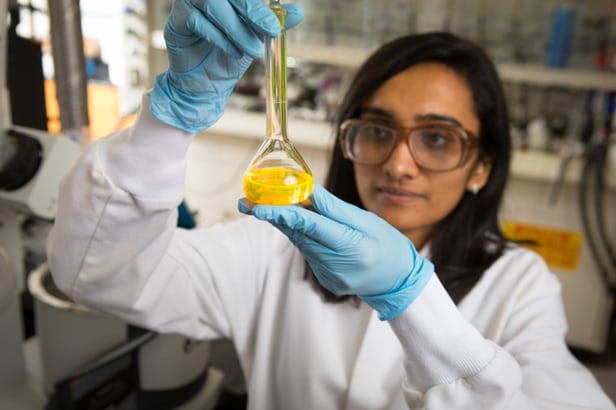
In the quest to power houses and cars more efficiently in the future, liquid-based redox flow batteries might beat out their lithium-ion counterparts with the help of BODIPY (boron-dipyrromethene), a chemical compound that is exceptionally good at both storing and transferring electrons. Researchers at the University of Buffalo are currently testing how this compound can help better energy storage solutions. “As the world becomes more reliant on alternative energy sources, one of the huge questions we have is, ‘How do we store energy?’ ” says lead researcher Timothy Cook. “What happens when the sun goes down at night, or when the wind stops? All these energy sources are intermittent, so we need batteries that can store enough energy to power the average house.” [New Atlas]
Tesla and SolarCity demonstrate what their newly official partnership can accomplish by powering Ta’u island, in American Samoa, through 5,300 photovoltaic panels and a Tesla Powerpack commercial battery storage facility. [Tech Crunch]
The Veterans Administration Hospital in New Orleans reopens its doors to a new, more resilient 1.7-million-square-foot facility, designed by NBBJ, 11 years after Hurricane Katrina devastated the area and damaged the hospital. [Fast Co. Design]
A massive 345-foot-tall-by-532-foot-wide metal arch, which began its off-site construction in 2012, will help detain Chernobyl’s radioactive wreckage. [Live Science]
The Swedish government aims to slash solar energy taxes by 98 percent in 2017. [Reuters]
Tech companies like Google and Facebook reiterate their support to the United Kingdom by announcing local construction and renovation projects in the aftermath of Brexit. [Engadget]
MIT’s Computer Science and Artificial Intelligence Laboratory has created MoVR, a virtual reality device that is capable of wirelessly transmitting quick data from a computer to a headset. [Wired]