
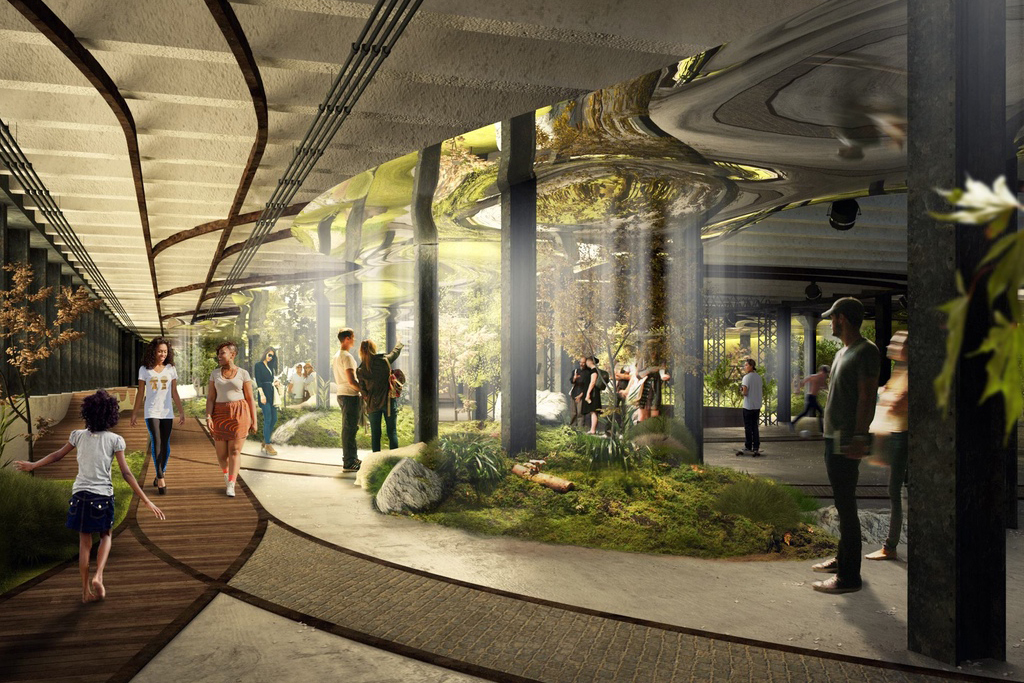
New York is building an underground park. The city is applying the same concept used for its highly successful High Line project below grade to its forthcoming Lowline. There’s just one hitch. The 1-acre site—a 107-year-old trolley station unoccupied since 1948—lacks the preeminent attribute of a public green space: access to sunlight. To introduce daylight underground, the team, led by Raad Studio in New York, is partnering with South Korean startup SunPortal to develop a collection system for the space. In application, the network of street-level sunlight collectors and lenses will reflect daylight downward for distribution across the site, where it will be diffused through dome-shaped fixtures to foster plant growth while shedding light on a long-hidden piece of New York history. The team recently wrapped up a Kickstarter campaign to fund the creation of a testing lab for the new technology in a nearby warehouse. [Fast Company’s Co.Design + Gizmodo + Kickstarter]
ICYMI: From an air-cleaning masonry wall to humanoid robots that help out at the jobsite, these nine trailblazing projects were recently named winners in ARCHITECT’s ninth annual R+D Awards. [ARCHITECT]
Building entrepreneurs are turning hemp into a building material. Their so-called hempcrete combines the Cannabis sativa plant’s wood-like interior with lime and water. The resulting material, which lacks structural properties, resists mold and is toxin free. [The New York Times]
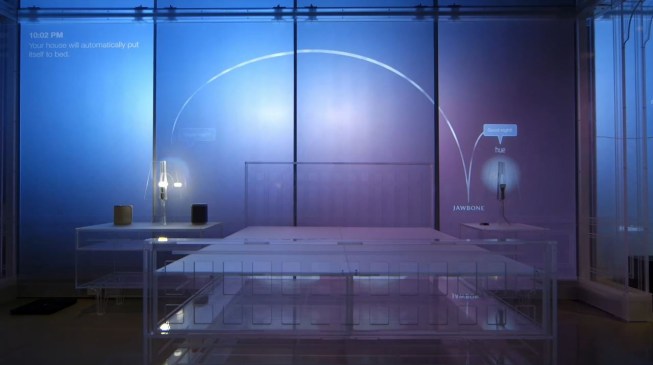
Local Projects, the New York studio behind the interactive installations at the Cooper Hewitt and the 9/11 Memorial Museum, recently teamed up with retailer Target to build a 3,500-square-foot storefront (shown above) in San Francisco devoted to the science of selling smart-home products. [Wired]
In the first half of 2015, more than 500 firms received the Federal Aviation Administration’s approval to fly drones in the U.S., catalyzing rapid growth in the still-nascent industry. [The Verge]
An indoor vertical farm, purported to be the world’s largest of its kind, is going into a 69,000-square-foot converted steel factory in Newark, N.J. The facility, designed by KSS Architects in Princeton, N.J., will grow crops for its local market using aeroponics, a farming process that combines adjusted-wavelength LED lighting and mist. [Gizmag]