
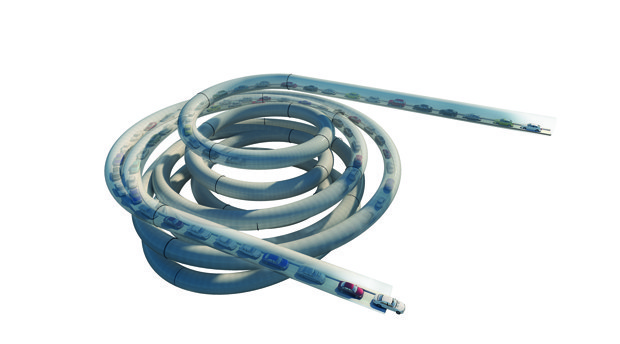
CarTube, an urban planning concept designed by London firm PLP Architecture, proposes building underground tunnels in order to alleviate the automobile traffic so prevalent in large cities. Though seemingly a tidy solution to an ever-present problem, critics like Robert Cervero, a recently retired professor of urban planning at University of California, Berkeley, says, “It risks exacerbating the past half-century of ever-worsening problems attributed to automobile-dependent lifestyles, [like] urban sprawl, the engineering of walking and face-to-face contact of everyday life.” [CityLab]
ICYMI: “Vespers,” a multi-material printing method developed by MIT’s Mediated Matter group and Stratasys enables 3D printing at the cellular level. [ARCHITECT]
A team of researchers from the University of Nottingham, in the U.K. and China, recently discovered that the use of non-destructive terrestrial laser scanning can be used to determine the changes in concrete strength after the building material has been exposed to extreme heat. [The University of Nottingham]
Budapest-based startup Platio takes solar panels to the sidewalk and covers them in a layer of recycled plastic for its eponymous first product. The panels, which are made up of monocrystalline silicon cells, are capable of being snapped together like Legos. [Nature World News]
Scientists at the Ulsan National Institute of Science and Technology (UNIST) in South Korea say they have found a way to make traditionally flat thermoelectric generators function as a coating on any surface. [New Atlas]
Teens Sanjay and Arvind Seshan took the tediousness out of writing holiday cards by building a robot out of Legos to do it for them. [The Verge]
The Internet of Things could help save the environment, reducing carbon dioxide emissions through innovative solutions that would decrease travel times and power smart buildings. [The Guardian]