
In a recent paper published in the journal Building and Environment, a team from MIT unveiled a new software tool that can complete a full life cycle analysis (LCAs) on a building during the design phase—a step that often occurs only after a structure is completed. “We wanted to address how to bridge that gap between using LCA at the end of the process and getting architects and engineers to use it as a design tool,” said Franz-Josef Ulm, one of the paper’s authors, in a university press release. Conventionally, architects have found LCA tools to be too restrictive on design choices and thus opted against integrating them into workflows. This new system considers everything from the materials used, to the construction process, to the local climate, to a structure’s orientation and dimensions, and even to factors in the dismantling and disposal of the structure at its end of life. These factors are plotted on a heat map, which correlates to a range of available design options that are far less limiting than previously available LCA systems, according to the team. “You barely touch the design flexibility,” Ulm said. “I was convinced we would come to a compromise. But in fact, the results proved me wrong.” [MIT]
WeWork is using more than just room sensors and surveys to understand how its occupants interact with its spaces. The co-working company recently used virtual reality systems and brain wave tracking EEG headsets to assess members’ impressions of the “vibe” of different WeWork spaces. Participants were shown 360-degree renderings of different WeWork locations and were asked to identify areas in which they could see themselves working and meeting. Based on the initial findings, WeWork members associate spaces with more natural light and bright finishes with greater productivity. Though the technology is in its infancy, WeWork plans to integrate the findings eventually into future designs. [WeWork]
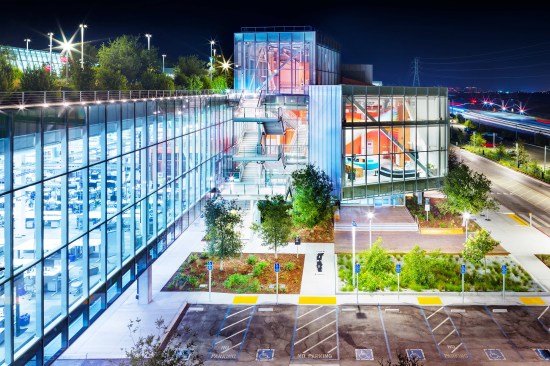
Facebook is located in Melo Park, Calif.
Just three years after moving into its newly constructed Menlo Park, Calif.–MPK 20 campus designed by Frank Gehry, FAIA, Facebook has unveiled MPK 21, a recently completed expansion also conceived by Gehry. Designed to achieve LEED Platinum certification, MPK 21 features a 3.6-acre rooftop garden with 200 trees, 1.4 megawatts of solar panels, a water recycling system that will save around 17 million gallons of water each year, and a zigzag-shaped roof to allow in more natural light, according to the social media company. [ARCHITECT]
Researchers at Swansea University in Wales have developed a system to turn plastic waste into car fuel. To achieve this, the team combined plastics with a light-absorbing material and added the mixture to an alkaline solution. When exposed to sunlight, the treated plastic creates hydrogen gas, which can be used to fuel a hydrogen vehicle. [Swansea University]
Contributor Brian Libby reveals how developer and architect Ben Kaiser of Path Architecture in Portland, Ore., overcame code and financing hurdles to construct the eight-story, cross-laminated timber condominium tower Carbon12. [ARCHITECT]
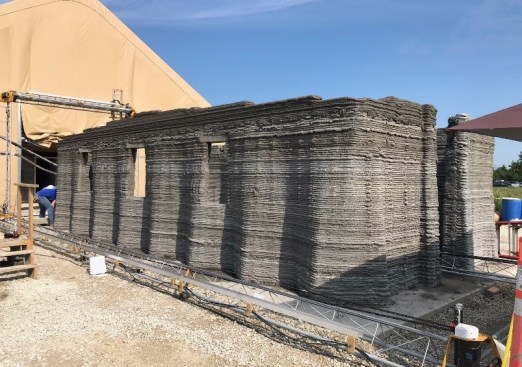
Courtesy the U.S. Marine Corps
Earlier this month, the U.S. Marine Corps successfully oversaw the 3D printing of a concrete 500-square-foot barracks hut in 40 consecutive hours. Normally, it takes 10 Marines approximately five days to construct a barracks hut out of wood. [U.S. Marine Corps]
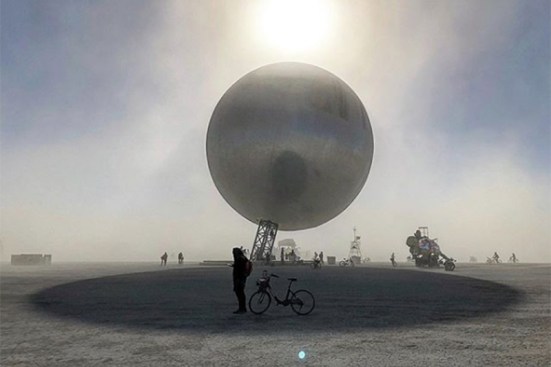
Bjarke Ingels and Jakob Lange erected an inflatable reflective orb measuring 100 feet in diameter in Nevada’s Black Rock Desert for Burning Man, an annual experimental festival for artists, performers, and those seeking “radical self expression.” [ARCHITECT]