

Singapore is getting a digital double. French software developer Dassault Systèmes and the city-state’s National Research Foundation have teamed up to create a virtual 3D model of the 276.5-square-mile Southeast Asian island, à la Google Earth, by 2018. The project, called Virtual Singapore, is a big step for Dassault Systèmes’ 3DExperiencity initiative, which aims to create digital 3D models of cities worldwide. For Singapore, the goal is to gather a range of data—such as topography, building composition, and demographics—that can be shared among public and private institutions to inform security, disaster management, infrastructure maintenance, and more. [Dassault Systèmes via Engineering.com]
Altering the look of a building’s
exterior can be much harder than renovating its interior. That could soon
change. An ultra-thin, flexible skin from the University of
Central Florida changes color by reflecting various wavelengths of light when different voltages of electricity are applied. Potential applications span clothing to building facades. [Phys.org]
This stainless-steel link bracelet contains 29 tools. [Leatherman]
IBM is predicting the weather and its effect on infrastructure. In partnership with the Weather Channel’s parent company, the Weather Co., the tech giant launched a predictive tool that combines weather forecasts and city maps to spot weak links in infrastructure and potential damage. [Time]
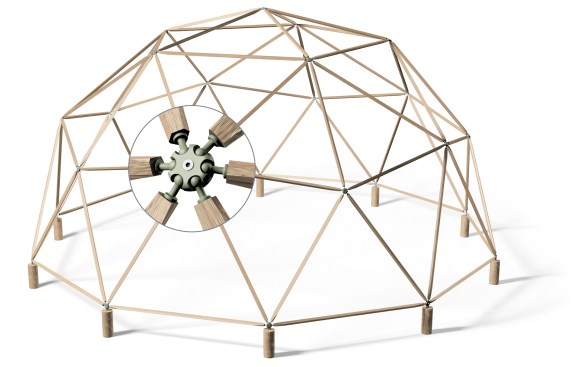
Build with Hubs
Bring a bit of Buckminster Fuller to your backyard with this DIY geodesic dome kit (above). The project launched this week on Kickstarter and is currently seeking beta testers. [Kickstarter]
Eat your heart out, Ikea. A new software platform from researchers in China, Israel, and Singapore designs flat-pack furniture that has no joinery. Instead, the kit of parts interlocks via friction fit to form the final design. No more leftover screws. [Fast Company’s Co.Design]
Laser cutters aren’t typically found in a home workshop. A new model by startup Glowforge, however, aims to make the fabrication tool more accessible to consumers with a streamlined interface and a below-average price point. [Wired]