




Independent Voice
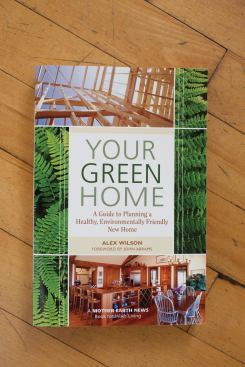
At first Wilson focused on freelance magazine articles and technical writing projects for utilities and manufacturers, and in 1990 he crafted the Consumer Guide to Home Energy Savings. That same year, Architecture magazine published an issue on green design, and “that’s when I started to think there was a niche for green publications,” he says.
With a small staff and a growing number of projects, Wilson outgrew his home office and built a two-car garage with workspace above it. He hired Nadav Malin, who had been working for an affordable housing agency, in 1991, and the two have been partners ever since.
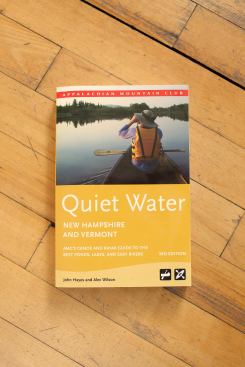
With his intense love of nature always present, Wilson’s first Quiet Water Canoe & Kayak Guide was published by the Appalachian Mountain Club in 1992. “It was my outlet to write about ecology and natural history,” says Wilson, who owns three canoes. He’s written four of the guides—New Hampshire/Vermont, Maine, Southern New England, and New York—that he updates with co-author John Hayes periodically.
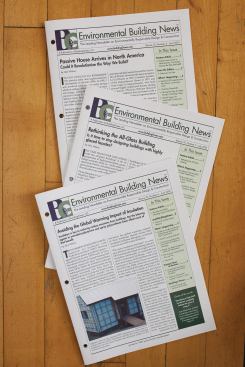
The year the first canoeing guide was printed, Wilson and Malin created Environmental Building News, which they first offered to members of NESEA, where Wilson had been on the board since leaving his full-time post. It was the first time anyone had really looked beyond a narrower energy focus to include the broader environmental impacts of materials and products, and how they might affect health and performance in buildings. It was also the first time anyone had combined the words “environmental” and “building” to describe a new mission and direction for the industry.
Early on, the partners agreed that the newsletter, which covers both commercial and residential construction with rigorous, in-depth reporting and analysis, would maintain an independent voice, relying on subscriptions rather than advertising for funding. “We knew we would be writing about building products, and we wanted the freedom to say what we thought,” Wilson says. It’s a difficult choice that he’s revisited many times. “That decision has been a good one,” he says. “Not that we’ve been very profitable, but it has allowed us to be independent.”
Wilson also believes the subscription-only model, coupled with a flexible monthly editorial plan, allows EBN to react quickly to product introductions, code changes, and other developments. “If we see something in February, we can write about it in March.”
That hallmark is what distinguished the newsletter when it launched nearly two decades ago, and now more than ever that it’s competing in a crowded field of publications and websites focused on sustainable building.
“It became pretty clear in the last decade that everyone was jumping into the green building game, and you had to be suspicious,” says Peter L. Pfeiffer, FAIA, himself a Hanley Award nominee this year. The Austin, Texas–based architect and green building expert calls this propagation “eco-bling.” “But Alex Wilson gets to the bottom of things—he gets to the truth.”
“Alex has had a long history of always providing unbiased, insightful information on very technical subjects,” adds Sam Rashkin, national director of Energy Star for Homes. “The industry needs a very objective oversight function to look at claims and … what’s reasonable. It is very helpful to have [a publication] that is so well researched and written.”