
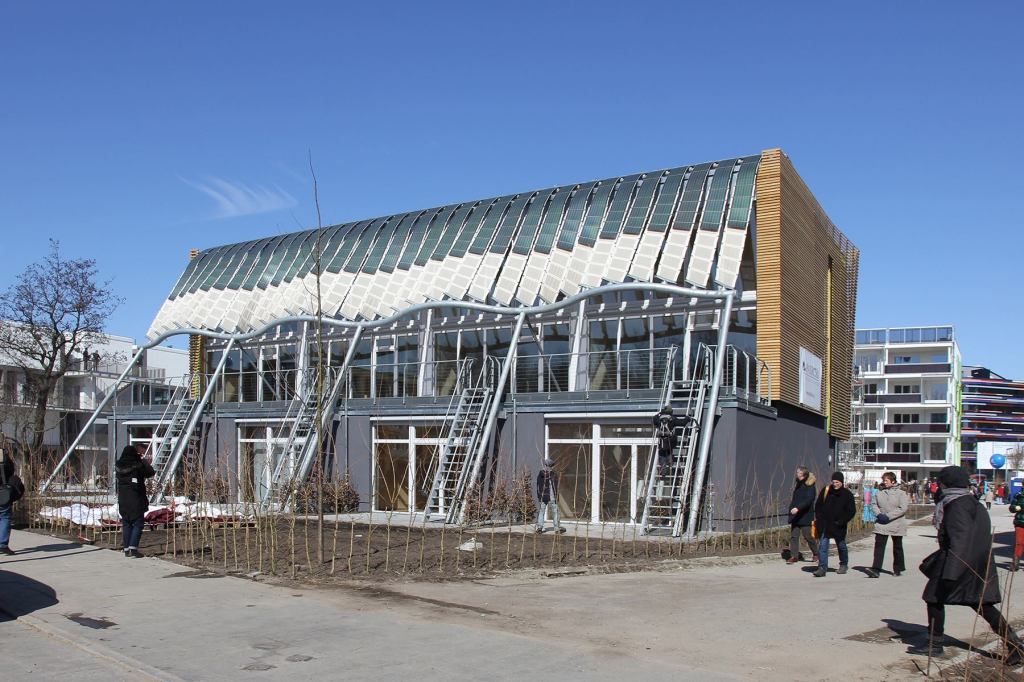
The Soft House, a set of carbon-neutral live/work residences, opened this past weekend in Hamburg, Germany. Designed by an international team led by KVA MATx and 360grad + Architekten as a winning competition entry for Hamburg’s International Building Exhibition (IBA, for International BauAustellung), the row houses feature ‘soft’ domestic infrastructure that responds to the exhibition’s theme of cities in climate change. Features such as flexible living concepts and wireless building controls merge with adjustable, photovoltaic-covered, textile louvers to re-examine the German Passive Haus typology with new materials. Built with carbon-sequestering wood panel and deck construction, and connected with wood dowel joints, the whole structure is fully demountable and recyclable at the end of the building’s lifecycle.
Inside each 160-square-meter (1,722-square-foot) unit, movable floor-to-ceiling curtains—embedded with LEDs—on adjustable tracks provide low-voltage illumination while also allowing interior spatial reconfigurations. The open-plan layouts can be separated into more private zones when necessary, using the light curtains as dividers. A three-story natural ventilation chamber between the façade and the dwellings further insulates them from extremes in temperature, and radiant floors provide additional heating and cooling. Each row house also has the option of having a separate 53-square-meter (570-square-foot) ground-level studio or garden apartment.
A programmable PTFE textile canopy serves as the Soft House’s south façade, with year-round solar tracking capabilities enabling its integrated, flexible photovoltaic panels to harvest energy while bending to either shade the structure or produce aperture to admit daylight, depending on the season. The thin-film photovoltaics, developed by Solan AG, are mounted to pliable fiber-reinforced composite boards, which can be adjusted to track optimal solar harvesting angles throughout the day with winch-operated actuators. KVA won an R+D Award in 2007 for an earlier prototype of its design for Soft House.
For more details and images of Soft House, visit ARCHITECT‘s Project Gallery.
See an animation of the flexible membrane twisters in action below:
