Not all building material innovation comes from the development of new materials. In reality, many advances come from the rediscovery of preindustrial vernacular traditions, some of which may be long-forgotten.
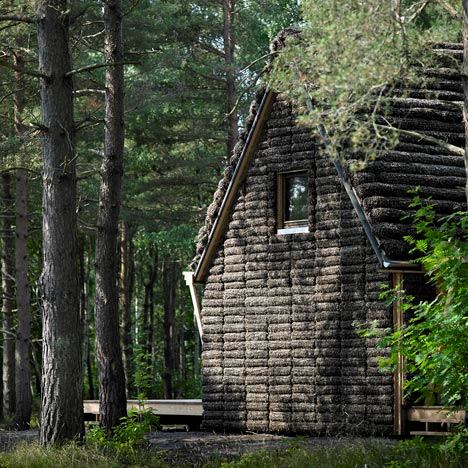
A new house designed by the architecture firm Vandkunsten on the Danish island Læsø is clad almost entirely in bundled seaweed. The Modern Seaweed House was sponsored by Realdania Byg in an effort to call attention to an important historic yet disappearing material tradition. As seen in the Kaline House, which was built in 1865 and restored by Realdania Byg in 2012, a local custom was to create thatchlike layers of seaweed on the roofs of island residences. Unfortunately, only twenty of these houses remain on Læsø.
Seaweed cladding exhibits many positive characteristics, including durability, thermal, and acoustic insulation, and resilience to moisture and vermin. According to Realdania Byg, it is possible for seaweed houses to possess a negative carbon footprint when combined with a wood structure, since the stored CO2 exceeds the amount emitted during fabrication and construction.
Vandkunsten’s new house design incorporates local seaweed in a new way, applying narrow pillows of eelgrass wrapped in knitted nets to the exterior walls as well as to the roof. The development of a regular module for both vertical and horizontal applications results in an approach that is both organic and industrialized, and suggests the potential for mass-production in regions where seaweed is a plentiful resource.
Blaine Brownell, AIA, is a regularly featured columnist whose stories appear on this website each week. His views and conclusions are not necessarily those of ARCHITECT magazine nor of the American Institute of Architects.