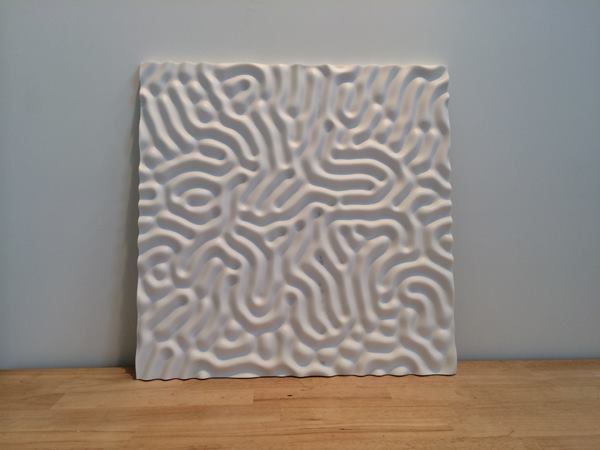
What happens when you give designers and engineers a set of the latest digital fabrication tools and cut them loose? Autodesk has been testing the idea in its artist-residency program, Pier 9, in San Francisco. Inspired by the collaborative energy that’s a natural outcome of this veritable makers’ playroom, one of its 2014 residents, new media artist and researcher Reza Ali, used computational design and CNC milling to create a (mostly decorative) mind map exploring the potential of new digital fabrication technology in realizing organic forms.
“I wanted to show the world that forms can be grown and evolved,” Ali said in an email. “Computers can help us in so many ways, [and] CAD software is just one of the ways we can generate form. Growing form has so much potential.”
Ali, whose previous work focused on writing code for digital products, wanted to translate those concepts into something tangible. He considered 3D printing and laser etching, but settled on CNC-milling solid-surface material in part because the method allowed him to capture more detail and at a larger scale, and because his fellow residents had yet to fabricate the material in that way. Additionally, CNC milling generally allows for a higher relief than does laser etching.
To create a design based on a reaction-diffusion model, Ali mapped the creases derived from a visual of the human brain and applied a mathematical model to predict their paths—resulting in a 3D pattern that, in effect, continues the neurological maze. He used Autodesk Maya and Rhino to develop the design, and Inventor HSM 2015 to create the toolpaths. Below, he shows his process:
Ali is one of an ever-growing number of designers and engineers turning to computational design to realize new forms. Other recent projects out of Pier 9 include a series of spinning, 3D printed sculptures based on the mathematical Fibonacci sequence. Elsewhere, Jessica Rosenkrantz and Jesse Louis-Rosenberg, co-leaders of Sommerville, Mass.–based Nervous System, recently used their Kinematics 4D-printing platform to create a dress whose form is based on parametric body models that determine rigidity and density as well as flexibility and openness throughout the printed fabric. This past fall, Tex-Fab announced the winner of its fourth-annual competition, which called for projects that make use of parametric design and digital fabrication to explore the concept of plasticity. Winner Justin Diles’ Plastic Stereotomy uses hollow, fiber-reinforced plastic and thick expanded polystyrene foam in a structural wall system. And perhaps among the best-known is Skylar Tibbits, who ARCHITECT profiled in December 2013 and whose work at MIT and his firm, SJET, focuses on programming printed objects to transform, on their own, over time.